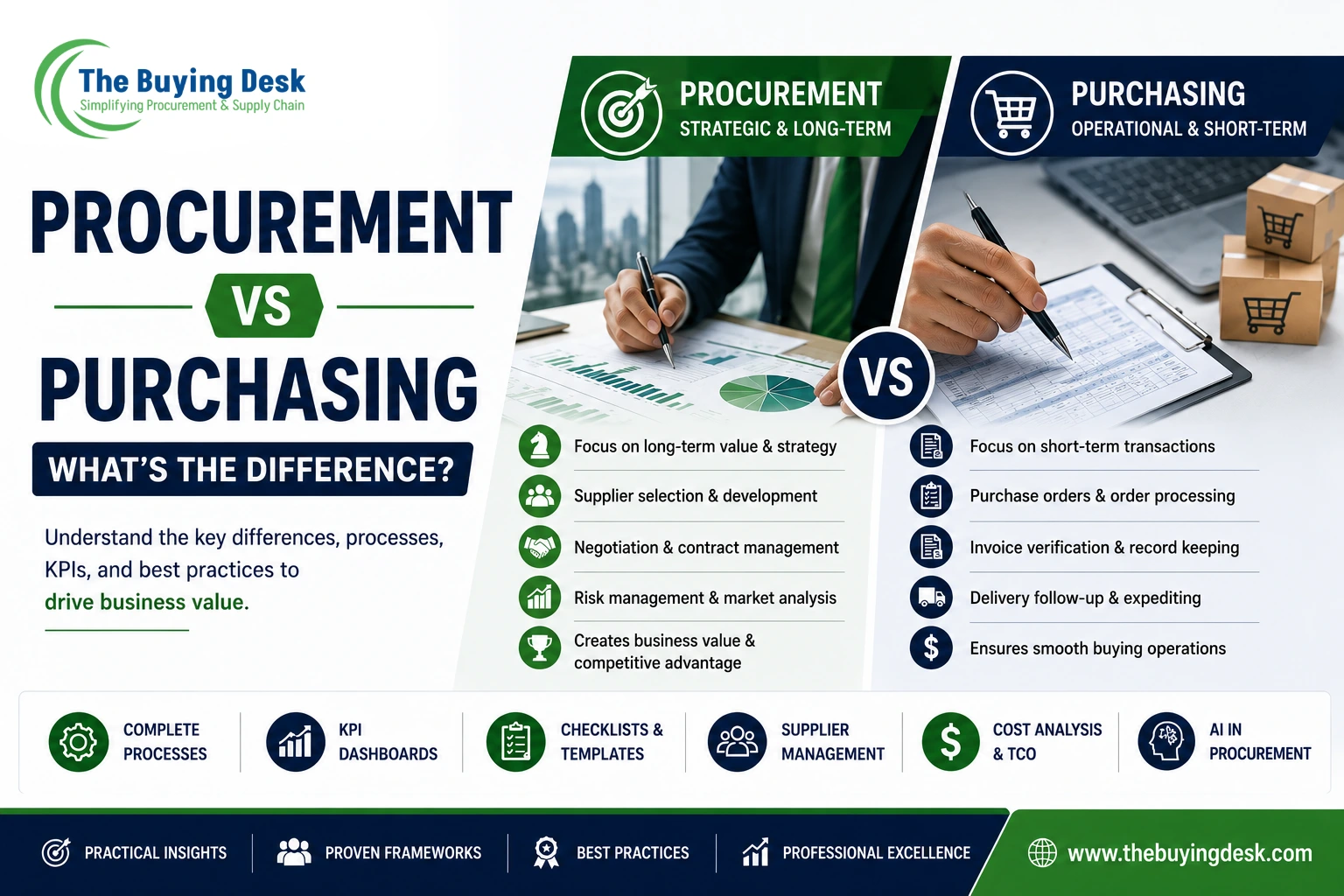
If you’ve ever heard someone say, “Procurement and purchasing are the same thing,” you’re not alone. In many organizations, these two terms are used interchangeably. However, in reality, they represent two different functions with distinct objectives, responsibilities, and business impact.
Imagine a manufacturing company that needs to purchase raw materials for production. Simply placing a purchase order is only one part of the journey. Before that order is issued, someone has already identified the business need, evaluated suppliers, compared quotations, negotiated prices, assessed quality standards, agreed on delivery schedules, and finalized commercial terms. These strategic activities are part of procurement.
Purchasing begins only after many of these decisions have already been made. It focuses on executing the buying process efficiently—raising purchase orders, coordinating deliveries, matching invoices, and ensuring suppliers are paid correctly.
Understanding this distinction is important because organizations that treat procurement as a strategic business function often achieve:
Whether you are a procurement professional, purchasing executive, engineering student, business owner, or preparing for an interview, understanding the difference between procurement and purchasing will help you make better business decisions and communicate more effectively in professional environments.
In this guide, we’ll explore the complete procurement lifecycle, compare procurement and purchasing side by side, examine real manufacturing examples, and discuss how modern technologies such as artificial intelligence are reshaping procurement.
Procurement is the strategic process of identifying business needs, sourcing suppliers, negotiating contracts, purchasing goods or services, managing supplier relationships, and continuously improving supplier performance to create long-term value for the organization.
Unlike purchasing, procurement begins long before a purchase order is created and continues even after goods have been delivered and paid for.
Procurement is not simply about buying products at the lowest price. Instead, it focuses on obtaining the best overall value, considering factors such as quality, delivery reliability, supplier capabilities, innovation, sustainability, and total cost of ownership.
A well-managed procurement function aims to:
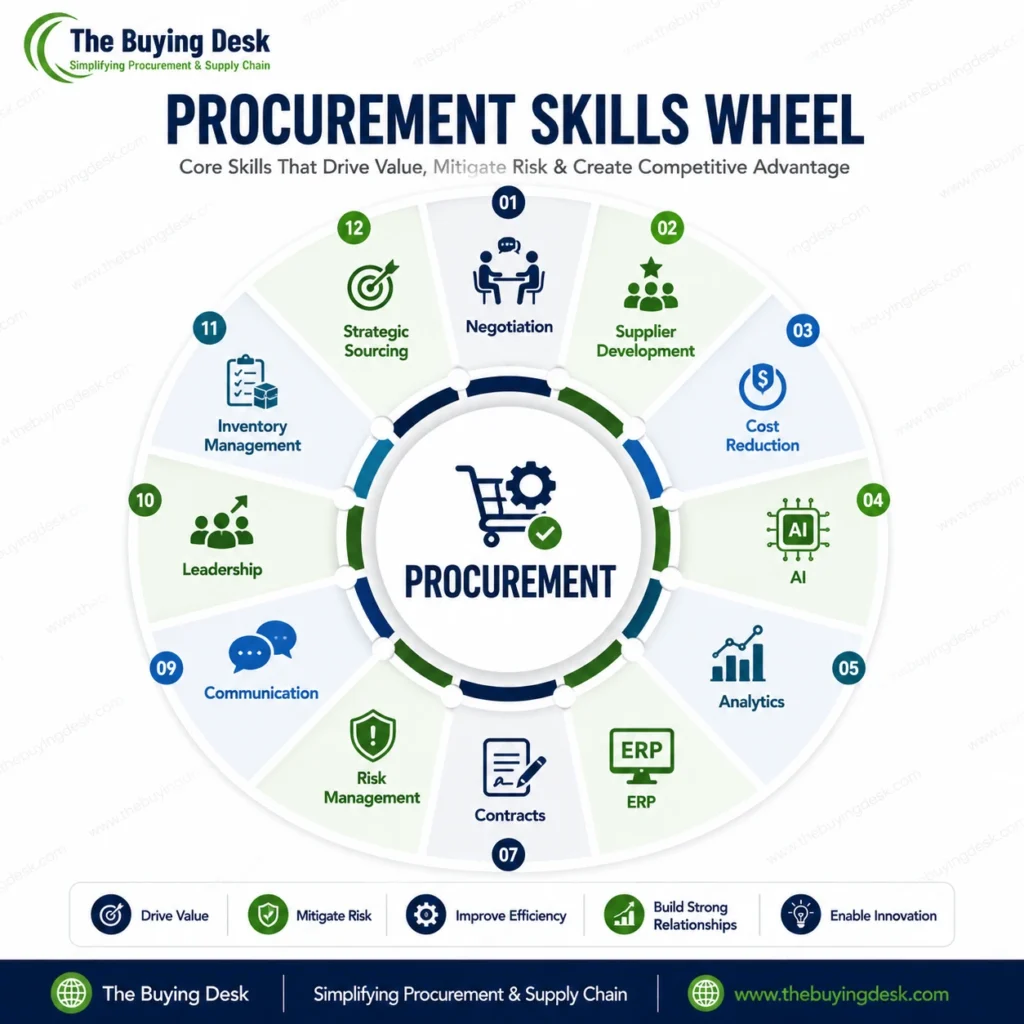
A procurement professional typically performs activities such as:
These activities require analytical thinking, negotiation skills, business understanding, and long-term planning.
Purchasing is the operational process of ordering goods and services from approved suppliers after procurement decisions have been completed.
It is a subset of procurement and focuses primarily on transaction execution rather than strategic planning.
The purchasing department ensures that approved materials are ordered accurately, delivered on time, received correctly, and paid according to agreed commercial terms.
The purchasing function aims to:
Purchasing professionals are responsible for:
Although purchasing is transactional, it remains essential because accurate execution directly affects production schedules, inventory availability, and customer satisfaction.
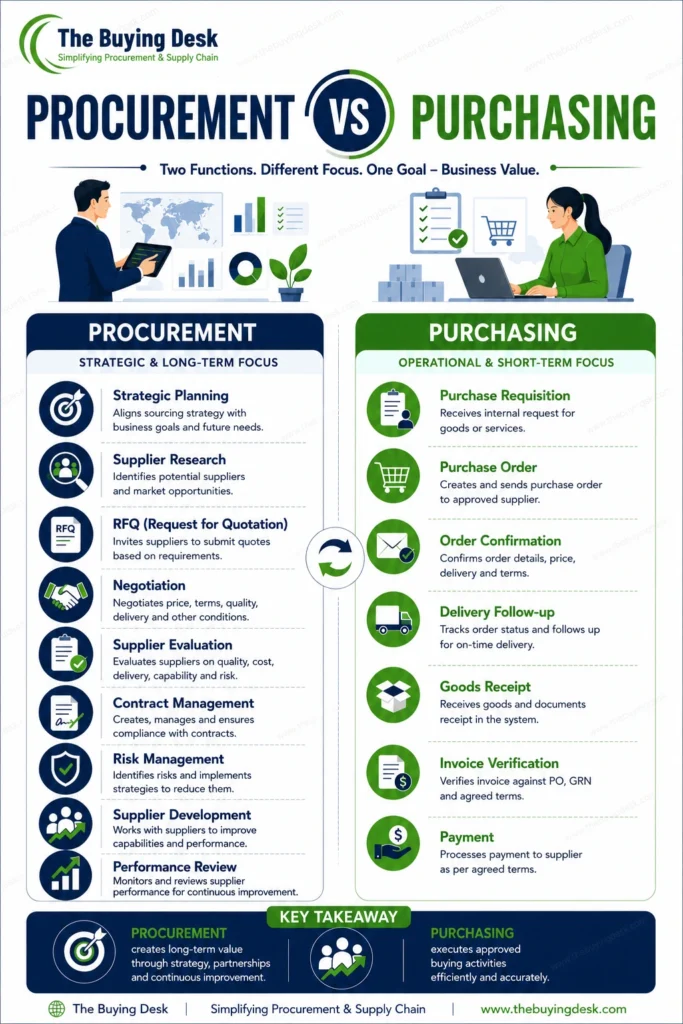
| Procurement | Purchasing |
|---|---|
| Strategic function | Operational function |
| Focuses on long-term value | Focuses on order execution |
| Includes supplier selection | Uses approved suppliers |
| Involves negotiation | Places purchase orders |
| Manages contracts | Processes transactions |
| Evaluates supplier performance | Tracks deliveries |
| Supports business strategy | Supports daily operations |
| Focuses on total cost of ownership | Focuses on purchase price |
| Continuous improvement | Order fulfillment |
| Relationship-driven | Transaction-driven |
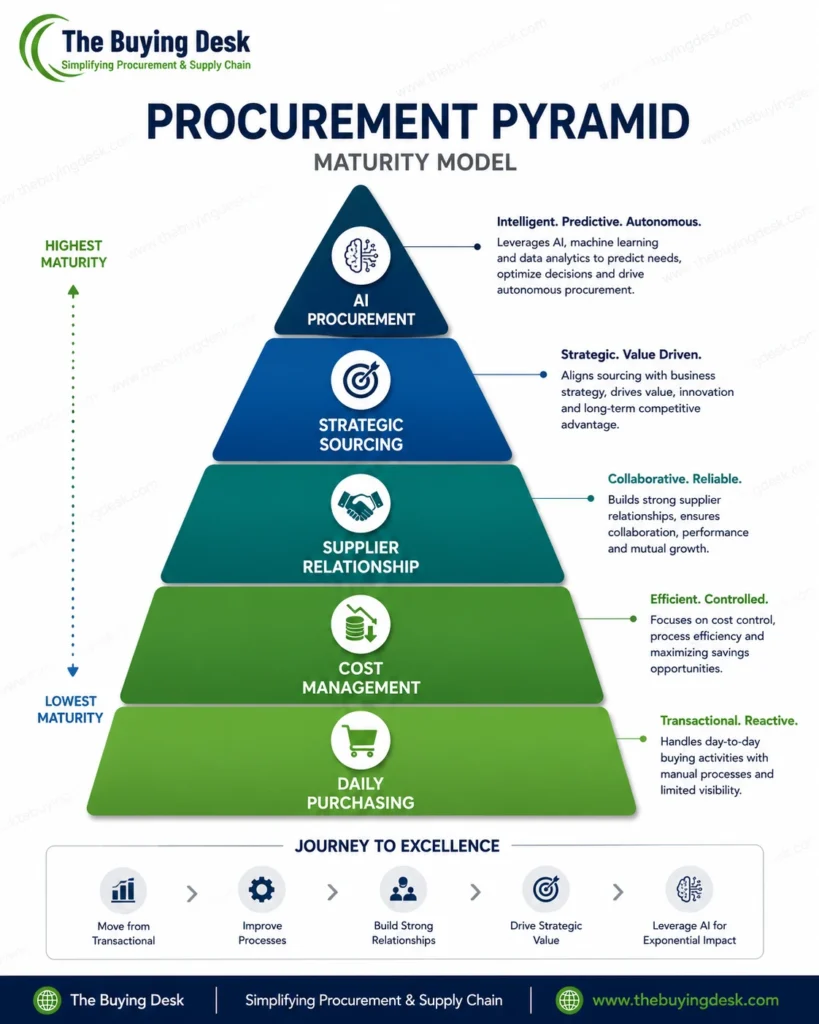
Organizations that invest in strategic procurement often achieve significant improvements in cost efficiency, supplier collaboration, innovation, and resilience. Purchasing remains a critical operational function, but it delivers the greatest value when supported by a strong procurement strategy.
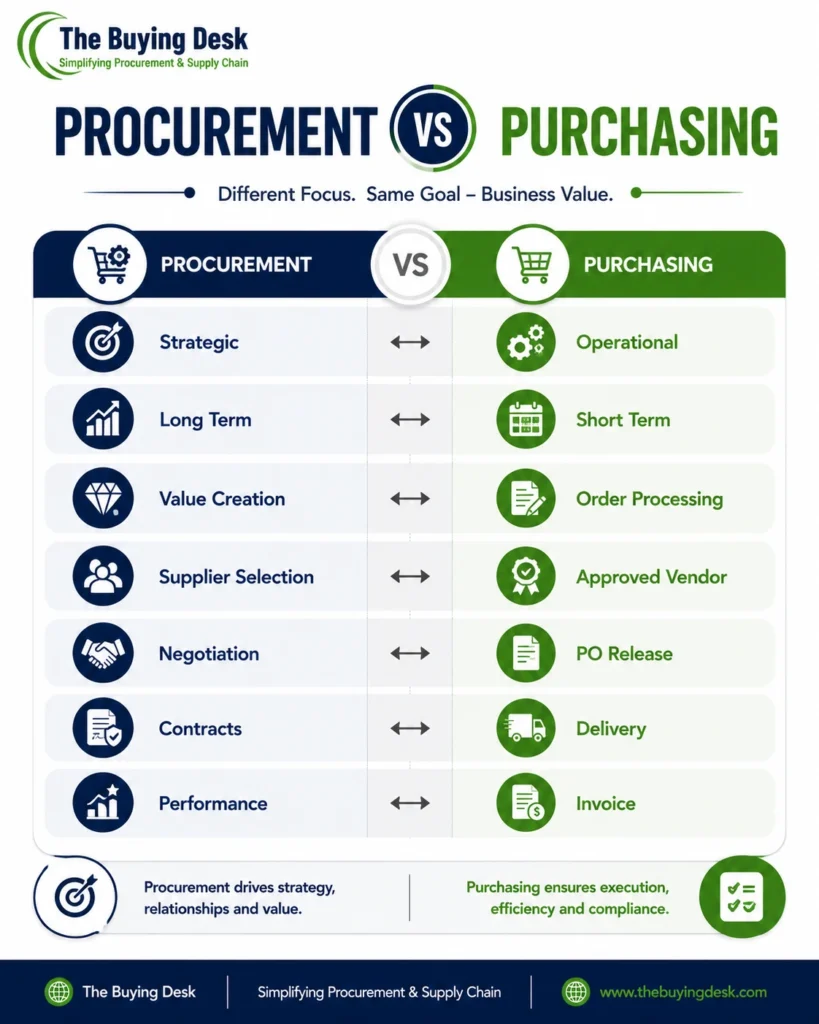
Although procurement and purchasing are closely related, they serve different business purposes. Procurement focuses on creating long-term value for the organization, while purchasing focuses on efficiently executing approved buying decisions.
Understanding these differences helps organizations assign responsibilities correctly, improve supplier relationships, and achieve sustainable cost savings.
| Aspect | Procurement | Purchasing |
|---|---|---|
| Purpose | Strategic value creation | Buying goods and services |
| Focus | Long-term | Short-term |
| Objective | Best overall value | Order execution |
| Supplier | Selection and development | Order placement |
| Negotiation | Extensive | Limited |
| Contracts | Creates and manages | Uses existing contracts |
| Cost | Total Cost of Ownership (TCO) | Purchase Price |
| Risk | Risk management | Delivery management |
| Performance | Supplier evaluation | Order tracking |
| Business Impact | Competitive advantage | Operational continuity |
The most significant difference lies in their strategic importance.
Procurement supports business growth by making informed decisions about suppliers, contracts, sourcing strategies, and long-term partnerships. Purchasing, on the other hand, ensures that approved materials are bought efficiently and delivered on time.
A car manufacturer planning to launch a new vehicle may spend months identifying reliable suppliers for electronic components, negotiating pricing, and assessing manufacturing capabilities. These activities belong to procurement.
Once suppliers are approved, the purchasing team issues purchase orders according to production schedules.
Procurement looks beyond immediate requirements. It considers future demand, supplier development, market trends, and business continuity.
Purchasing generally focuses on fulfilling current operational needs.
Signing a three-year supply agreement for steel with annual price reviews.
Issuing a purchase order for this month’s steel requirement.
Procurement identifies potential suppliers, evaluates capabilities, conducts audits, and selects the most suitable partner.
Purchasing works with suppliers that have already been approved.
Negotiation is a major procurement responsibility.
Procurement professionals negotiate:
Purchasing usually follows the negotiated terms already agreed upon.
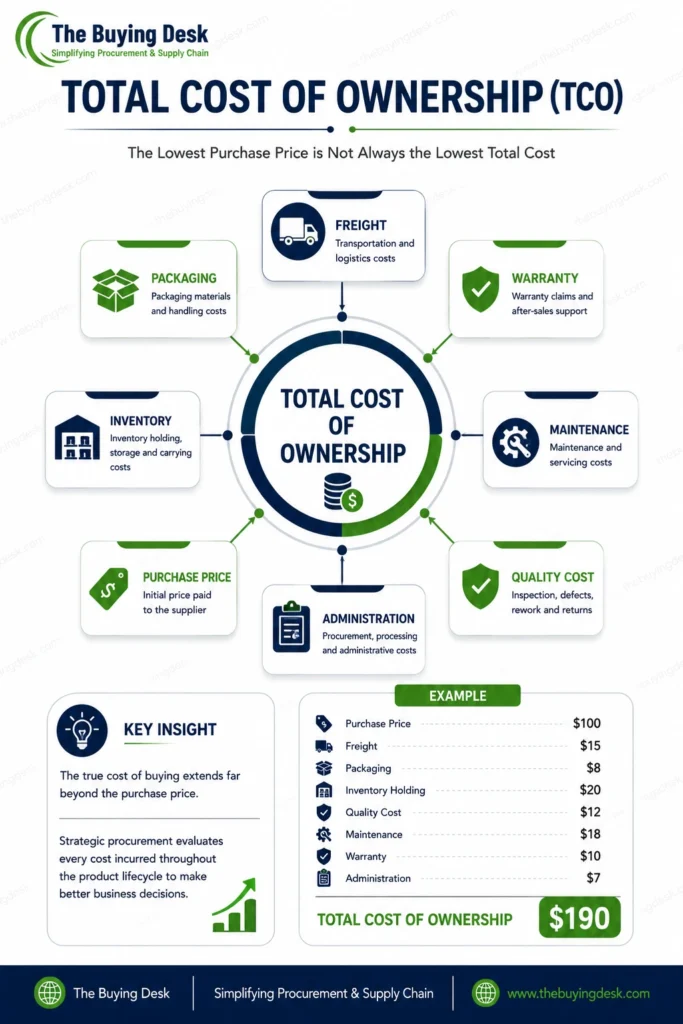
One of the biggest misconceptions is believing the lowest purchase price always results in the lowest overall cost.
Professional procurement teams evaluate the Total Cost of Ownership (TCO), which includes:
Supplier A offers a lower unit price but has frequent quality issues and delivery delays.
Supplier B charges slightly more but delivers consistently with excellent quality.
Over time, Supplier B may provide a lower total cost despite the higher purchase price.
Procurement plays a crucial role in identifying and reducing supply chain risks.
Examples include:
Purchasing focuses more on ensuring current orders are delivered as planned.
Procurement creates and manages supplier agreements.
Typical contract elements include:
Purchasing executes transactions within those agreed terms.
Procurement continuously monitors supplier performance using measurable KPIs.
Common metrics include:
Purchasing mainly monitors order-specific performance.
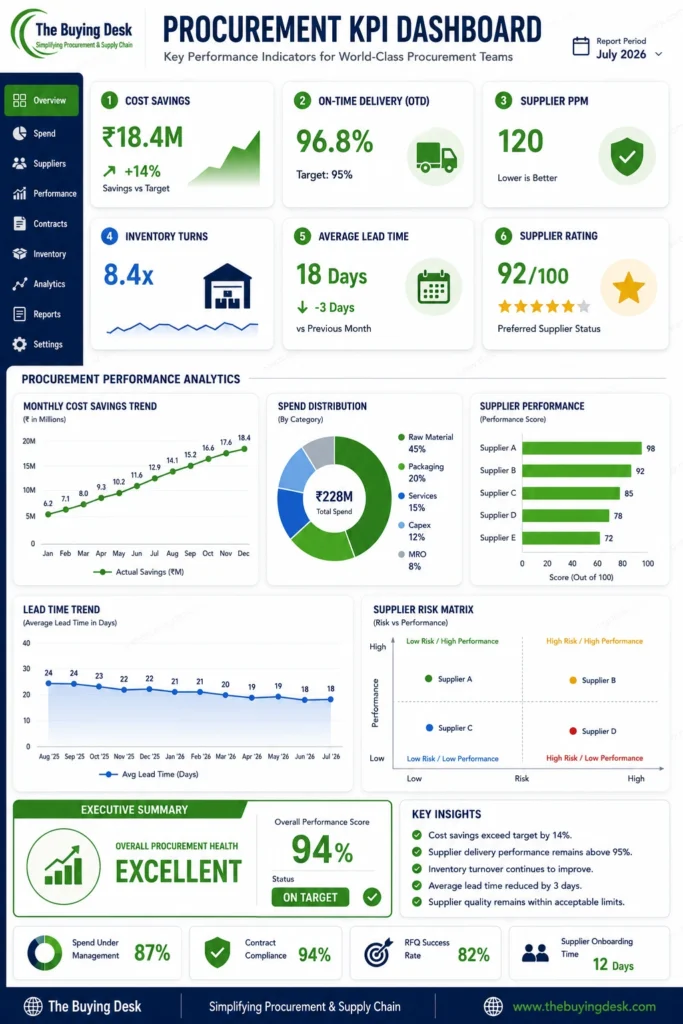
Procurement directly influences:
Purchasing primarily supports day-to-day operational execution.
Procurement develops strategic supplier partnerships.
Instead of negotiating only for lower prices, procurement professionals collaborate with suppliers on:
Purchasing maintains operational communication regarding orders and deliveries.
A structured procurement process ensures transparency, cost control, and supplier reliability.
A department raises a requirement for goods or services.
Example:
Production requires 10,000 plastic components for the next month’s manufacturing plan.
The procurement team reviews:
Potential suppliers are identified through:
Procurement sends RFQs to shortlisted suppliers requesting:
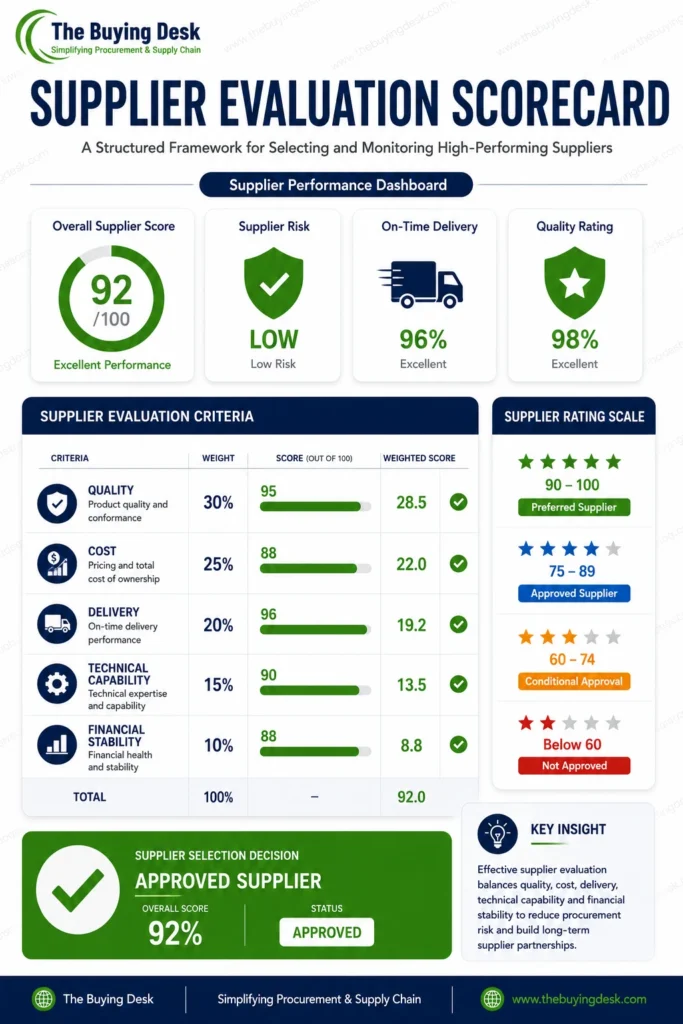
Evaluation criteria include:
| Criteria | Weight |
|---|---|
| Quality | 30% |
| Cost | 25% |
| Delivery | 20% |
| Technical Capability | 15% |
| Financial Stability | 10% |
Key negotiation points:
The supplier offering the best overall value—not necessarily the lowest price—is selected.
The procurement team finalizes:
The purchasing department issues the Purchase Order based on approved terms.
The purchasing team tracks:
Regular reviews measure:
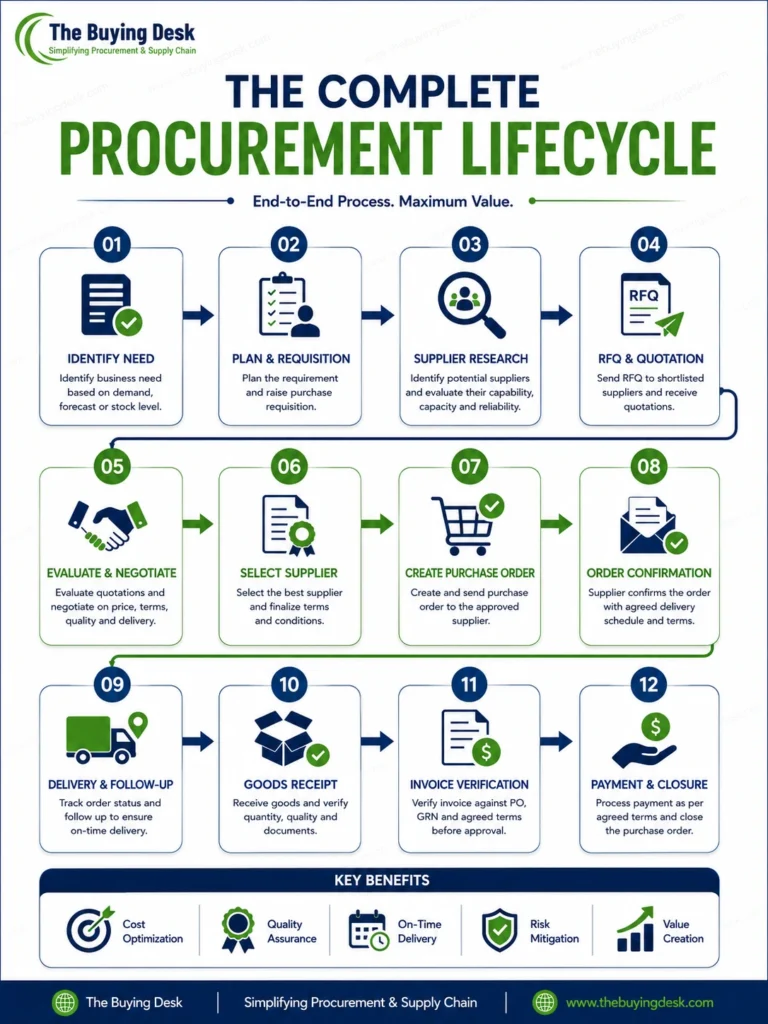
The purchasing cycle is shorter and focuses on transaction execution.
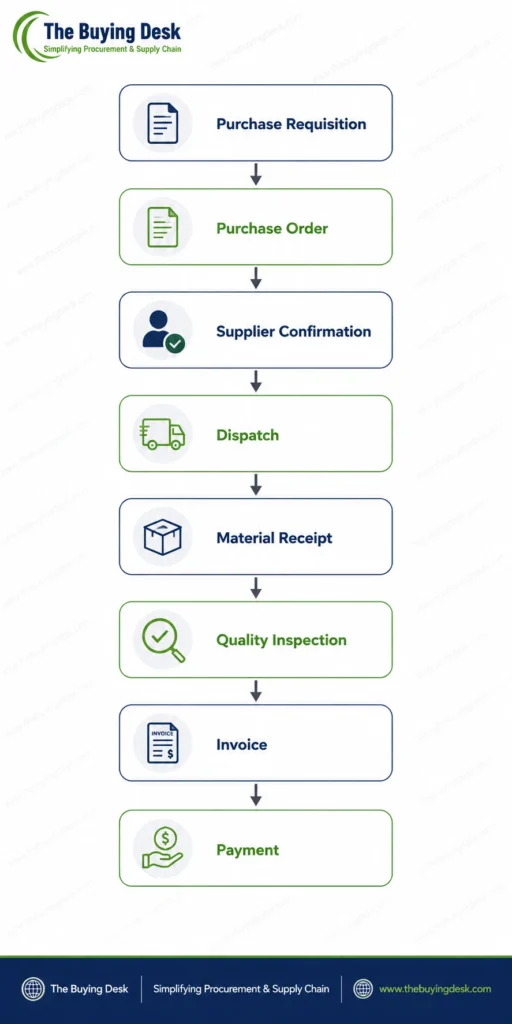
Imagine an automotive component manufacturer needs aluminum die-casting parts.
Together, these functions ensure uninterrupted production while balancing cost, quality, and supplier performance.
Organizations that invest in procurement as a strategic function often achieve significant advantages beyond simply buying goods and services. Procurement contributes directly to business growth, operational efficiency, and competitive advantage.
Strategic procurement focuses on reducing the Total Cost of Ownership (TCO) rather than only the purchase price.
For example, negotiating better payment terms, reducing logistics costs, improving supplier quality, and minimizing inventory can deliver greater savings than negotiating a lower unit price alone.
Long-term supplier partnerships lead to:
Organizations that treat suppliers as strategic partners often achieve more sustainable business results.
Procurement professionals continuously monitor supplier risks, including:
Developing alternate suppliers and contingency plans helps ensure business continuity.
Selecting suppliers based on capability, certifications, and quality performance reduces defects and customer complaints.
Supplier development programs and regular performance reviews contribute to continuous improvement.
Effective procurement supports:
Organizations with mature procurement functions can respond more quickly to market changes, introduce new products efficiently, and maintain stronger supplier networks.
Even experienced organizations can make procurement-related mistakes. Recognizing these pitfalls helps improve long-term performance.
The lowest quotation does not always represent the best value.
Poor quality, delayed deliveries, and hidden costs can outweigh initial savings.
Supplier evaluation should continue after business is awarded.
Regular reviews based on delivery, quality, responsiveness, and cost competitiveness help maintain high standards.
Relying heavily on one supplier increases business risk.
Whenever possible, organizations should develop alternate suppliers for critical materials.
Incomplete purchase specifications, unclear contracts, or missing quality agreements often lead to disputes and delays.
Standardized procurement documentation reduces misunderstandings.
Procurement decisions should involve stakeholders from engineering, quality, production, finance, and logistics when appropriate.
Cross-functional collaboration results in better supplier selection and smoother implementation.
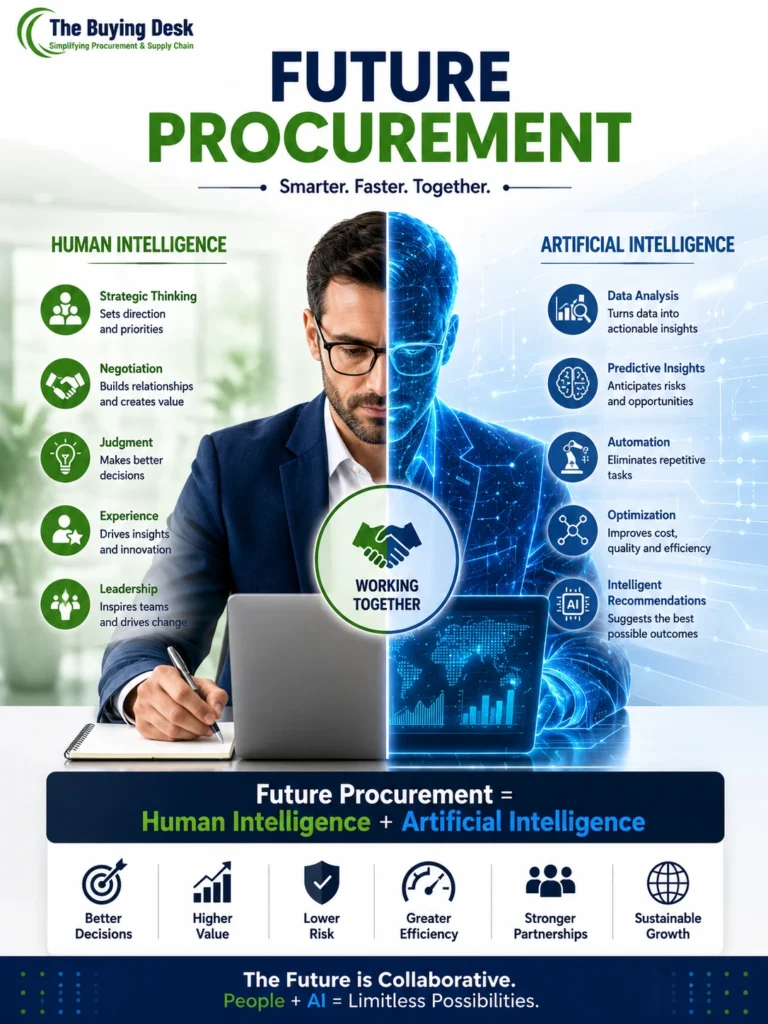
Artificial Intelligence (AI) is transforming procurement by improving decision-making and automating repetitive tasks.
Examples include:
AI enhances procurement efficiency, but human expertise remains essential for negotiation, relationship management, and strategic decision-making.
Procurement continues to evolve rapidly. Key trends include:
Professionals who combine technology with strong business judgment will remain highly valuable.
Build Smarter Procurement Decisions
Explore expert insights, practical tools and real-world case studies on The Buying Desk to elevate your procurement and supply chain expertise.
Although the terms procurement and purchasing are often used interchangeably, they serve different purposes within an organization.
Procurement is about making informed strategic decisions that support long-term business success. It involves understanding market conditions, evaluating suppliers, negotiating agreements, managing risks, and building sustainable partnerships.
Purchasing, by contrast, focuses on executing approved transactions accurately and efficiently to ensure uninterrupted operations.
Both functions are essential. When procurement and purchasing work together effectively, organizations benefit from improved quality, reduced costs, stronger supplier relationships, and greater operational efficiency.
Whether you are beginning your procurement career or leading a purchasing team, understanding these distinctions will help you make better decisions and contribute more effectively to your organization.
Is procurement the same as purchasing?
No. Procurement is a broader strategic function that includes supplier selection, negotiation, contracting, and supplier management. Purchasing focuses on executing approved buying activities.
Which comes first: procurement or purchasing?
Procurement comes first. Purchasing is one stage within the overall procurement process.
Can a small business benefit from procurement?
Yes. Even small businesses can reduce costs and improve supplier relationships by applying procurement principles.
Why is supplier evaluation important?
It helps organizations select reliable suppliers capable of meeting quality, cost, and delivery expectations.
Does procurement always involve negotiation?
In most strategic sourcing activities, yes. Negotiation is a key procurement responsibility.
What is Total Cost of Ownership (TCO)?
TCO considers all costs associated with acquiring and using a product or service, not just the purchase price.
Is purchasing a part of procurement?
Yes. Purchasing is one component of the broader procurement process.
What skills are essential for procurement professionals?
Negotiation, analytical thinking, supplier management, communication, cost analysis, and strategic planning.
Can AI replace procurement professionals?
AI can automate repetitive tasks, but human judgment, negotiation, and relationship management remain critical.
Why should organizations invest in strategic procurement?
Strategic procurement improves profitability, supplier performance, risk management, and long-term competitiveness.