A business does not purchase something only once.
It continuously identifies requirements, plans purchases, searches for suppliers, negotiates commercial terms, places orders, receives materials, processes payments, evaluates suppliers, and improves future purchasing decisions.
This continuous movement is known as the procurement cycle.
For a manufacturing company, the cycle might begin when production planning identifies a future requirement for raw materials. Procurement then works with suppliers, negotiates prices, places purchase orders, monitors deliveries, coordinates with stores and quality, and evaluates supplier performance.
But the cycle does not end when the material arrives.
The information generated from that purchase—price, quality, delivery performance, supplier responsiveness, consumption and total cost—can influence the next procurement decision.
That is what makes procurement a cycle rather than a one-time transaction.
Understanding the procurement cycle is essential for anyone working in purchasing, procurement, supply chain, inventory, manufacturing or business management.
In this guide, we’ll explain the procurement cycle step by step, compare it with the procurement process, examine a practical manufacturing example, discuss common problems, and explore how technology and data can improve the cycle.
The procurement cycle is the continuous sequence of activities an organization follows to identify its requirements, plan purchases, source suppliers, purchase goods or services, receive and pay for them, evaluate supplier performance, and use the results to improve future procurement decisions.
In simple terms:
The procurement cycle describes how an organization moves from identifying a need to completing the purchase and then uses the results to improve the next purchasing decision.
Unlike a simple transaction, the procurement cycle is continuous.
A supplier’s delivery performance today can influence tomorrow’s sourcing decision.
A price increase can trigger a new negotiation.
A quality problem can lead to supplier development or qualification of an alternative supplier.
A change in demand can alter the next procurement plan.
This continuous feedback makes the procurement cycle an important part of strategic supply chain management.
Think of the procurement cycle as:
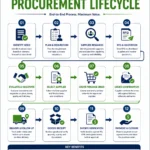
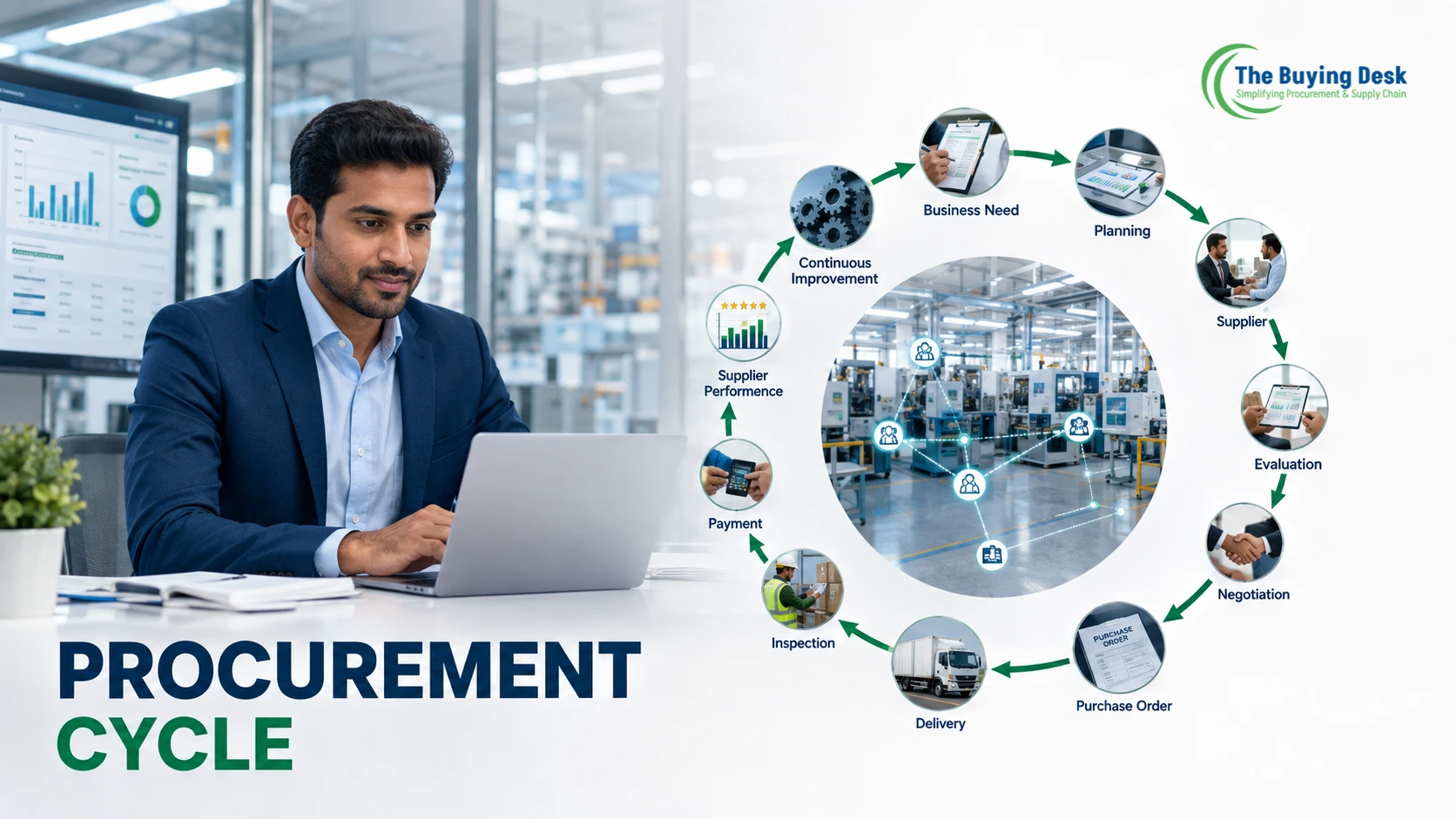
Plan → Source → Select → Buy → Receive → Pay → Evaluate → Improve → Plan Again
The cycle then starts again.
This can be represented as:
Identify Need
      ↓
Plan Requirement
      ↓
Source Suppliers
      ↓
Evaluate & Select
      ↓
Negotiate
      ↓
Purchase
      ↓
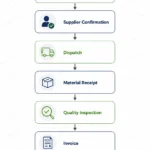
Receive & Inspect
      ↓
Invoice & Payment
      ↓
Evaluate Supplier
      ↓
Improve
      ↓
Plan Next Requirement
      ↺
A properly managed procurement cycle helps organizations control the entire journey of a purchase rather than focusing only on the moment an order is placed.
It can help businesses improve:
The strongest procurement teams don’t simply ask:
“What price did we get?”
They ask:
“What did this procurement cycle achieve for the business?”
That broader perspective changes procurement from a transactional function into a strategic business capability.
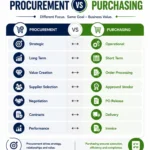
These terms are closely related, but they are not exactly the same.
The procurement process describes the steps involved in executing a procurement activity.
For example:
Need → Specification → RFQ → Evaluation → Negotiation → PO → Delivery → Inspection
The procurement cycle describes the continuous end-to-end journey, including planning, purchasing, payment, supplier performance, feedback and improvement.
| Procurement Process | Procurement Cycle |
|---|---|
| Focuses on execution | Focuses on the complete continuous journey |
| Usually describes individual procurement activities | Connects one procurement activity to future decisions |
| More operational | Operational + strategic |
| Ends after the defined process is completed | Feeds lessons and data into the next cycle |
| Often starts with a requirement | Can begin with planning and forecasting |
A simple way to remember it:
The procurement process explains how a purchase is executed. The procurement cycle explains how procurement continuously operates and improves.
Organizations may structure their procurement cycles differently, but most mature procurement functions include the following stages:
Let’s examine each stage.
Every procurement cycle starts with a business requirement.
The requirement may come from:
In manufacturing, the requirement may be generated through production planning, inventory levels, customer orders or material requirement planning.
A manufacturing company plans to produce 20,000 units next month.
The planning team calculates that it needs:
Procurement must understand the requirement before approaching suppliers.
Buying immediately without checking inventory, open purchase orders or future demand can create excess stock and unnecessary working-capital requirements.
Once the requirement is identified, procurement planning determines how and when the organization should purchase.
Planning may consider:
Suppose a supplier has a lead time of 45 days and the production team needs the material after 30 days.
The procurement team cannot wait until the material is required.
The purchase decision must account for the supplier lead time.
This is why procurement planning and supply planning need to work closely together.
The next stage is to clearly define what needs to be purchased.
Specifications may include:
Poor specifications create problems later.
If the buyer sends an unclear requirement, suppliers may quote different products, making commercial comparison difficult.
Instead of:
“Need bearing.”
A better requirement might specify:
The clearer the requirement, the better the procurement decision.
Once the requirement is clear, procurement identifies suitable suppliers.
Sources may include:
For strategic or high-value purchases, procurement may conduct broader market research rather than simply asking existing suppliers for quotations.
The objective is not simply to find a supplier.
The objective is to find the right supplier for the requirement.
After potential suppliers are identified, procurement evaluates them.
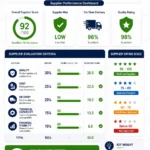
A supplier evaluation may consider:
| Evaluation Area | Typical Consideration |
|---|---|
| Cost | Price and total cost |
| Quality | Defect rate and quality systems |
| Delivery | Lead time and OTD |
| Capacity | Ability to meet demand |
| Technology | Manufacturing capability |
| Financial Stability | Business continuity |
| Service | Responsiveness |
| Risk | Supply and operational risks |
| Sustainability | Environmental/social requirements |
A weighted scorecard can make the decision more objective.
Supplier A:
Supplier B:
Selecting Supplier A solely because it has the lowest quoted price may create additional costs later through delays, defects or emergency transportation.
This is why procurement should evaluate total value, not only purchase price.
Once the preferred supplier is identified, procurement negotiates commercial and contractual terms.
Negotiation may include:
Strategic negotiations should focus on the overall relationship rather than simply forcing a supplier to reduce price.
A procurement team negotiates:
The result may create significantly more value than simply negotiating a lower unit price.
Once commercial and internal approvals are complete, the organization issues a Purchase Order (PO).
The PO formally communicates the purchasing commitment to the supplier.
A PO commonly contains:
The PO should be reviewed carefully before release.
A wrong quantity, price or delivery date can create problems throughout the rest of the cycle.
The procurement cycle continues after the PO is released.
The procurement team may monitor:
Once the material arrives, stores and quality teams verify the shipment.
Checks may include:
If the material meets requirements, it can be accepted into inventory or released for use according to the organization’s procedures.
If it does not meet requirements, the organization may initiate:
After receipt and acceptance, the invoice moves through the organization’s financial process.
Many organizations use a three-way match involving:
Purchase Order
Goods Receipt
Supplier Invoice
The objective is to confirm that:
This helps reduce payment errors, duplicate payments and unauthorized purchases.
Payment terms negotiated during the sourcing stage now become relevant to cash-flow management.
This is the stage that turns a transaction into a cycle.
After the purchase is completed, procurement evaluates the supplier.
Typical measurements include:
Suppose a supplier delivered:
Another supplier delivered:
This information should influence future sourcing decisions.
The cycle then feeds the learning back into the next procurement plan.
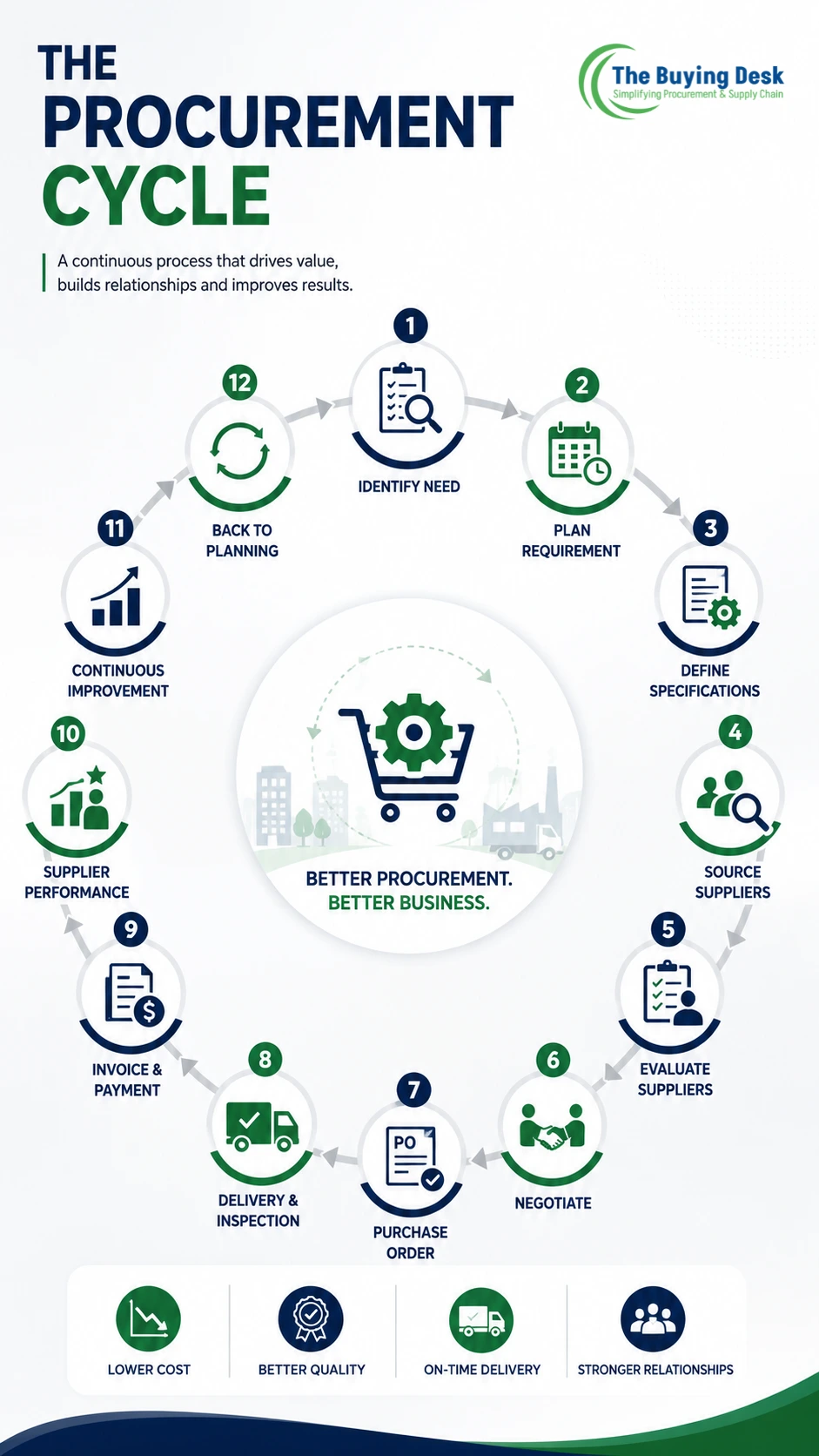
The most important concept to understand is that the cycle does not simply stop after payment.
It continues.
        NEED
          ↓
       PLANNING
          ↓
    REQUIREMENT
          ↓
      SOURCING
          ↓
     EVALUATION
          ↓
    NEGOTIATION
          ↓
     PURCHASE
          ↓
 DELIVERY & RECEIPT
          ↓
       PAYMENT
          ↓
 SUPPLIER PERFORMANCE
          ↓
     IMPROVEMENT
          ↓
    FUTURE PLANNING
          ↺
The final stage influences the next cycle.
Let’s take a practical example.
Imagine an Indian manufacturing company producing electrical appliances.
The company needs 50,000 bearings for the next production cycle.
Production planning identifies the requirement.
Procurement checks:
Engineering confirms the required bearing specification.
Procurement identifies three qualified suppliers.
Suppliers are evaluated for:
Procurement negotiates:
The approved supplier receives the Purchase Order.
Procurement tracks the supplier until the material reaches the factory.
Stores and quality verify the shipment.
Finance processes the invoice after the required matching and approvals.
Procurement evaluates the supplier.
If the supplier performed well, it remains a preferred source.
If performance was poor, procurement may initiate corrective action or develop an alternate source.
And then the next production requirement begins the cycle again.
Another common source of confusion is the difference between the procurement cycle and Procure-to-Pay (P2P).
P2P generally focuses on the transactional journey from identifying a purchasing requirement through ordering, receiving and paying for the goods or services.
A simplified P2P flow is:
Requisition → Purchase Order → Receipt → Invoice → Payment
The procurement cycle is broader.
It can include:
Therefore:
P2P is an important part of procurement operations, but the procurement cycle is broader.
For strategic procurement teams, the term Source-to-Pay (S2P) is also important.
S2P covers activities from sourcing and supplier selection through contracting, purchasing, receiving and payment.
A simplified S2P flow is:
Spend Analysis → Sourcing → Supplier Selection → Contract → Purchase → Receipt → Invoice → Payment
The procurement cycle may extend beyond this transactional flow by incorporating supplier performance, strategic planning and continuous improvement.
Even companies with established procurement procedures can experience problems.
Incorrect demand information can result in:
Improve collaboration between procurement, production planning, sales and inventory teams.
Relying heavily on one supplier can increase supply risk.
For critical materials, assess whether alternate suppliers should be qualified.
Repeated late deliveries or quality failures can disrupt production.
Use supplier scorecards, performance reviews and corrective action plans.
Frequent urgent purchases often indicate weaknesses in planning.
Analyze the root causes rather than treating every emergency individually.
The lowest quoted price may not represent the lowest overall cost.
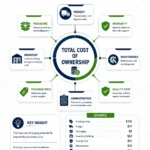
Evaluate Total Cost of Ownership (TCO).
Procurement, production, quality, finance and suppliers may have different information.
Create clear communication channels and shared data.
Create clear procedures for:
Track:
Data helps procurement move from reactive decisions to informed decisions.
Suppliers should not be treated only as sources of products.
For strategic categories, organizations can collaborate on:
Digital tools can automate:
This reduces manual work and improves visibility.
Useful KPIs include:
Modern procurement systems can connect different stages of the cycle.
For example:
Demand Planning
      ↓
ERP / MRP
      ↓
Purchase Requisition
      ↓
Approval
      ↓
RFQ
      ↓
Supplier Selection
      ↓
Purchase Order
      ↓
Goods Receipt
      ↓
Invoice
      ↓
Payment
      ↓
Supplier Analytics
This creates a more connected procurement environment.
Artificial intelligence can support procurement in several areas.
AI can analyze historical demand and other relevant data to support forecasting.
AI can categorize large amounts of purchasing data and identify spending patterns.
AI-assisted systems can help identify potential supplier risks and prioritize areas for review.
AI can help summarize contracts and identify important clauses, dates and obligations.
AI can assist with repetitive activities such as information retrieval, document processing and procurement queries.
However, procurement decisions still require human judgment, supplier relationships, commercial understanding and business context.
A procurement cycle should be measurable.
| KPI | What It Measures |
|---|---|
| Procurement Cycle Time | Speed of procurement execution |
| PO Processing Time | Time required to convert approved requirements into POs |
| Supplier OTD | Delivery reliability |
| Supplier PPM / Defect Rate | Quality performance |
| Cost Savings | Financial value created |
| Spend Under Contract | Procurement control |
| Emergency Purchase % | Planning effectiveness |
| Supplier Response Time | Supplier responsiveness |
| Invoice Processing Time | Finance/procurement efficiency |
| Contract Compliance | Adherence to agreed terms |
The right KPIs depend on the organization’s objectives and procurement maturity.
A high-performing procurement cycle generally includes:
Avoid unnecessary emergency purchasing.
Specifications should be accurate and complete.
Don’t evaluate suppliers based only on unit price.
Critical categories may require alternate supply options.
Use objective supplier scorecards.
Procurement cannot operate effectively in isolation.
Automate repetitive processes and improve visibility.
Use procurement data to improve future decisions.
Before closing a procurement activity, procurement teams can ask:
☐ Is the requirement clearly defined?
☐ Is the quantity correct?
☐ Is the required date confirmed?
☐ Is the supplier qualified?
☐ Has supplier performance been reviewed?
☐ Is supply risk acceptable?
☐ Has pricing been evaluated?
☐ Have payment terms been reviewed?
☐ Has Total Cost of Ownership been considered?
☐ Is the PO accurate?
☐ Are delivery dates clear?
☐ Are quality requirements included?
☐ Was material received on time?
☐ Was quantity verified?
☐ Was quality accepted?
☐ Does the invoice match the PO?
☐ Does the receipt match the invoice?
☐ Was supplier performance measured?
☐ Were problems documented?
☐ Can the next cycle be improved?
The procurement cycle is a continuous journey rather than a single purchasing transaction.
The major stages include:
The most important point is the final one:
Procurement should learn from every completed transaction.
Supplier performance, price movements, quality issues, delivery problems, inventory trends and stakeholder feedback should influence future procurement decisions.
That is how a procurement department evolves from simply processing orders to creating measurable business value.
A well-managed procurement cycle connects business requirements with suppliers, purchasing, logistics, quality, finance and future planning.
For a manufacturing organization, this connection can directly influence production continuity, inventory levels, working capital, product quality and customer satisfaction.
Procurement professionals who understand the complete cycle can identify problems earlier, make better sourcing decisions, build stronger supplier relationships and contribute more strategically to the organization.
The goal isn’t simply to complete one purchase successfully.
The goal is to make the next procurement cycle better than the previous one.
What is the procurement cycle?
The procurement cycle is the continuous sequence of activities from identifying a business need through planning, sourcing, supplier selection, purchasing, receiving, payment, supplier evaluation and continuous improvement.
What are the main stages of the procurement cycle?
The stages generally include need identification, planning, specification, sourcing, supplier evaluation, negotiation, purchasing, delivery, payment, supplier performance and improvement.
What is the difference between procurement process and procurement cycle?
The procurement process focuses on executing a procurement activity, while the procurement cycle emphasizes the continuous end-to-end journey and the feedback used to improve future procurement decisions.
What is the difference between procurement cycle and P2P?
Procure-to-Pay generally focuses on the transactional process from requisition through purchase, receipt and payment. The procurement cycle is broader and can include sourcing, supplier management and continuous improvement.
Why is procurement called a cycle?
It is called a cycle because the results of one procurement activity—such as price, quality, delivery and supplier performance—can influence the next procurement decision.
What is the role of supplier evaluation in the procurement cycle?
Supplier evaluation measures performance and provides information that helps procurement decide whether to continue, improve, develop or replace a supplier.
How can companies reduce procurement cycle time?
Companies can reduce cycle time by standardizing requirements, simplifying approval workflows, using digital tools, maintaining qualified suppliers and eliminating unnecessary manual activities.
What is the role of procurement planning?
Procurement planning ensures that requirements are purchased at the right time and in the right quantity while considering demand, inventory, supplier lead times, budget and business priorities.
What is the role of technology in procurement?
Technology can automate approvals, RFQs, purchase orders, supplier management, invoice matching, analytics and reporting.
Can small businesses use a procurement cycle?
Yes. Even small businesses benefit from a simple structured cycle covering need identification, supplier comparison, purchasing, receiving, payment and supplier review.
Why should procurement not select suppliers only by price?
The lowest price may result in higher costs if the supplier has poor quality, late delivery, high logistics costs or weak service.
What is Total Cost of Ownership?
Total Cost of Ownership considers the complete cost associated with purchasing and using a product or service rather than only its initial purchase price.