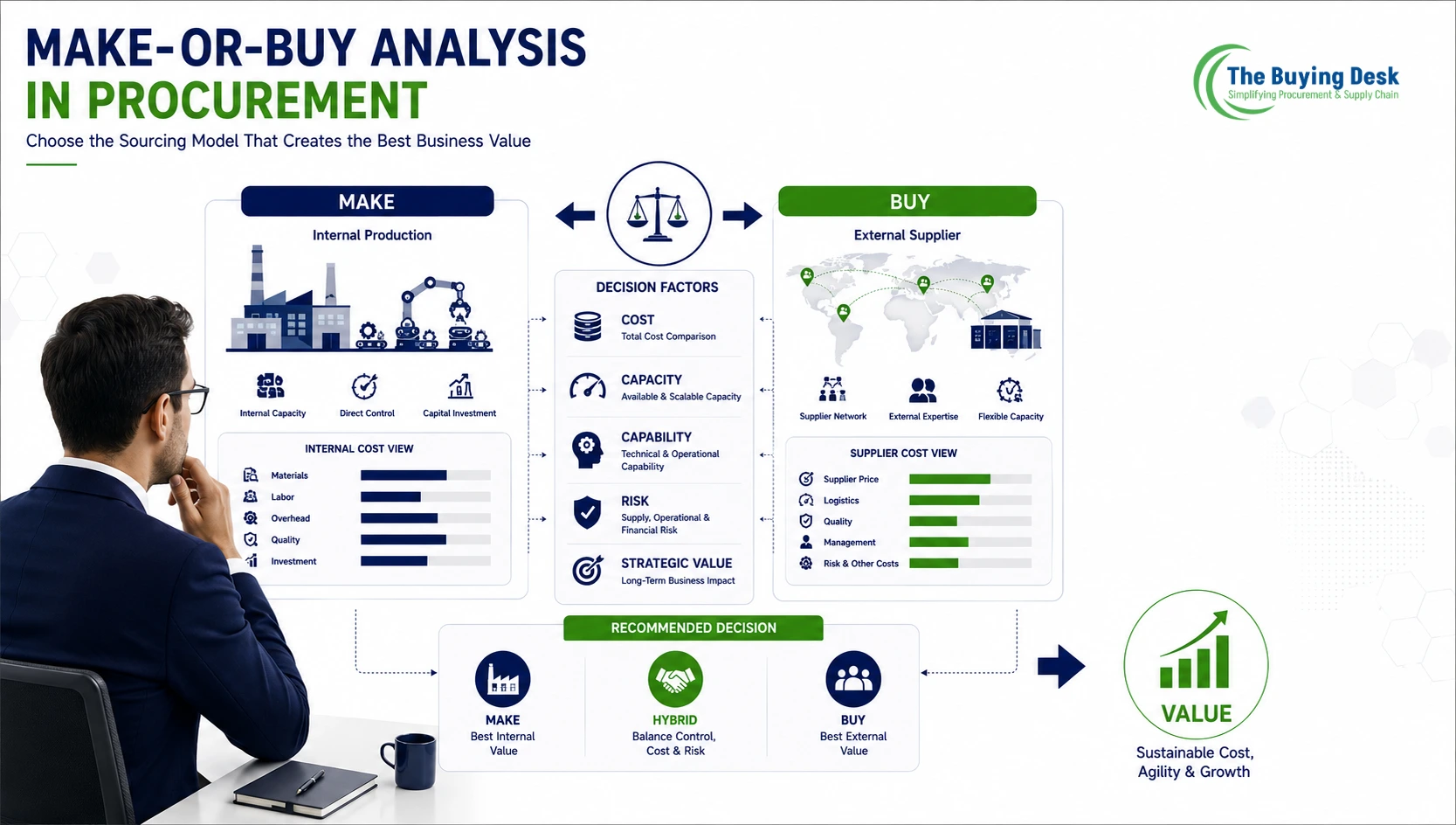
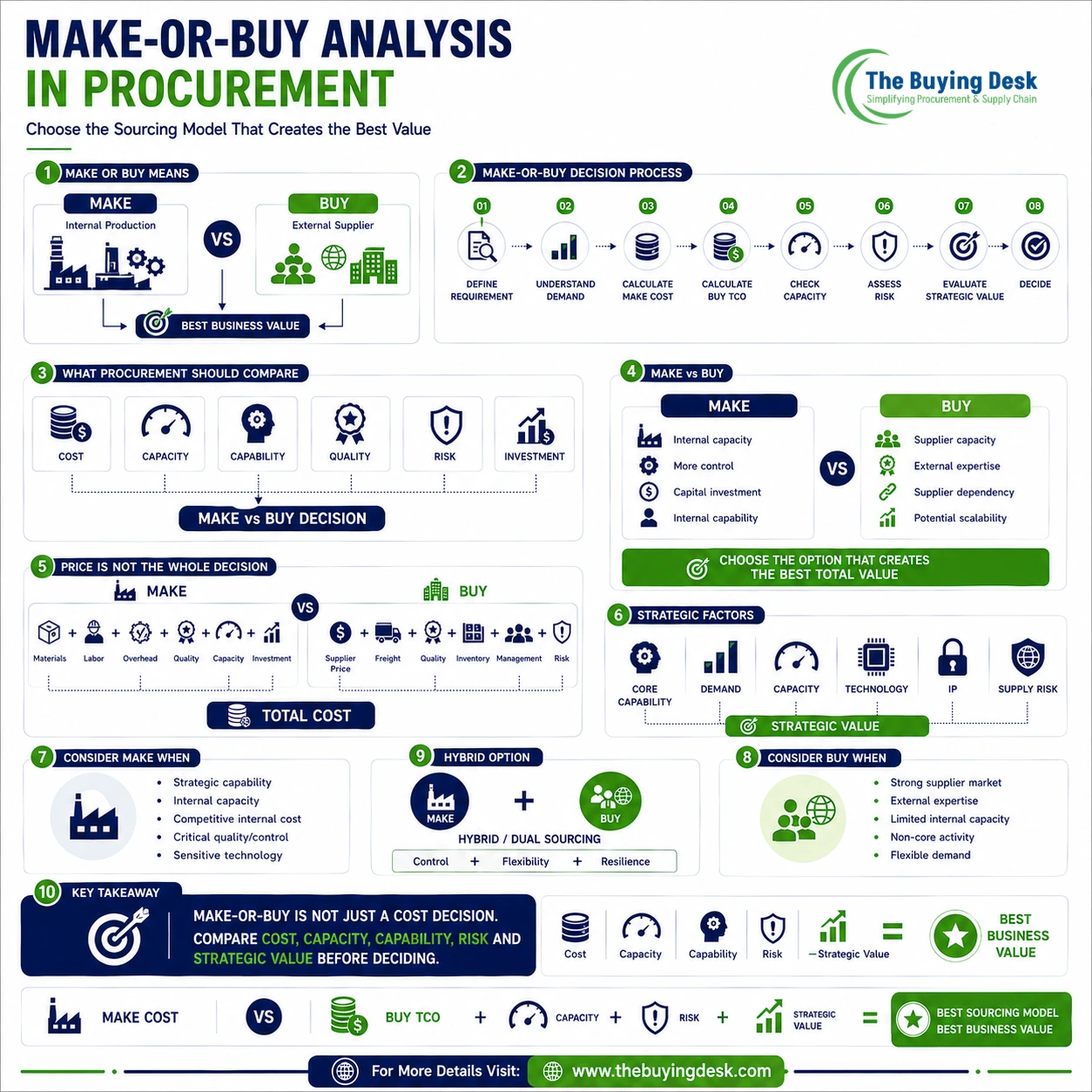
Make-or-buy analysis is a strategic procurement decision used to determine whether an organization should produce a product, component or service internally or purchase it from an external supplier.
The decision is more complex than comparing internal production cost with a supplier quotation.
A proper make-or-buy analysis considers:
Cost + Capacity + Quality + Capability + Risk + Investment + Flexibility + Strategic Value
The objective is to determine which option provides the best overall business outcome over the relevant time horizon.
For procurement and supply-chain teams, make-or-buy analysis can influence sourcing strategy, supplier development, manufacturing footprint, capacity planning, outsourcing and long-term cost competitiveness.
Make-or-buy analysis is the systematic evaluation of two alternatives:
MAKE
Produce the required product, component or service internally.
BUY
Purchase it from an external supplier.
The basic decision can be represented as:
Internal Production Economics + Strategic Factors
versus
External Sourcing Economics + Strategic Factors
The preferred option is not necessarily the one with the lowest immediate price.
It is the option that creates the best total business value while meeting operational, quality and risk requirements.
Organizations frequently face decisions about whether to manufacture internally or outsource.
Examples include:
A poorly evaluated decision can create hidden costs, capacity problems or supply risks.
A structured analysis helps management understand the financial and strategic consequences before committing resources.
| Make | Buy |
|---|---|
| Internal production | External supplier |
| Requires internal capacity | Uses supplier capacity |
| Requires operational management | Requires supplier management |
| May require capital investment | May reduce internal investment |
| Greater direct control | Greater external dependency |
| Potential long-term capability | Access to external expertise |
| Internal fixed-cost exposure | Supplier commercial margin |
Neither option is universally better.
The right choice depends on the product, category, economics, capabilities and strategic priorities.
A practical framework is:
DEFINE REQUIREMENT
↓
UNDERSTAND DEMAND
↓
CALCULATE MAKE COST
↓
CALCULATE BUY COST
↓
ASSESS CAPACITY & CAPABILITY
↓
EVALUATE RISK
↓
CONSIDER STRATEGIC FACTORS
↓
COMPARE TOTAL VALUE
↓
MAKE OR BUY DECISION
This approach prevents procurement from making the decision based solely on a supplier quotation.
Before comparing alternatives, clearly define what is required.
The analysis may need to establish:
A poorly defined requirement can make the financial comparison unreliable.
Demand is one of the most important variables in a make-or-buy decision.
Procurement should understand:
A high and stable volume may justify internal investment, while low or unpredictable demand may favor external sourcing.
Internal production cost can include:
Materials consumed to manufacture the product.
Labor directly associated with production.
Costs that change with production volume.
Examples include:
Costs that may continue regardless of production volume.
Examples include:
Costs related to inspection, testing, rework and scrap.
Internal movement, handling and storage costs.
A simplified calculation is:
Make Cost = Material + Labor + Variable Overhead + Allocated Relevant Fixed Costs + Quality + Logistics
However, not every accounting cost should automatically be included.
This distinction is critical.
A make-or-buy decision should focus on relevant incremental costs and avoidable costs, not simply accounting allocations.
For example, if a factory manager’s salary will remain unchanged regardless of the decision, that cost may not be relevant to the short-term decision.
Similarly, if a machine becomes unnecessary when production is outsourced, its avoidable operating cost may be relevant.
Therefore:
Accounting Cost ≠ Decision-Relevant Cost
The buy option should consider more than the supplier’s quoted unit price.
The total buy cost may include:
Supplier Price + Freight + Duties + Inspection + Supplier Management + Inventory + Quality Costs + Switching Costs
Other factors may include:
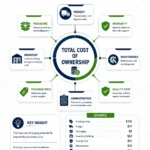
This is where make-or-buy analysis connects closely with Total Cost of Ownership (TCO).
Capacity can significantly influence the decision.
Procurement and operations should determine:
A theoretically cheaper make option may not be practical if the organization lacks sufficient production capacity.
Likewise, a supplier may offer an attractive price but lack the capacity to support future growth.
Cost is only one part of the decision.
The organization should ask whether it has the required:
If the required capability does not exist internally, the true cost of making may be significantly higher than the initial calculation suggests.
For the buy option, procurement should assess supplier capability.
Important factors include:
The supplier must be capable of delivering the required outcome consistently.
Quality considerations should include:
A lower-cost option may become more expensive if it generates significant quality failures.
Therefore:
Purchase Price + Cost of Poor Quality
may be more meaningful than purchase price alone.
The buy option can create external supply dependency.
Potential risks include:
However, internal production also carries risks.
For example:
The decision should compare both internal and external risks.
The make option may require investment in:
The investment should be evaluated against expected demand and future returns.
Important measures can include:
Capital Investment
Payback Period
Return on Investment
Net Present Value
Capacity Utilization
Cost behavior is important when comparing make and buy.
These generally change with production volume.
Examples:
These may remain relatively stable within a relevant capacity range.
Examples:
Understanding the cost structure helps determine how the decision changes at different volumes.
A useful concept is the break-even volume.
A simplified formula is:
Break-Even Volume = Fixed Cost Difference ÷ Unit Variable Cost Difference
For example, if internal production requires additional fixed investment but has a lower variable cost per unit, higher production volume may eventually make the make option more attractive.
The calculation should be based on relevant costs and realistic assumptions.
Suppose an organization requires a component every year.
The external supplier offers:
Buy Price = $18 per unit
The internal production economics are:
Variable Production Cost = $12 per unit
Additional Annual Fixed Cost = $60,000
The simplified break-even volume is:
$60,000 ÷ ($18 − $12) = 10,000 units
At approximately 10,000 units, the two alternatives reach the simplified economic break-even point.
Below that volume, buying may be financially attractive.
Above that volume, making may become more attractive.
However, the final decision should also consider quality, capacity, investment, risk and strategic factors.
Make-or-buy decisions should use a broad cost perspective.
May include:
May include:
The comparison should use equivalent cost boundaries.
Opportunity cost is often overlooked.
If internal production uses a machine or factory line, that capacity may not be available for another product.
The organization should therefore ask:
What else could we produce with this capacity?
If internal capacity could generate higher-value output elsewhere, outsourcing may become more attractive.
Capacity utilization can change the economics.
Making may be attractive because existing resources are already available.
Buying may be attractive if outsourcing avoids additional capital investment.
The make option may require significant investment and implementation time.
Capacity utilization should therefore be included in the financial model.
Some products or capabilities are strategically important.
Organizations may prefer to keep certain activities internal because they involve:
In such cases, the strategic value of internal capability may outweigh a simple cost comparison.
A common strategic consideration is whether an activity is core to the business.
An activity directly contributing to competitive advantage or proprietary capability.
Potential approach:
Consider Make
An activity that external specialists can perform effectively.
Potential approach:
Consider Buy
However, “non-core” does not automatically mean “outsource.”
Supply risk, economics and business requirements still matter.
Intellectual property can influence the decision significantly.
Consider:
External sourcing may create IP protection and confidentiality considerations.
Where sensitive intellectual property is involved, procurement should work with legal, engineering and business stakeholders.
Flexibility is another important consideration.
Internal production may provide greater control over:
External suppliers may provide:
The right answer depends on the business model.
Suppliers can sometimes provide capabilities that are difficult or expensive to develop internally.
External suppliers may offer:
Therefore, the buy option should not be viewed simply as outsourcing production.
It may also provide access to external innovation.
Supplier market analysis should be incorporated into the decision.
If the market has:
Many Qualified Suppliers
→ Buying may offer strong competition.
Few Qualified Suppliers
→ Buying may create dependency.
Highly Concentrated Supply
→ Risk mitigation may be necessary.
Emerging Technologies
→ External sourcing may provide access to innovation.
This connects Article #26’s supplier market analysis directly to the make-or-buy decision.
Make-or-buy analysis is a component of strategic sourcing.
The broader decision can be:
Make
Buy
Dual Source
Hybrid Model
A hybrid approach may involve keeping critical activities internal while outsourcing selected components or processes.
Sometimes the answer does not have to be purely make or buy.
For example:
70% Internal Production + 30% External Sourcing
may provide a balance between:
Dual sourcing can also provide an external market reference for internal manufacturing costs.
A practical decision matrix can assess:
| Factor | Make | Buy |
|---|---|---|
| Cost | Internal economics | Supplier economics |
| Capacity | Available internal capacity | Supplier capacity |
| Quality | Internal capability | Supplier capability |
| Risk | Internal operational risk | External supply risk |
| Investment | Capital required | Supplier investment |
| Flexibility | Internal control | Supplier scalability |
| Technology | Internal capability | External expertise |
| Strategy | Core capability | Non-core capability |
The weights should reflect business priorities.
For complex decisions, procurement can assign weights to important criteria.
Example:
| Criterion | Weight |
|---|---|
| Total Cost | 30% |
| Quality | 15% |
| Capacity | 15% |
| Supply Risk | 15% |
| Strategic Importance | 10% |
| Flexibility | 10% |
| Technology | 5% |
Each option can then be scored against the criteria.
The result is a structured comparison rather than a purely subjective decision.
A strong make-or-buy decision should use two perspectives.
Answers:
Which option is economically attractive?
Answers:
Which option best supports the business strategy?
The final decision should consider both.
The answer can change depending on the time horizon.
Existing capacity and avoidable costs may dominate.
Capital investment, technology, supplier development, demand growth and strategic capability may become more important.
Therefore, procurement should avoid making a long-term sourcing decision using only short-term economics.
A make-or-buy decision should normally involve cross-functional stakeholders.
Potential participants include:
Procurement should facilitate the commercial analysis while ensuring the decision reflects the wider business context.
Supplier price and internal production cost are not equivalent measures.
Capital and facility implications can materially change the decision.
Internal capacity may have a higher-value alternative use.
Not every allocated overhead is relevant to the decision.
Outsourcing can create dependency and disruption exposure.
Internal manufacturing also has operational risks.
External suppliers may introduce logistics, quality, management and transaction costs.
Volume assumptions strongly influence economics.
A sourcing decision should consider expected future conditions.
Separate decision-relevant costs from accounting allocations.
Consider the full economic impact of each option.
Test multiple demand scenarios where appropriate.
Evaluate both internal and supplier capacity.
Compare internal and external risk exposure.
Protect capabilities that genuinely create competitive advantage.
Understand the external supplier landscape before deciding.
Consider changes in volume, price, capacity and investment.
Finance, operations, engineering and quality can identify important factors procurement may otherwise miss.
Make-or-buy decisions should be reviewed when market, technology, demand or capacity conditions materially change.
Scenario analysis can improve decision quality.
Low volume may favor buying because internal fixed costs are difficult to absorb.
High volume may favor making if internal variable costs are competitive.
External sourcing may provide faster access to capacity.
Internal production may become strategically attractive.
External suppliers may provide capabilities unavailable internally.
Scenario analysis prevents the organization from treating the current environment as permanent.
Before making the decision, procurement should be able to answer:
A practical business template can contain seven sections.
Define the product, service, specification and demand.
Calculate relevant internal costs and required investment.
Calculate supplier TCO and external sourcing costs.
Compare internal and external capabilities.
Assess supply, operational, financial and strategic risks.
Evaluate technology, IP, competitive advantage and flexibility.
Document the preferred option, assumptions and implementation requirements.
A simplified decision tree can be:
Is the capability strategically critical?
If yes:
Can internal capability deliver competitively?
If yes:
Consider Make or Hybrid
If no:
Consider Strategic External Sourcing
If the capability is not strategically critical:
Is the external market competitive and capable?
If yes:
Consider Buy
If no:
Evaluate Hybrid, Supplier Development or Internal Capability
Making may be attractive when:
Buying may be attractive when:
A hybrid model may be appropriate when the organization wants to balance:
Cost + Control + Capacity + Risk + Flexibility
For example, a company may manufacture a critical component internally while outsourcing overflow production to qualified suppliers.
This can create both internal capability and external supply flexibility.
Make-or-buy analysis is not simply a question of:
“Can we make it cheaper?”
It is a broader strategic question:
“Which sourcing model creates the best overall business value?”
The strongest analysis considers:
Cost + Capacity + Quality + Capability + Risk + Investment + Flexibility + Strategic Value
The decision journey is:
REQUIREMENT → DEMAND → MAKE COST → BUY TCO → CAPACITY → CAPABILITY → RISK → STRATEGIC VALUE → DECISION
A well-structured make-or-buy analysis enables procurement, operations and management to make sourcing decisions based on facts, economics and business strategy rather than assumptions.
What is make-or-buy analysis in procurement?
Make-or-buy analysis determines whether an organization should produce a product, component or service internally or purchase it from an external supplier. The decision considers cost, capability, capacity, risk and strategic value.
What factors should be considered in a make-or-buy decision?
Key factors include total cost, internal capacity, supplier capability, quality, capital investment, supply risk, demand, flexibility, technology and strategic importance.
Is make-or-buy analysis based only on cost?
No. Cost is important, but strategic and operational factors can materially affect the decision. A slightly higher-cost option may provide better resilience, quality, flexibility or strategic control.
What is the difference between make cost and buy cost?
Make cost represents relevant internal production economics, while buy cost represents the supplier’s total cost to the organization. Both should include comparable relevant costs rather than relying only on accounting or quoted figures.
How does TCO support make-or-buy analysis?
Total Cost of Ownership captures costs beyond the basic purchase price, such as freight, quality, inventory, tooling and supplier-management costs. This creates a more realistic comparison between internal and external sourcing.
Can make-or-buy analysis result in a hybrid decision?
Yes. Organizations can use a hybrid or dual-sourcing model, keeping some production internal while outsourcing other volumes. This can balance cost, control, capacity and supply resilience.
Who should participate in a make-or-buy decision?
Procurement should normally work with finance, operations, manufacturing, engineering, quality, supply chain and relevant business leaders. Cross-functional participation helps capture both financial and operational considerations.
When should a make-or-buy decision be reviewed?
The decision should be revisited when major changes occur in demand, supplier markets, technology, capacity, cost structure, regulations or strategic priorities. Periodic review can prevent an outdated sourcing model from continuing by default.