Not all procurement activities are the same.
A manufacturing company purchasing steel, an IT company buying cloud services, a hospital purchasing medical equipment and an office buying stationery all perform procurement—but their requirements, suppliers, risks and purchasing processes can be very different.
This is why organizations use different types of procurement.
Understanding procurement types helps businesses determine:
For example, buying a critical production component may require detailed supplier qualification, technical evaluation and risk management.
Buying routine office stationery may require a much simpler process.
Therefore:
The right procurement approach depends on the category, business requirement, risk, value and supply market.
In this article, we will explore the major types of procurement and explain where each type is commonly used.
Types of procurement are different ways of classifying procurement activities based on what is purchased, why it is purchased, how strategically important it is, how suppliers are managed and how purchasing decisions are organized.
There is no single universal classification system.
A procurement activity can belong to more than one category.
For example:
A company may purchase a production component through:
These classifications describe different aspects of the same purchasing activity.
Classifying procurement correctly helps organizations choose an appropriate procurement strategy.
It can influence:
For example, a critical raw material should not necessarily be managed in the same way as routine office supplies.
Similarly, a strategic technology service may require a different approach from a standard consumable.
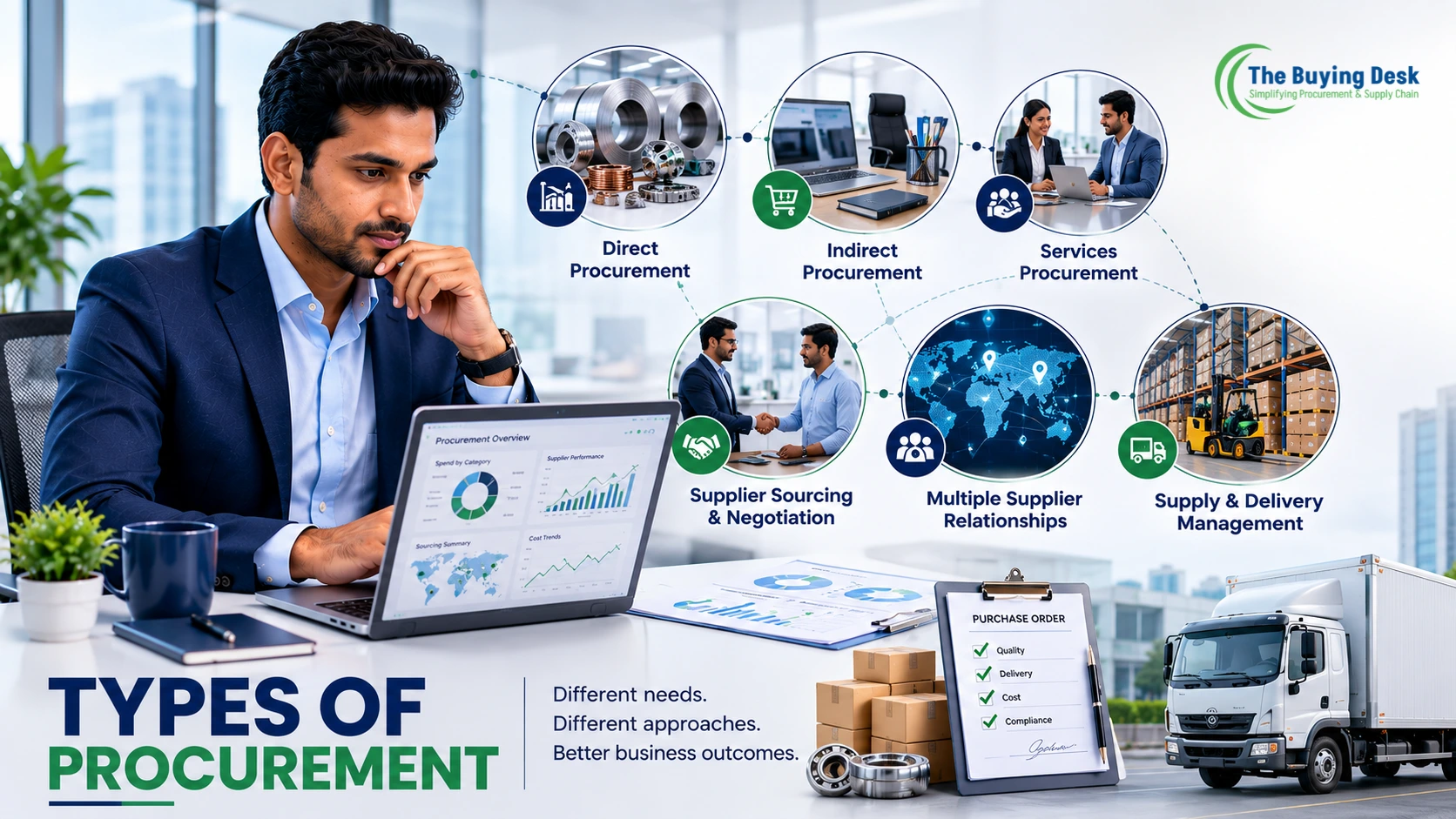
The most useful procurement classifications include:
Let’s understand each one.
Direct procurement refers to purchasing goods, materials or services that directly contribute to the production of a company’s products or delivery of its core offering.
In manufacturing, direct procurement commonly includes materials and components that become part of the finished product.
A manufacturing company may directly procure:
A company manufactures air-conditioning equipment.
It may directly procure:
These materials directly support production.
Direct materials can have a major impact on:
Therefore, direct procurement is often closely connected with production, engineering, quality and supply planning.
Indirect procurement refers to goods and services that support business operations but generally do not become part of the finished product.
A factory may require:
These purchases support the organization but may not become part of the manufactured product.
| Direct Procurement | Indirect Procurement |
|---|---|
| Supports product production directly | Supports business operations |
| Often production-critical | Often operationally important |
| Closely linked to BOM | Usually outside BOM |
| May have significant quality impact | Usually has lower direct product impact |
| Often high recurring spend | Spend can be fragmented |
| Production disruption can be significant | Business disruption depends on category |
Both are important.
The appropriate sourcing strategy depends on the category and its business impact.
Goods procurement involves purchasing physical products.
These products may be used in:
Goods procurement often involves considerations such as:
Services procurement involves acquiring services rather than physical products.
Services procurement can be more complex than goods procurement because the output may not be physically measurable in the same way as a product.
Therefore, organizations may need clearly defined:
| Goods Procurement | Services Procurement |
|---|---|
| Physical products | Intangible or activity-based output |
| Quantity is often measurable | Scope and deliverables are important |
| Quality can often be inspected physically | Performance may require service KPIs |
| Inventory may be required | Usually no traditional inventory |
| Delivery is product-based | Delivery may occur over time |
| Warranty may apply | SLA and service obligations may apply |
Strategic procurement focuses on long-term value creation rather than simply completing individual purchases.
It involves understanding:
Strategic procurement may include:
A company spends ₹20 crore annually on aluminium.
Instead of negotiating each purchase order separately, strategic procurement may:
This is strategic procurement.
Tactical procurement focuses on executing sourcing and purchasing activities within an established procurement strategy.
It often sits between strategic planning and day-to-day operational purchasing.
The organization has already decided that a particular category will be sourced from approved suppliers.
The tactical procurement team may conduct the RFQ, compare quotations, negotiate and recommend the supplier.
| Strategic | Tactical |
|---|---|
| Long-term | Short-to-medium term |
| Category strategy | Sourcing execution |
| Market analysis | RFQ management |
| Supplier strategy | Supplier quotation comparison |
| Cost modeling | Commercial negotiation |
| Risk strategy | Supplier selection within defined framework |
| Long-term value | Immediate sourcing requirement |
Operational procurement focuses on the day-to-day execution of purchasing activities.
Typical activities include:
Operational procurement ensures that approved requirements are converted into actual supply.
Production requires 5,000 components next week.
The operational procurement team may:
Operational procurement keeps the purchasing process moving.
In centralized procurement, purchasing decisions and procurement activities are managed by a central procurement organization.
For example, a company with five factories may have one central procurement team responsible for major categories.
Centralized procurement can provide:
Five manufacturing plants each require packaging materials.
Instead of negotiating separately, central procurement may consolidate the demand and negotiate with suppliers based on total company volume.
In decentralized procurement, individual plants, departments or business units manage some or most of their own procurement activities.
Decentralization can provide:
A company has plants in Delhi, Pune and Chennai.
Each plant may purchase certain locally available maintenance items from local suppliers based on its specific requirements.
| Centralized | Decentralized |
|---|---|
| Central decision-making | Local decision-making |
| Greater spend consolidation | Greater local flexibility |
| Standardized processes | Localized processes |
| Higher negotiation leverage | Faster local response |
| Better global visibility | Better local market knowledge |
| Stronger governance | Potentially greater supplier diversity |
Many organizations use a hybrid procurement model.
This combines centralized and decentralized procurement.
For example:
May manage:
May manage:
This model attempts to combine central purchasing power with local flexibility.
Single-source procurement means purchasing a requirement from one selected supplier.
This can be appropriate when:
A component is designed around a supplier’s proprietary technology.
Changing suppliers may require:
In such circumstances, single sourcing may be commercially or technically justified.
Single sourcing creates dependency.
Potential risks include:
Therefore, the organization should understand and manage the associated risk.
Multi-source procurement means purchasing the same or similar requirement from multiple suppliers.
A company requires 100,000 components per month.
Instead of buying everything from one supplier, it may source:
Multi-sourcing is especially useful when supply continuity is critical.
Emergency procurement occurs when an organization must purchase goods or services urgently because normal procurement planning cannot meet the immediate requirement.
A critical production machine fails.
A spare part is unavailable in stores.
The normal sourcing process may take several days, but production cannot wait.
The procurement team may need to identify an available supplier immediately.
Emergency procurement may be necessary, but frequent emergency purchasing can indicate weaknesses in:
Therefore, emergency purchases should be monitored and analyzed.
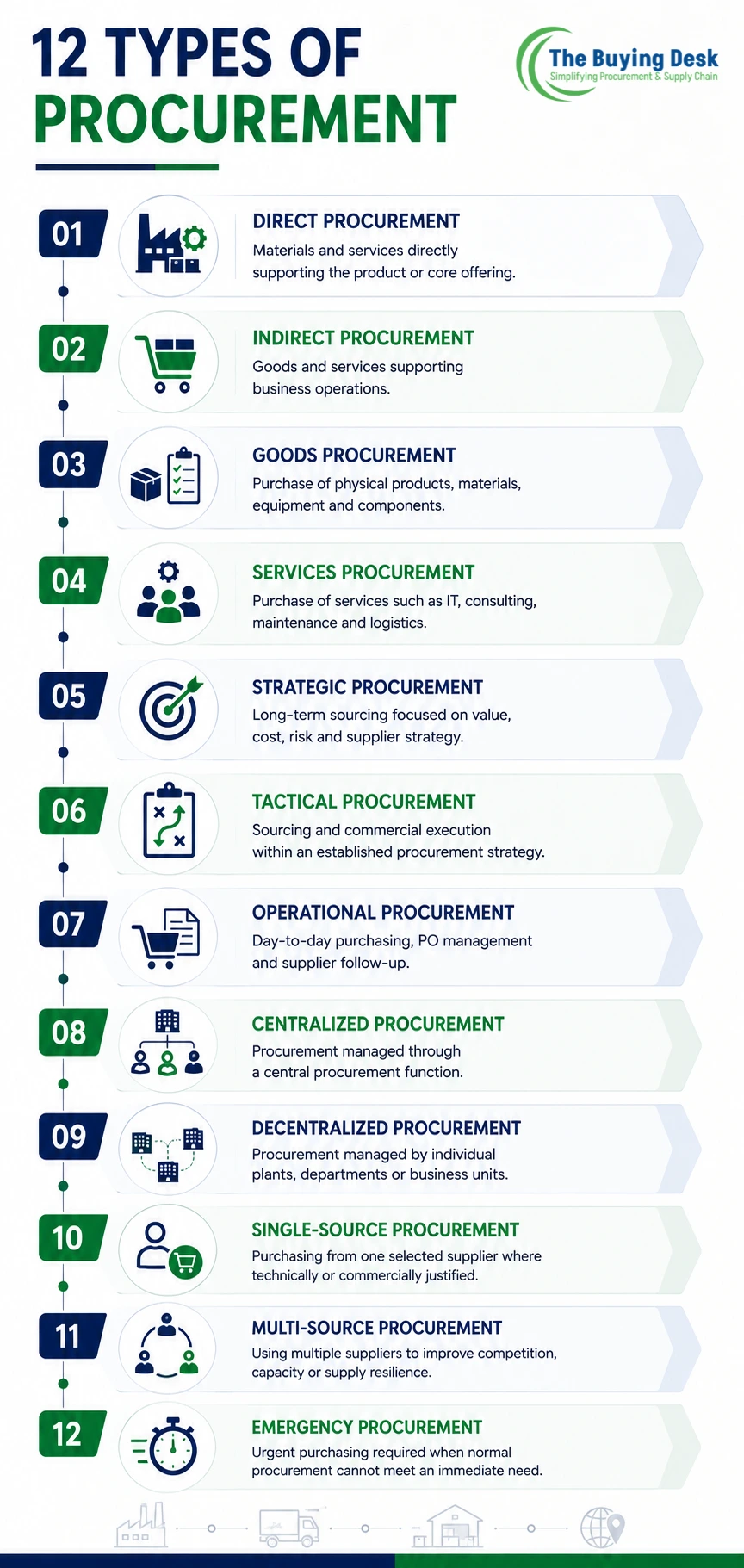
One of the most important concepts to understand is that these types are not mutually exclusive.
Consider this example:
A manufacturer purchases a critical aluminium component.
It could be classified as:
Direct Procurement
Because it goes into the finished product.
Goods Procurement
Because it is a physical product.
Strategic Procurement
Because the category has high annual spend and business importance.
Centralized Procurement
Because the corporate procurement team manages the category.
Multi-Source Procurement
Because the company buys from three approved suppliers.
This demonstrates why procurement classification should be viewed from multiple dimensions.
A useful way to classify procurement is through five questions.
Goods or Services
↓
Direct or Indirect
↓
Strategic, Tactical or Operational
↓
Centralized, Decentralized or Hybrid
↓
Single Source or Multi Source
This framework helps procurement teams select an appropriate sourcing strategy.
| Purchase | Type 1 | Type 2 | Possible Strategy |
|---|---|---|---|
| Raw material | Direct | Goods | Strategic / multi-source |
| Office stationery | Indirect | Goods | Operational |
| Security service | Indirect | Services | Tactical / strategic |
| Production tooling | Direct | Goods | Strategic |
| IT software | Indirect | Services | Strategic |
| Machine spare part | Direct/Operational | Goods | Single or multi-source |
| Facility maintenance | Indirect | Services | Tactical |
| Emergency spare | Direct | Goods | Emergency procurement |
The appropriate classification depends on the organization’s context.
These two concepts are related but different.
Describes what kind of procurement activity it is.
Describes how the organization intends to manage that procurement activity.
For example:
Type: Direct procurement
Strategy: Multi-source with long-term supplier agreements.
Another example:
Type: Indirect services procurement
Strategy: Competitive RFP followed by a three-year SLA-based contract.
The type helps describe the category.
The strategy determines how the organization will approach it.
There is no single procurement model that works for every category.
Consider the following factors.
Higher-value categories generally deserve greater strategic attention.
A low-cost component can still be extremely important if its absence stops production.
Consider:
If changing suppliers is expensive or time-consuming, supplier strategy becomes more important.
Consider:
Stable demand may support long-term agreements.
Highly unpredictable demand may require more flexibility.
Highly technical requirements may require stronger supplier qualification and engineering involvement.
Procurement should avoid choosing a procurement model based only on purchase price.
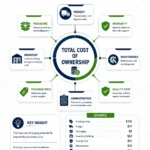
Consider Total Cost of Ownership (TCO).
TCO can include:
Supplier A:
Purchase price: ₹100
Supplier B:
Purchase price: ₹96
At first glance, Supplier B appears cheaper.
But Supplier B may have:
The total cost may therefore be higher.
This is why procurement classification and sourcing strategy should consider the complete cost picture.
A critical production component should not automatically follow the same process as stationery.
Low-spend items can still have high operational risk.
Price is only one part of value.
Supplier dependency should be understood before committing to one source.
Multi-sourcing can improve resilience, but excessive supplier fragmentation can increase complexity.
Some categories require local knowledge and speed.
Decentralization can reduce purchasing leverage and create inconsistent processes.
Manufacturing organizations commonly use a combination of procurement types.
The best approach depends on the organization’s products, supply chain and risk profile.
Service businesses also use procurement extensively.
Examples include:
Therefore, procurement is not limited to manufacturing.
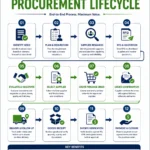
Regardless of the procurement type, most procurement activities follow a broadly similar flow:
Need Identification
↓
Requirement Definition
↓
Sourcing Strategy
↓
Supplier Identification
↓
RFQ / RFP
↓
Supplier Evaluation
↓
Negotiation
↓
Contract / Purchase Order
↓
Delivery
↓
Inspection / Acceptance
↓
Payment
↓
Supplier Performance
The difference lies in how much complexity, governance and strategic involvement is required at each stage.
There are many ways to classify procurement.
The most important types include:
The most important lesson is that procurement types can overlap.
A purchase can simultaneously be:
Direct + Goods + Strategic + Centralized + Multi-Source
The right procurement approach depends on the organization’s requirements, spend, risk, supply market, business criticality and supplier landscape.
The goal is not to choose a procurement type simply because it sounds efficient.
The goal is to select the right procurement model for the business requirement.
What are the main types of procurement?
The main types include direct, indirect, goods, services, strategic, tactical, operational, centralized, decentralized, single-source, multi-source and emergency procurement.
What is direct procurement?
Direct procurement involves purchasing materials, components or services that directly contribute to the production of a company’s products or core offering.
What is indirect procurement?
Indirect procurement involves goods and services that support business operations but generally do not become part of the finished product.
What is strategic procurement?
Strategic procurement focuses on long-term value creation through sourcing strategy, supplier management, cost analysis, risk management and commercial planning.
What is tactical procurement?
Tactical procurement focuses on executing sourcing activities within an established procurement strategy, such as RFQs, quotation comparison and commercial negotiation.
What is operational procurement?
Operational procurement handles day-to-day purchasing activities such as purchase orders, supplier follow-up, delivery monitoring and documentation.
What is centralized procurement?
Centralized procurement means procurement decisions or activities are managed by a central procurement function.
What is decentralized procurement?
Decentralized procurement allows individual plants, departments or business units to manage some or most purchasing activities independently.
Is single-source procurement risky?
It can be. Single sourcing can provide commercial, technical or operational benefits, but it can also create supplier dependency and supply continuity risks.
Why use multi-source procurement?
Multi-sourcing can reduce supplier dependency, improve resilience, maintain competitive pressure and provide additional capacity.
What is emergency procurement?
Emergency procurement is the urgent acquisition of goods or services when normal procurement processes cannot meet an immediate business requirement.
Can one purchase belong to multiple procurement types?
Yes. Procurement classifications describe different dimensions of the same activity. For example, a critical production component may be direct, goods-based, strategic, centralized and multi-sourced.