A procurement team does much more than purchase goods and services.
It also has to ensure that purchasing decisions are:
Authorized
Transparent
Competitive where appropriate
Compliant
Cost-effective
Properly documented
Aligned with business requirements
This is where a procurement policy becomes important.
Without clear procurement policies, different departments may follow different purchasing practices.
One department may obtain three quotations.
Another may purchase directly from a familiar supplier.
Someone else may place an order without an approved purchase requisition.
Over time, these inconsistencies can create:
Uncontrolled spending
Supplier dependency
Compliance issues
Duplicate purchases
Poor documentation
Approval problems
Fraud risks
Higher costs
A well-designed procurement policy establishes a common framework for how an organization purchases goods and services.
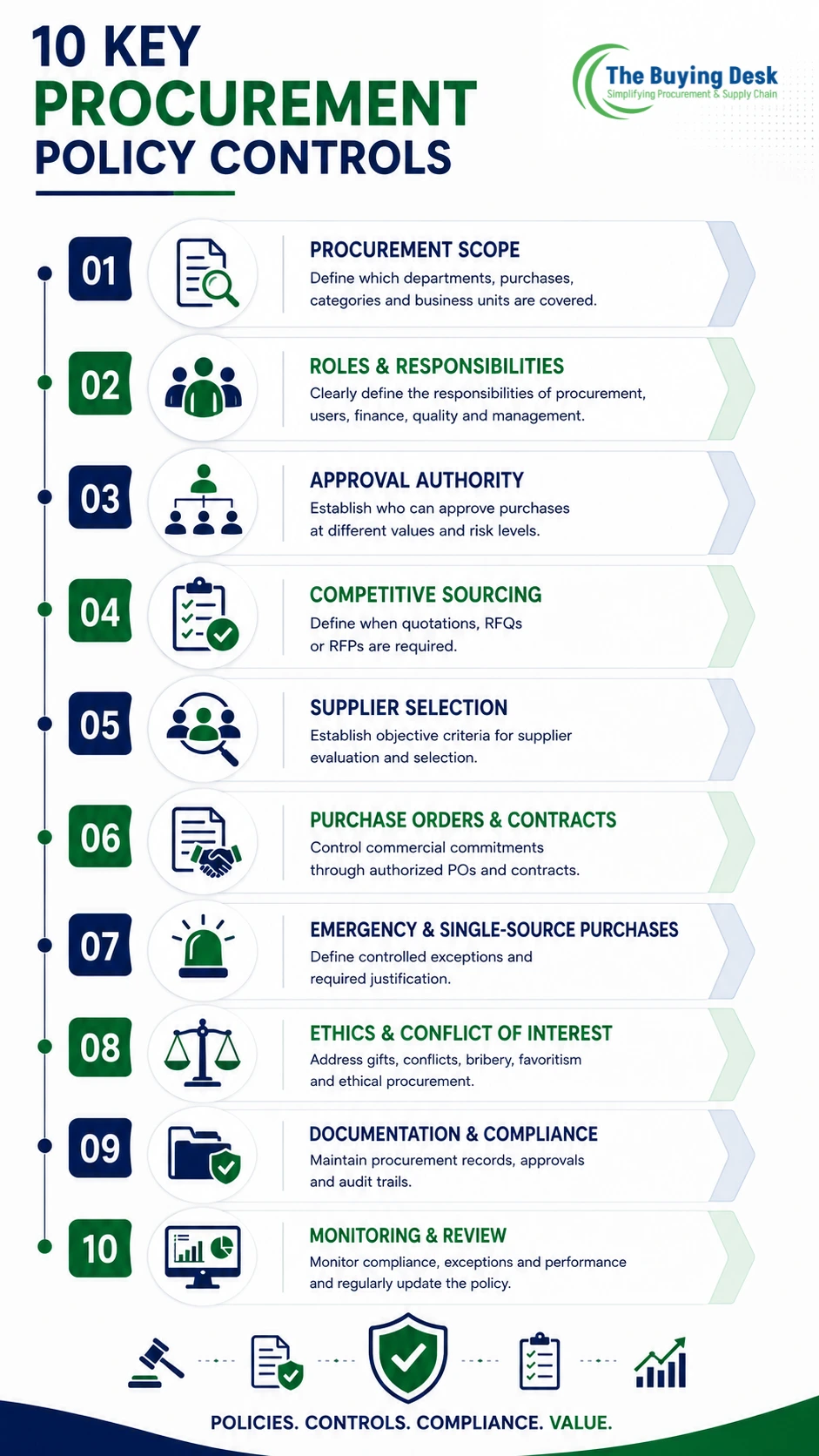
A procurement policy defines the rules and controls under which an organization conducts procurement.
But a policy should not become a document that nobody reads.
An effective procurement policy should help employees understand what is required, who is responsible, what approvals are needed and when exceptions are permitted.
A procurement policy is a formal set of rules, principles and controls that governs how an organization purchases goods and services.
It typically defines:
Who can purchase
What purchasing process must be followed
Which approvals are required
When competitive quotations are required
How suppliers are selected
How purchase orders are issued
How exceptions are handled
What documentation must be maintained
How conflicts of interest are managed
How procurement compliance is monitored
A procurement policy provides a framework.
Detailed operating instructions are generally covered through procurement procedures, work instructions, approval matrices and standard operating procedures (SOPs).
Procurement Policy vs Procurement Procedure
These terms are often confused.
Procurement Policy
A policy explains:
What the organization requires and the principles it follows.
Procurement Procedure
A procedure explains:
How the organization carries out the required activity.
Example
Policy
Competitive sourcing should be used for significant purchases where market competition is reasonably available.
Procedure
The procedure may define:
Create purchase requisition.
Identify qualified suppliers.
Issue RFQ.
Receive quotations.
Prepare comparison statement.
Conduct technical evaluation.
Complete commercial evaluation.
Obtain approval.
Issue purchase order.
Therefore:
Policy = Rules and principles
Procedure = Steps and execution
Why Are Procurement Policies Important?
A procurement policy creates consistency across the organization.
It helps procurement teams balance:
Cost + Quality + Delivery + Risk + Compliance + Business Value
Let’s examine the major benefits.
1. Spend Control
Procurement policies establish controls around organizational spending.
For example, an organization may require:
Approved purchase requisition
Budget confirmation
Authorized approval
Purchase order
Supplier invoice matching
This reduces uncontrolled spending.
2. Better Governance
Procurement involves financial and commercial decisions.
A policy defines:
Authority
Responsibility
Approval levels
Documentation requirements
Escalation mechanisms
This creates stronger governance.
3. Transparency
A structured procurement policy makes purchasing decisions easier to understand and review.
For competitive purchases, the organization can document:
Suppliers invited
Quotations received
Evaluation criteria
Negotiation results
Final recommendation
Approval
This creates an audit trail.
4. Reduced Procurement Risk
Procurement policies can help address risks related to:
Supplier selection
Fraud
Conflict of interest
Unauthorized purchases
Poor documentation
Supplier dependency
Contractual commitments
Compliance
Policies cannot eliminate all risks, but they establish controls to manage them.
5. Consistent Procurement Practices
Large organizations often have:
Multiple departments
Multiple plants
Multiple locations
Different procurement teams
Without common rules, procurement practices can become inconsistent.
A procurement policy creates a common framework.
6. Improved Supplier Management
A policy can establish expectations for:
Supplier registration
Supplier qualification
Supplier evaluation
Supplier selection
Supplier performance
Supplier review
Supplier compliance
This supports more systematic supplier management.
7. Faster Decision-Making
A well-designed approval matrix can actually make procurement faster.
Employees know:
Who approves what
Which documents are required
When quotations are needed
Which exceptions are allowed
When procurement involvement is mandatory
This reduces unnecessary back-and-forth.
8. Better Audit Readiness
A clear procurement policy makes it easier to demonstrate that purchasing activities followed established controls.
Typical evidence may include:
Purchase requisition
Quotations
Comparative statement
Technical evaluation
Approval
Purchase order
Delivery documentation
Invoice
Goods receipt
Contract
What Should a Procurement Policy Include?
A comprehensive procurement policy can contain the following sections:
Purpose
Scope
Procurement principles
Roles and responsibilities
Procurement authority
Approval matrix
Purchase requisition requirements
Supplier selection
Competitive quotation requirements
RFQ / RFP requirements
Evaluation and selection
Negotiation
Purchase order requirements
Contract management
Emergency procurement
Sole/single-source procurement
Supplier onboarding
Conflict of interest
Ethical procurement
Gifts and hospitality
Procurement documentation
Invoice and payment controls
Compliance
Exceptions
Record retention
Monitoring and review
Not every organization needs the same level of detail.
The policy should reflect the organization’s:
Size
Industry
Risk profile
Regulatory environment
Procurement maturity
Geographic footprint
1. Purpose
The policy should clearly explain why it exists.
For example:
The purpose of the procurement policy is to establish a consistent framework for acquiring goods and services in a transparent, controlled, competitive and commercially responsible manner.
A good purpose statement should be short and clear.
2. Scope
The policy should define who and what it applies to.
For example:
It may apply to:
Procurement department
Finance
Engineering
Operations
Stores
IT
Administration
All business units
It should also clarify whether the policy covers:
Goods
Services
Capital equipment
Raw materials
Maintenance
Subcontracting
Consulting
Emergency purchases
3. Procurement Principles
A procurement policy should establish the organization’s fundamental principles.
Common principles include:
Value for Money
Purchasing decisions should consider overall business value rather than price alone.
Fair Competition
Suppliers should be evaluated fairly where competitive sourcing is appropriate.
Transparency
Important procurement decisions should be properly documented.
Accountability
Employees should be responsible for decisions made within their authority.
Compliance
Procurement activities should comply with applicable organizational and legal requirements.
Ethical Conduct
Procurement decisions should be free from inappropriate personal influence.
4. Roles and Responsibilities
A procurement policy should clearly define responsibilities.
User Department
Responsible for:
Identifying the requirement
Defining technical specifications
Confirming quantity
Confirming required date
Supporting technical evaluation
Procurement
Responsible for:
Supplier sourcing
RFQ/RFP
Commercial evaluation
Negotiation
Purchase order
Supplier coordination
Commercial documentation
Quality
May be responsible for:
Supplier quality evaluation
Inspection requirements
Quality approval
Supplier audits
Finance
May be responsible for:
Budget control
Financial approval
Tax requirements
Payment controls
Management
Responsible for:
Strategic approvals
High-value purchases
Exceptions
Major contractual commitments
Clear responsibilities reduce confusion and duplication.
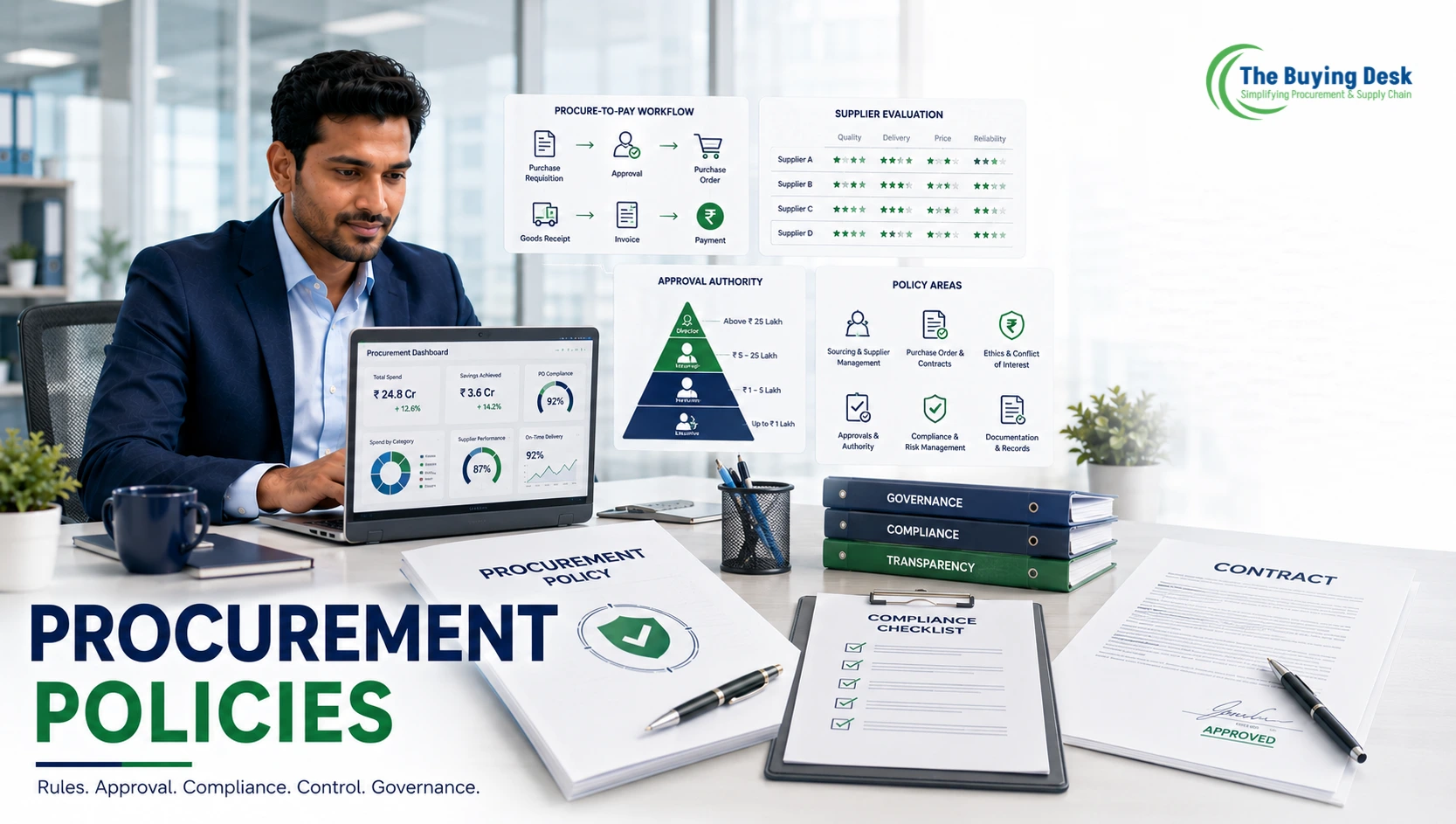
5. Procurement Approval Matrix
One of the most important components of procurement governance is the approval matrix.
It defines who can approve purchases at different values or risk levels.
For example:
Purchase Value
Typical Approval Level
Up to ₹25,000
Department Manager
₹25,001–₹1 lakh
Functional Head
₹1–₹5 lakh
Department Head / Management
₹5–₹25 lakh
Senior Management
Above ₹25 lakh
Executive / Authorized Management
These values are only an example.
Every organization should establish approval levels based on its own structure and risk.
6. Purchase Requisition Policy
A purchase requisition, or PR, is generally the formal request to purchase a good or service.
A procurement policy may require the PR to include:
Material/service description
Quantity
Specification
Required date
Cost center
Budget information
Technical documents
Justification where required
Approver
The objective is to ensure procurement understands exactly what the business needs.
7. Competitive Quotation Policy
Organizations often establish quotation requirements based on purchase value, category or risk.
For example:
Purchase Level
Possible Requirement
Low value
Single quotation / approved catalog
Medium value
Multiple quotations
High value
Formal RFQ/RFP
Strategic category
Structured sourcing process
The exact thresholds should be defined by the organization.
The important principle is:
The level of procurement control should be proportionate to the value and risk of the purchase.
8. Supplier Selection Policy
A procurement policy should establish how suppliers are selected.
Evaluation criteria may include:
Price
Quality
Delivery
Capacity
Technical capability
Financial stability
Experience
Certifications
Compliance
Service capability
Risk
Sustainability requirements
A supplier should not automatically be selected simply because it offers the lowest price.
9. RFQ and RFP Policy
RFQ
A Request for Quotation is generally used when the requirement is sufficiently defined and suppliers are being asked to provide commercial quotations.
RFP
A Request for Proposal is generally used when the organization wants suppliers to propose a solution, approach or service model in addition to commercial terms.
The policy should explain when each sourcing method is appropriate.
10. Technical and Commercial Evaluation
Procurement decisions often require both technical and commercial evaluation.
Technical Evaluation
May assess:
Specification compliance
Capability
Quality
Capacity
Technology
Experience
Commercial Evaluation
May assess:
Price
Payment terms
Delivery
Freight
Taxes
Warranty
Commercial conditions
A structured evaluation helps prevent decisions based purely on price.
11. Negotiation Policy
Procurement policies should establish who can negotiate and what can be negotiated.
Common negotiation areas include:
Price
Payment terms
Delivery
Warranty
Lead time
Minimum order quantity
Freight
Price escalation
Contract duration
Service levels
Negotiation authority should also be defined.
Not every employee should have unlimited authority to commit the organization commercially.
12. Purchase Order Policy
A procurement policy should establish when a purchase order is mandatory.
A typical principle is:
Goods or services should not be committed to a supplier without appropriate approval and an authorized purchase order, except where an approved exception applies.
The PO should clearly define:
Supplier
Item/service
Quantity
Price
Delivery date
Delivery location
Payment terms
Quality requirements
Applicable taxes
Other commercial conditions
13. No-PO / No-Pay Principle
Many organizations use a No PO, No Pay principle.
This means suppliers are expected to receive an authorized purchase order before supplying goods or services.
The objective is to reduce:
Unauthorized purchases
Invoice disputes
Price discrepancies
Budget leakage
Approval bypasses
However, organizations may define controlled exceptions for specific categories.
14. Contract Management
Some procurement activities require formal contracts rather than only purchase orders.
Contracts may be required for:
Long-term services
High-value purchases
Strategic suppliers
Consulting
Facility management
Transportation
IT services
Technology licensing
The policy should establish:
Contract approval
Authorized signatories
Contract review
Renewal
Expiry monitoring
Amendments
Termination
15. Emergency Procurement
Emergency procurement should be covered explicitly.
Examples include:
Production stoppage
Critical equipment failure
Safety requirement
Natural disaster
Unexpected supply disruption
The policy should define:
What qualifies as an emergency
Who can approve it
Documentation required
Supplier selection approach
Post-purchase review
Emergency procurement should not become a routine shortcut.
16. Single-Source Procurement
Single-source procurement should be controlled because it reduces competitive pressure.
Possible legitimate reasons include:
Proprietary technology
Compatibility requirements
Existing qualified tooling
Unique technical capability
Customer-mandated supplier
Genuine lack of alternatives
The policy may require a single-source justification.
The justification should explain:
Why competition is not practical
Why the supplier is suitable
What alternatives were considered
What commercial controls will be applied
17. Conflict of Interest
Procurement policies should clearly address conflicts of interest.
A conflict may arise when an employee has a personal relationship or financial interest connected to a supplier.
Employees should generally be required to disclose relevant conflicts and avoid influencing decisions where an actual conflict exists.
This protects both the employee and the organization.
18. Gifts and Hospitality
Supplier gifts and hospitality can create perceived or actual conflicts.
The policy should clearly define:
What is prohibited
What must be declared
Monetary limits, if applicable
Approval requirements
Special rules during supplier selection or negotiation
The safest approach is to ensure procurement decisions remain independent and commercially objective.
19. Ethical Procurement
Procurement teams should operate with professional integrity.
A procurement policy may address:
Bribery
Kickbacks
Fraud
Misrepresentation
Confidential information
Supplier favoritism
Unauthorized commitments
Improper influence
Ethical requirements should apply not only to procurement employees but also to relevant stakeholders involved in purchasing decisions.
20. Supplier Confidentiality
Supplier quotations and commercial information should be handled carefully.
For example, procurement employees should not improperly disclose:
Supplier A’s quotation to Supplier B to force Supplier B to reduce its price.
Competitive sourcing must remain fair and professionally managed.
Confidential commercial information should be protected according to organizational requirements.
21. Procurement Documentation
A good policy should specify what records need to be maintained.
Typical records include:
Purchase requisition
RFQ/RFP
Supplier quotations
Technical evaluation
Commercial comparison
Negotiation records
Approval
Purchase order
Contract
Delivery documentation
Inspection records
Invoice
Payment records
Supplier performance records
Good documentation creates traceability.
22. Supplier Onboarding
Before a supplier becomes active, the organization may require:
Supplier registration
Company information
Tax documentation
Banking information
Quality certifications
Technical information
Compliance declarations
Financial information
NDA where required
The exact requirements should depend on supplier category and risk.
23. Supplier Performance Management
A procurement policy should establish expectations for supplier performance monitoring.
Typical indicators include:
On-time delivery
Quality
Responsiveness
Cost performance
Documentation
Corrective action closure
Capacity
Service performance
This connects procurement policy with supplier management.
24. Procurement Compliance
Compliance means following the organization’s established procurement rules.
Common compliance checks include:
Was the purchase approved?
Was the correct sourcing method used?
Were required quotations obtained?
Was supplier selection documented?
Was the PO issued correctly?
Were approval limits respected?
Was the contract authorized?
Were exceptions properly documented?
Compliance should be monitored periodically.
25. Exceptions to Procurement Policy
No procurement policy can predict every business situation.
Therefore, a policy should explain how exceptions are handled.
An exception process may require:
Reason for exception
Business justification
Risk assessment
Authorized approval
Documentation
Post-event review where appropriate
This is much better than allowing informal policy bypasses.
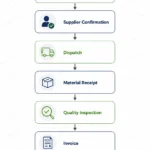
Procurement Policy Approval Workflow
A practical governance structure may look like this:
Business Requirement
↓
Purchase Requisition
↓
Budget / Need Confirmation
↓
Procurement Review
↓
Sourcing Method Determination
↓
Supplier Sourcing
↓
Technical Evaluation
↓
Commercial Evaluation
↓
Negotiation
↓
Approval
↓
Purchase Order / Contract
↓
Delivery
↓
Invoice / Payment
↓
Supplier Performance
This provides control without unnecessarily slowing down procurement.
Procurement Policy and Segregation of Duties
One of the most important internal controls is segregation of duties.
The same person should not necessarily control the entire purchasing process from beginning to end.
For example:
Activity
Responsible Function
Requirement
User Department
Supplier Sourcing
Procurement
Technical Approval
Engineering / Quality
Commercial Approval
Procurement / Management
Purchase Approval
Authorized Approver
PO Creation
Procurement
Goods Receipt
Stores / User
Invoice Processing
Finance
Payment
Finance
The exact structure varies by organization.
The principle is to reduce the risk of unauthorized or inappropriate transactions.
Procurement Policy and the Three-Way Match
A common financial control is the three-way match.
The three documents are:
Purchase Order
Goods Receipt
Supplier Invoice
The organization compares these records before payment.
For example:
PO:
1,000 pieces at ₹100 each
Goods Receipt:
1,000 pieces received
Invoice:
1,000 pieces × ₹100
If the records match according to the organization’s tolerance rules, the invoice can proceed through the payment process.
This helps reduce invoice discrepancies.
Procurement Policy for Different Procurement Types
The policy should not necessarily apply identical controls to every category.
For example:
Direct Strategic Procurement
May require:
Detailed supplier qualification
Technical evaluation
Quality approval
Commercial negotiation
Contract
Supplier performance monitoring
Indirect Routine Procurement
May use:
Approved catalog
Framework agreement
Simplified quotation process
Emergency Procurement
May use:
Accelerated approval
Exception documentation
Post-event review
This is an important principle:
Good procurement governance is risk-based, not simply bureaucracy-based.
Common Procurement Policy Mistakes
1. Making the Policy Too Complicated
If employees cannot understand it, compliance will suffer.
2. Creating Rules Without Exceptions
Real business situations require controlled flexibility.
3. Using the Same Controls for Every Purchase
A ₹5,000 routine purchase and a ₹5 crore strategic contract should not necessarily have identical controls.
4. Not Defining Approval Authority
Ambiguous authority creates delays and risk.
5. Ignoring Emergency Procurement
Emergency situations will happen. The policy should explain how to handle them.
6. Focusing Only on Price
Procurement governance should cover quality, delivery, risk, compliance and value.
7. Not Updating the Policy
Business structures, systems, regulations and procurement practices change.
Policies should therefore be reviewed periodically.
How Often Should a Procurement Policy Be Reviewed?
There is no universal review frequency.
Many organizations establish an annual review or review the policy whenever there is a significant:
Organizational change
Process change
ERP/system change
Regulatory change
Risk event
Audit finding
Delegation-of-authority change
The important point is that the policy should remain relevant.
An outdated procurement policy can become an obstacle rather than a control.
How to Make Procurement Policies More Effective
1. Keep the Policy Clear
Use simple language.
2. Separate Policy From Procedure
Keep high-level rules in the policy and operational instructions in procedures/SOPs.
3. Define Ownership
Every important control should have an accountable owner.
4. Use Approval Matrices
Employees should know exactly who can approve what.
5. Digitize Where Possible
ERP and procurement systems can automate:
Approvals
Purchase orders
Supplier records
Workflow
Audit trails
Spend reporting
6. Train Employees
A policy is useful only when people understand it.
7. Monitor Compliance
Use audits and KPIs to identify recurring issues.
Procurement Policy KPIs
Organizations can monitor procurement policy effectiveness through metrics such as:
PO Compliance
Percentage of purchases made through approved purchase orders.
Competitive Sourcing Compliance
Percentage of applicable purchases following the required sourcing process.
Approval Compliance
Percentage of purchases receiving appropriate approval before commitment.
Exception Rate
Percentage of purchases processed through exceptions.
Supplier Onboarding Compliance
Percentage of active suppliers completing required qualification.
Contract Compliance
Percentage of spend covered by approved contracts where applicable.
These metrics can later connect directly to the Procurement KPIs article in this series.
Practical Example: Procurement Policy in a Manufacturing Company
Consider a manufacturing company purchasing a critical component.
Step 1 — Requirement
Engineering defines the specification.
Step 2 — Purchase Requisition
Production raises the requirement.
Step 3 — Supplier Sourcing
Procurement identifies qualified suppliers.
Step 4 — RFQ
Commercial quotations are requested.
Step 5 — Technical Evaluation
Engineering and Quality evaluate technical suitability.
Step 6 — Commercial Evaluation
Procurement compares:
Price
Payment terms
Delivery
Freight
Warranty
Other commercial conditions
Step 7 — Negotiation
Procurement negotiates with shortlisted suppliers.
Step 8 — Approval
The purchase is approved according to the authority matrix.
Step 9 — Purchase Order
Procurement issues the PO.
Step 10 — Delivery
Supplier delivers the material.
Step 11 — Inspection
Quality/stores complete the required checks.
Step 12 — Invoice
Finance processes the invoice according to applicable controls.
Step 13 — Supplier Performance
Delivery and quality performance are recorded.
The procurement policy provides the governance framework around this entire process.
Procurement Policy Checklist
Before publishing or reviewing a procurement policy, ask:
Governance
Is the purpose clearly defined?
Is the scope clear?
Are roles defined?
Is ownership assigned?
Sourcing
Are quotation requirements defined?
Are RFQ/RFP rules clear?
Is supplier selection documented?
Are single-source purchases controlled?
Approval
Is an approval matrix available?
Are financial limits clear?
Are exceptions controlled?
Purchasing
Are PR requirements defined?
Is the PO process clear?
Are unauthorized purchases addressed?
Suppliers
Is supplier onboarding defined?
Are supplier performance requirements included?
Are conflicts of interest addressed?
Compliance
Are records retained?
Are audits possible?
Is segregation of duties considered?
Is compliance monitored?
Improvement
Is the policy reviewed periodically?
Are audit findings incorporated?
Are employees trained?
Key Takeaways
A procurement policy is more than a list of purchasing rules.
It is a governance framework that helps an organization control spending, manage risk, ensure accountability and create consistent procurement practices.
A strong procurement policy should clearly establish:
What procurement rules apply
Who is responsible
Who can approve purchases
How suppliers are selected
When competition is required
How exceptions are handled
How purchase orders and contracts are controlled
How supplier relationships are managed
What records must be maintained
How compliance is monitored
The most effective procurement policies are not necessarily the longest.
Ultimately, procurement governance should not exist simply to create paperwork.
It should help the organization make better purchasing decisions while protecting the business from unnecessary cost, risk and compliance problems.
Frequently Asked Questions
What is a procurement policy?
A procurement policy is a formal set of rules and principles governing how an organization purchases goods and services.
What is the purpose of a procurement policy?
Its purpose is to establish consistent purchasing practices, control spending, define authority, improve transparency and manage procurement risks.
What is the difference between procurement policy and procurement procedure?
A policy explains what rules and principles must be followed, while a procedure explains how those rules are implemented step by step.
What should a procurement policy include?
It commonly includes scope, responsibilities, approval levels, supplier selection, quotation requirements, purchase orders, contracts, exceptions, ethical requirements, documentation and compliance.
Why is an approval matrix important?
An approval matrix defines who has authority to approve purchases at different values or risk levels.
What is No PO, No Pay?
It is a procurement control under which suppliers generally need an authorized purchase order before supplying goods or services for payment.
Should emergency purchases be included in a procurement policy?
Yes. The policy should define what qualifies as an emergency and establish appropriate approval and documentation requirements.
What is a single-source procurement policy?
It defines when an organization may purchase from one supplier without normal competitive sourcing and what justification and approval are required.
How can procurement policies reduce fraud risk?
Clear approvals, segregation of duties, supplier controls, documentation, competitive sourcing and audit trails can reduce opportunities for unauthorized or inappropriate purchasing activity.
How often should a procurement policy be reviewed?
Organizations commonly establish periodic reviews, often annually, and should also review the policy after major organizational, system, regulatory or risk changes.
Join Free
💬
Join Our WhatsApp Channel
Get practical procurement & supply chain insights directly on WhatsApp.