Finding a supplier is relatively easy.
Finding a supplier that is capable, reliable, compliant and suitable for long-term business is much more difficult.
A supplier may offer an attractive price, but can the supplier consistently meet your quality requirements?
Does it have sufficient production capacity?
Can it support your required volumes?
Are its processes stable?
Does it have the required certifications?
Is its financial and operational position strong enough?
These questions are addressed through supplier qualification.
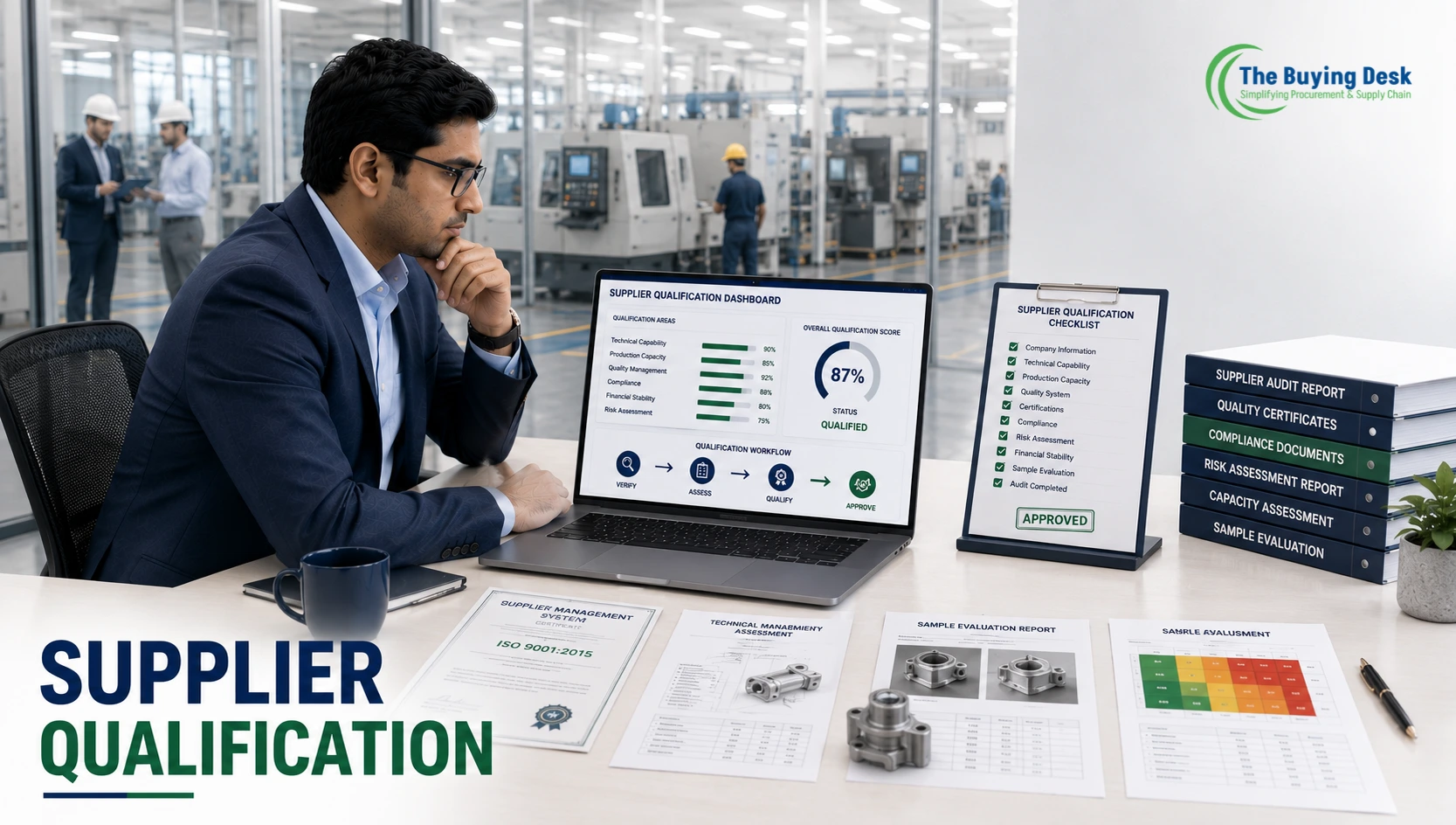
Supplier qualification is the structured process of determining whether a supplier has the capability, capacity, quality systems, commercial strength and compliance required to become an approved supplier.
For procurement teams, supplier qualification is an important risk-control activity because selecting an unsuitable supplier can create problems long after the purchase order is issued.
This article explains the complete supplier qualification process, key qualification criteria, supplier pre-qualification, audits, documentation, approval methods and a practical supplier qualification checklist.
Supplier qualification is the process of assessing whether a potential supplier meets an organization’s predefined requirements before the supplier is approved for business.
The qualification process normally evaluates areas such as:
The objective is simple:
Determine whether the supplier is capable of reliably meeting the organization’s requirements before significant business is committed.
Supplier qualification is therefore more comprehensive than simply comparing quotations.
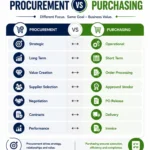
These two activities are often confused.
Supplier Qualification asks:
Can this supplier meet our requirements?
Supplier Selection asks:
Which qualified supplier should we choose?
For example, imagine that procurement identifies five potential suppliers.
After qualification:
Procurement can then conduct commercial and strategic evaluation among the qualified suppliers.
A typical sequence is:
Supplier Identification → Pre-Qualification → Qualification → Supplier Selection → Approval → Onboarding → Performance Evaluation
Supplier qualification reduces the probability of selecting a supplier that cannot meet business requirements.
It can help organizations reduce:
For critical materials, supplier qualification can be especially important because supplier failure may directly affect production or customer deliveries.
Not every supplier requires the same level of qualification.
Qualification may be required when:
The level of qualification should be proportional to supplier and category risk.
Before conducting a detailed qualification, procurement can use a supplier pre-qualification stage.
The objective is to quickly determine whether the supplier is worth evaluating further.
A pre-qualification questionnaire may ask about:
This helps procurement eliminate clearly unsuitable suppliers before investing significant resources.
A practical supplier qualification process can follow these stages:
1. Define Requirements
2. Identify Potential Suppliers
3. Conduct Pre-Qualification
4. Review Supplier Documentation
5. Assess Technical Capability
6. Assess Manufacturing Capacity
7. Evaluate Quality Systems
8. Assess Financial & Business Risk
9. Conduct Supplier Audit
10. Conduct Trial / Sample Evaluation
11. Final Qualification Decision
12. Supplier Approval & Onboarding
13. Periodic Requalification
Let’s examine each stage.
Before evaluating a supplier, procurement should define what “qualified” means.
Requirements may include:
Clearly defined requirements make the qualification process more objective.
Potential suppliers can be identified through:
At this stage, procurement should focus on building a suitable supplier pool rather than immediately selecting the cheapest supplier.
Use a structured questionnaire to collect basic information.
For example:
| Area | Example Question |
|---|---|
| Company | How long has the company operated? |
| Capacity | What is the annual production capacity? |
| Quality | Which certifications are available? |
| Customers | Which relevant industries are served? |
| Technology | What manufacturing technology is available? |
| Finance | Is the business financially stable? |
| Compliance | Are required legal and regulatory requirements met? |
| Supply Chain | What is the typical lead time? |
| Risk | Are there critical sub-suppliers? |
Suppliers that fail mandatory requirements can be removed from further consideration.
Documentation provides evidence supporting the supplier’s claims.
Possible documents include:
Documents should be verified rather than simply collected.
Technical capability is especially important for engineered products and manufacturing suppliers.
Assess:
The supplier should demonstrate that it can manufacture the required product consistently rather than simply producing a successful prototype.
Capacity is one of the most frequently overlooked qualification criteria.
A supplier may have excellent technology but insufficient capacity.
Evaluate:
For example:
Required monthly demand = 50,000 pieces
Supplier capacity = 60,000 pieces/month
Current utilization = 85%
The supplier may technically have capacity, but the available buffer is limited.
Procurement should therefore evaluate both nominal capacity and practical available capacity.
Quality qualification should determine whether the supplier has a reliable system for preventing and detecting defects.
Evaluate:
Depending on the industry, relevant certifications may also be required.
Certification alone, however, should not automatically mean that the supplier has strong operational quality.
The actual effectiveness of the quality system should also be assessed.
Financial stability can influence supply continuity.
Possible indicators include:
Procurement does not necessarily need to become a financial analyst.
However, for critical suppliers, basic financial risk assessment can prevent significant future problems.
For high-risk or strategic suppliers, an on-site or remote supplier audit may be appropriate.
An audit can examine:
The audit should generate documented findings and actions.
Before full approval, the supplier may need to provide:
The trial should verify that the supplier can convert capability claims into actual product performance.
For manufacturing suppliers, this stage can involve:
Drawing → Sample → Inspection → Testing → Approval
For services, it may involve a pilot project or trial assignment.
The supplier can be classified using a structured decision model.
For example:
Supplier meets all mandatory requirements.
Supplier meets most requirements but specific actions must be completed.
Supplier fails one or more mandatory requirements.
Supplier has strategic potential but requires improvement before full approval.
The decision should be documented.
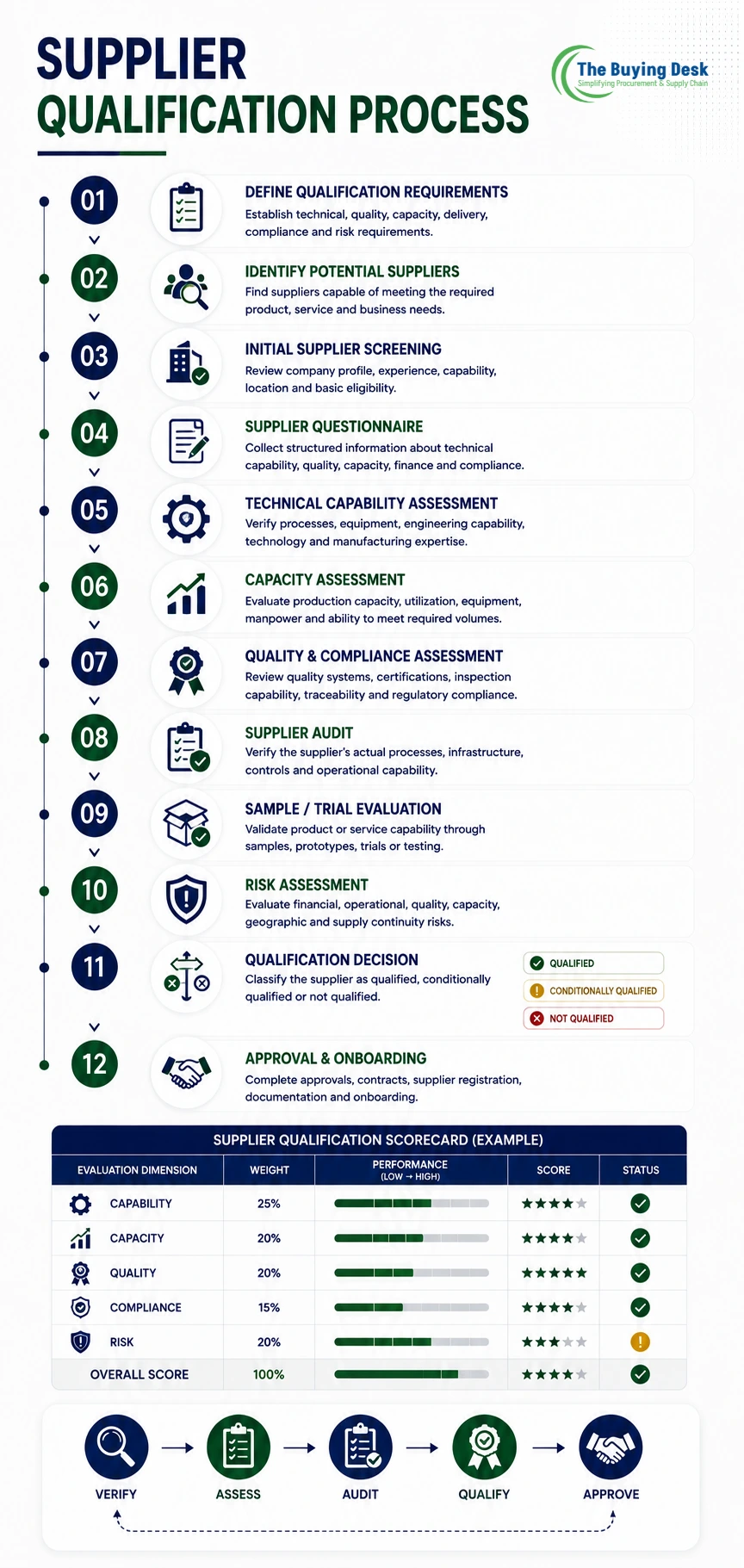
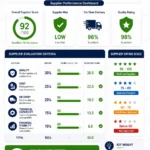
A weighted scorecard can improve consistency.
Example:
| Qualification Area | Weight |
|---|---|
| Quality System | 20% |
| Technical Capability | 15% |
| Capacity | 15% |
| Delivery Capability | 10% |
| Commercial Capability | 10% |
| Financial Stability | 10% |
| Compliance | 10% |
| Risk Management | 5% |
| Continuous Improvement | 5% |
| Total | 100% |
The weights should be adjusted based on supplier category and risk.
A simple 1–5 scoring system can be used:
| Score | Meaning |
|---|---|
| 5 | Excellent |
| 4 | Good |
| 3 | Acceptable |
| 2 | Weak |
| 1 | Unacceptable |
However, mandatory criteria should not always be overridden by the total score.
For example, if a critical certification is mandatory and the supplier does not have it, a high overall score should not automatically qualify the supplier.
This is an important distinction between weighted scoring and mandatory qualification requirements.
Supplier qualification should ideally use two levels.
The supplier must satisfy these requirements.
Examples:
These criteria influence the overall score.
Examples:
This approach prevents an excellent commercial score from compensating for a critical compliance failure.
A practical qualification checklist can include:
An audit scorecard can provide another layer of assessment.
For example:
| Area | Score |
|---|---|
| Quality System | 92% |
| Manufacturing | 88% |
| Capacity | 90% |
| Warehouse | 85% |
| Maintenance | 82% |
| Supplier Management | 87% |
| Documentation | 95% |
| Overall | 88% |
The score should be supported by actual audit evidence.
These activities are related but not identical.
Supplier Qualification is the broader decision process used to determine whether a supplier should be approved.
Supplier Audit is one method used to verify supplier capability and systems.
Therefore:
Supplier Audit ⊂ Supplier Qualification
An organization may qualify a supplier using:
An audit is only one component of the overall qualification process.
For critical components, qualification should be more rigorous.
Consider increasing the depth of:
The higher the potential business impact of supplier failure, the stronger the qualification process should be.
Supplier qualification should not necessarily be permanent.
Requalification may be required when:
A risk-based requalification approach is generally more practical than automatically requalifying every supplier at the same frequency.
After qualification, the supplier needs to be formally onboarded.
Supplier onboarding may include:
The qualification decision and onboarding process should be connected.
A supplier should not be able to receive normal purchasing activity before required approvals are completed.
Sometimes procurement starts with the preferred supplier and then performs qualification as a formality.
This defeats the purpose of qualification.
A low price cannot compensate for unacceptable quality, capacity or supply risk.
Supplier questionnaires are useful, but important claims should be verified through documentation, audits, samples or other evidence.
A supplier may have excellent performance with current customers but insufficient capacity for your requirements.
A certification demonstrates compliance with a particular standard or requirement. It does not automatically prove strong day-to-day performance.
Critical raw materials or processes may depend on another supplier.
Sub-supplier dependency should be considered where relevant.
Supplier conditions can change significantly after initial approval.
If the qualification decision is not documented, future procurement teams may not understand why the supplier was approved.
A mature supplier qualification system should:
Not every supplier needs the same qualification depth.
A practical model can be:
Basic documentation + commercial review.
Documentation + capability review + quality assessment + sample evaluation.
Detailed documentation + technical assessment + quality audit + capacity review + risk assessment + trial production.
Full qualification + on-site audit + process validation + business continuity assessment + periodic requalification.
This approach allows procurement teams to focus resources where supplier failure would have the greatest impact.
Imagine a manufacturing company is looking for a supplier for a critical machined component.
Three suppliers are identified.
A price-only evaluation might select Supplier C.
A qualification-based evaluation would identify that Supplier C does not meet mandatory requirements.
Supplier B may therefore become the strongest candidate despite not offering the lowest initial price.
This demonstrates an important procurement principle:
Supplier qualification protects the business from choosing an apparently attractive supplier that cannot reliably support the requirement.
A standard supplier qualification file may contain:
Maintaining these records creates an auditable supplier approval trail.
Supplier qualification should be integrated with procurement governance.
A clear governance model can define:
Procurement
Supplier identification, commercial assessment and coordination.
Quality
Quality-system evaluation, audits and product approval.
Engineering
Technical capability and specification evaluation.
Finance
Financial and commercial risk assessment.
Legal / Compliance
Contracts, regulatory and compliance requirements.
Management
Approval of strategic or high-risk suppliers.
This cross-functional approach reduces the risk of procurement approving a supplier based only on price and commercial considerations.
What is supplier qualification?
Supplier qualification is the process of determining whether a supplier has the required technical, quality, capacity, commercial and compliance capabilities to become an approved supplier.
What is supplier pre-qualification?
Supplier pre-qualification is an initial screening process used to identify suppliers that meet basic requirements before detailed qualification.
What are the main supplier qualification criteria?
Common criteria include quality, technical capability, capacity, delivery, financial stability, compliance, risk, infrastructure and commercial capability.
Is supplier qualification the same as supplier selection?
No. Qualification determines whether a supplier is capable of meeting requirements. Selection determines which qualified supplier should be chosen.
Is a supplier audit mandatory?
Not for every supplier. Audit depth should depend on supplier criticality and risk.
How often should suppliers be requalified?
There is no universal frequency. Critical suppliers may require periodic formal requalification, while lower-risk suppliers may only require requalification after significant changes or risk events.
Can the lowest-cost supplier be selected after qualification?
Yes, if multiple suppliers are qualified and the lowest-cost supplier also meets the organization’s quality, delivery, capability, risk and compliance requirements.
What is the difference between supplier qualification and supplier evaluation?
Supplier qualification generally determines whether a supplier is suitable for approval, while supplier evaluation measures the supplier’s ongoing performance after approval.
Supplier qualification is one of the most important controls in professional procurement.
It ensures that a supplier is not approved simply because it offers an attractive price.
A robust qualification process evaluates:
Capability → Capacity → Quality → Delivery → Compliance → Risk → Commercial Suitability
The strongest procurement organizations use a risk-based qualification model and combine supplier documentation, technical assessment, quality evaluation, audits, samples and business-risk analysis.
The ultimate objective is not to find a supplier that can provide the lowest price.
It is to find a supplier that can reliably deliver the required value over the life of the business relationship.