Supplier relationships can have a major impact on procurement performance.
A supplier may offer a competitive price, but that alone does not guarantee reliable delivery, consistent quality, quick response or long-term business value.
This is why modern procurement teams focus not only on selecting suppliers, but also on managing and developing supplier relationships.
This discipline is known as Supplier Relationship Management (SRM).
Supplier Relationship Management is a structured approach to managing interactions with suppliers throughout the business relationship to improve performance, reduce risk, create value and support long-term business objectives.
For procurement professionals, SRM moves supplier management from a transactional approach to a more strategic and collaborative model.
Supplier Relationship Management (SRM) is the systematic process of segmenting, managing, monitoring, developing and collaborating with suppliers to maximize business value.
It covers activities such as:
The objective is not to treat every supplier in exactly the same way.
A supplier providing a critical production component may require significantly more attention than a supplier providing routine office stationery.
Therefore, effective SRM starts with understanding the importance, risk and strategic value of each supplier.
Procurement traditionally focused heavily on price, purchase orders and delivery follow-up.
Modern procurement has a broader responsibility.
Suppliers can influence:
A weak supplier relationship can create recurring problems.
A strong supplier relationship can help procurement teams solve problems faster, improve processes and identify opportunities before they become major issues.
1. Better Supplier Performance
Regular monitoring and communication help suppliers understand expectations and performance gaps.
2. Improved Quality
Structured collaboration can help identify root causes and implement permanent corrective actions.
3. Better Delivery Reliability
Regular performance reviews help identify capacity and planning issues before they affect production.
4. Reduced Supply Risk
Strong supplier relationships improve visibility into financial, operational and capacity-related risks.
5. Cost Improvement
Collaboration can identify opportunities for process improvement, waste reduction, productivity improvement and total-cost reduction.
6. Faster Problem Resolution
When communication channels are established, critical issues can be escalated and resolved faster.
7. Supplier Innovation
Strategic suppliers can contribute new technologies, materials, processes and ideas.
8. Long-Term Business Value
The relationship can move beyond price negotiations toward mutual improvement and business growth.
These terms are often used interchangeably, but there is an important distinction.
Supplier Management generally focuses on managing supplier performance and commercial activities.
Supplier Relationship Management goes further by considering the strategic relationship between the organization and supplier.
| Supplier Management | Supplier Relationship Management |
|---|---|
| Supplier performance | Supplier performance + relationship |
| Delivery monitoring | Collaboration and long-term planning |
| Quality monitoring | Joint quality improvement |
| Purchase orders | Strategic commercial relationship |
| Corrective actions | Joint problem solving |
| Supplier compliance | Trust, governance and collaboration |
| Transaction focused | Value focused |
In practice, both disciplines overlap.
SRM can be viewed as the broader strategic framework within which supplier management activities operate.
A structured SRM process can typically be divided into the following stages.
Not every supplier requires the same level of relationship management.
Start by identifying suppliers that are important because of:
These suppliers generally require stronger engagement.
Classify suppliers according to their strategic importance and risk.
A practical segmentation may include:
Strategic Suppliers
High business impact and high strategic importance.
Critical Suppliers
High supply or operational risk.
Leverage Suppliers
Significant spend with multiple available alternatives.
Routine Suppliers
Low-value or standardized purchases that require limited relationship management.
Supplier segmentation helps procurement allocate resources where they create the greatest value.
Different suppliers require different relationship strategies.
For example:
Strategic supplier:
Joint planning, executive reviews and long-term collaboration.
Critical supplier:
Strong risk monitoring, contingency planning and frequent performance reviews.
Leverage supplier:
Competitive sourcing and commercial optimization.
Routine supplier:
Automation, standard processes and limited management effort.
Supplier relationships become difficult when expectations are unclear.
Define expectations for:
Where appropriate, these expectations should be documented through contracts, purchase orders, SLAs or supplier agreements.
Supplier performance should be measured using agreed KPIs.
Typical indicators include:
Performance measurement creates an objective basis for supplier discussions.
Strategic suppliers should be reviewed periodically.
A supplier business review can cover:
Performance
What is working and what is not?
Problems
What issues have occurred?
Root Causes
Why did they occur?
Actions
What needs to change?
Future Requirements
What will the business need in the coming months?
Opportunities
Where can both organizations create additional value?
The goal should not be to simply present a scorecard.
The goal is to create a productive discussion about improvement.
Supplier problems should be addressed through structured problem solving.
For example:
Problem → Data → Root Cause → Corrective Action → Verification → Closure
Avoid repeatedly asking a supplier to “improve” without identifying the actual cause.
A strong SRM process focuses on permanent solutions rather than repeated firefighting.
Some suppliers may have the right relationship and strategic importance but require capability improvement.
Procurement may work with suppliers on:
This connects SRM directly with Supplier Development.
Strategic suppliers can become an important source of innovation.
Procurement can collaborate with suppliers on:
This is one of the major differences between transactional purchasing and strategic procurement.
Supplier relationships must also be evaluated from a risk perspective.
Monitor risks such as:
A good relationship does not eliminate supplier risk.
Instead, it creates better visibility and improves the ability to manage that risk.
SRM should itself be measured.
Possible indicators include:
Supplier relationships should evolve with business requirements.
The relationship may move from:
Transaction → Performance → Collaboration → Development → Strategic Partnership
However, not every supplier needs to reach the partnership stage.
The objective is to establish the right level of relationship for the supplier’s business importance.
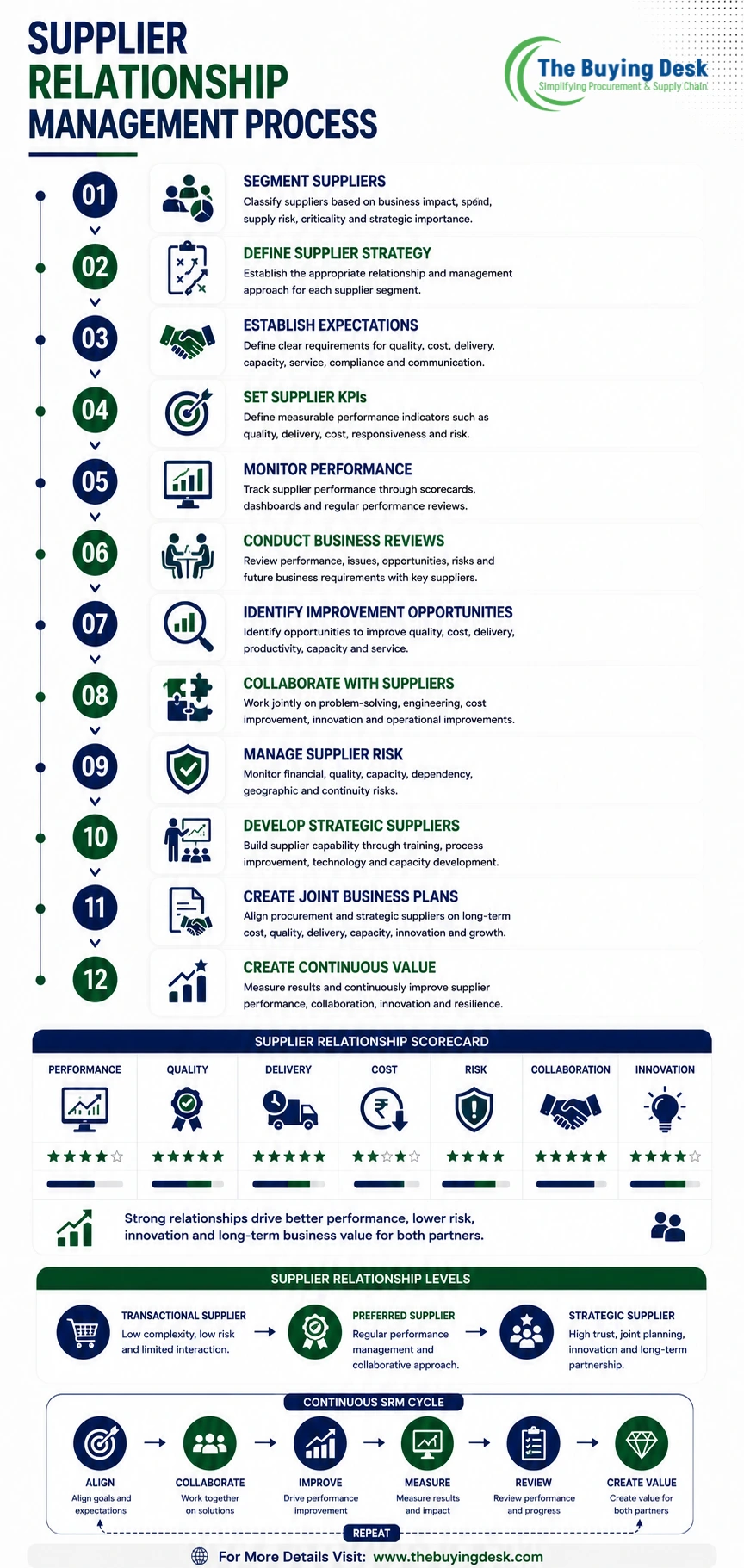
A simple SRM framework can be represented as:
SEGMENT → ALIGN → MEASURE → REVIEW → IMPROVE → COLLABORATE → INNOVATE
This creates a continuous supplier relationship cycle.
Determine the supplier’s strategic importance.
Align expectations, objectives and responsibilities.
Monitor supplier performance.
Discuss performance, risks and opportunities.
Address performance gaps.
Work together on strategic opportunities.
Use supplier capabilities to create additional business value.
Then the cycle starts again.
Consider a manufacturer that depends heavily on one supplier for a critical component.
The supplier has good pricing but has experienced repeated delivery delays.
A transactional procurement approach may simply issue warning emails or negotiate a penalty.
An SRM approach would investigate the broader problem.
The procurement team could:
The result is not simply better supplier communication.
It is a more resilient supply relationship.
SRM should not be the responsibility of procurement alone.
Depending on the organization, different functions may participate.
Procurement
Owns commercial relationship, sourcing strategy and supplier governance.
Quality
Manages quality performance, audits and corrective actions.
Engineering / Technical
Supports technical capability and product/process improvement.
Operations / Production
Provides production requirements and supplier performance feedback.
Finance
Supports financial analysis, payment and commercial governance.
Supply Chain / Planning
Manages demand, capacity and supply continuity.
Management
Provides strategic direction and executive-level escalation where required.
Cross-functional involvement is especially important for strategic suppliers.
A strategic supplier should not be managed in the same way as a low-value routine supplier.
Price is important, but total supplier value includes quality, delivery, risk, responsiveness and capability.
Supplier meetings become ineffective when discussions are based on opinions instead of performance data.
Supplier relationships work better when both sides understand expectations, constraints and business objectives.
Commercial penalties may sometimes be necessary, but excessive reliance on penalties can damage long-term collaboration.
Procurement cannot build a strong supplier relationship if internal departments send conflicting requirements.
A supplier meeting without action owners and deadlines rarely creates sustainable improvement.
Invest relationship-management resources according to supplier importance.
Measure quality, delivery, cost, responsiveness and risk using agreed data.
Create a structured review cadence for strategic and critical suppliers.
Define communication channels, escalation paths and responsibilities.
Solve recurring problems instead of repeatedly treating symptoms.
Better visibility can help suppliers plan capacity and materials.
Help strategically important suppliers improve capability where justified.
Create opportunities for suppliers to contribute ideas and technologies.
Strong relationships should never compromise procurement ethics, competition or controls.
Evaluate SRM based on measurable improvements rather than simply the number of supplier meetings.
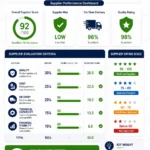
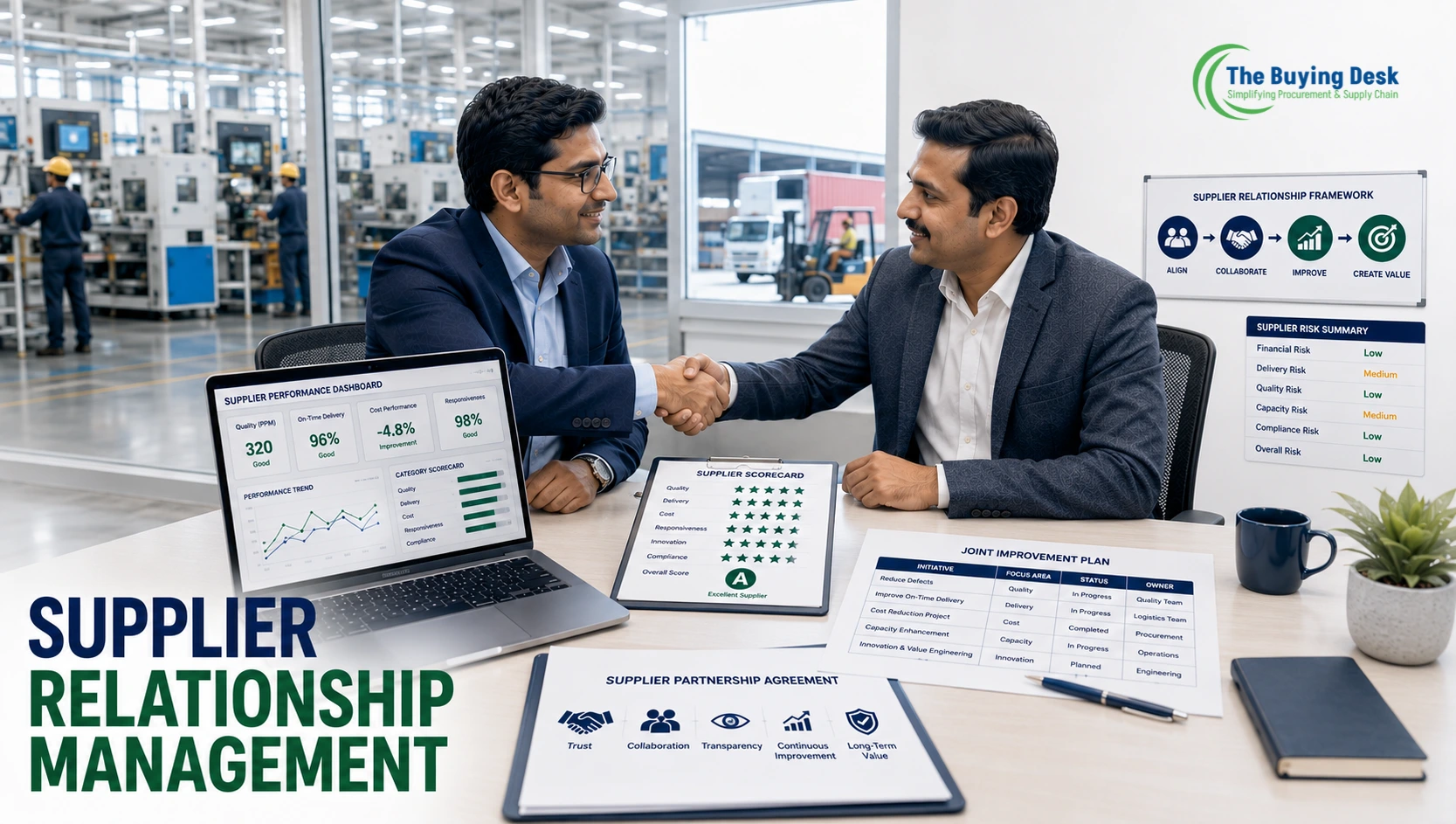
A practical SRM dashboard can include:
| KPI | What It Measures |
|---|---|
| On-Time Delivery | Supplier delivery reliability |
| Supplier PPM | Quality performance |
| Supplier Rejection Rate | Incoming quality |
| Corrective Action Closure | Responsiveness to problems |
| Cost Improvement | Commercial improvement |
| Lead Time | Supply responsiveness |
| Supplier Risk Score | Overall supplier risk |
| Contract Compliance | Adherence to agreed terms |
| Supplier Innovation | Value from supplier ideas |
| Supplier Review Completion | SRM governance |
| Stakeholder Satisfaction | Internal customer experience |
| Joint Improvement Projects | Collaboration effectiveness |
Digital procurement platforms can make SRM more effective by providing centralized supplier information.
A modern SRM system may connect:
Supplier Master Data → Contracts → Purchase Orders → Quality → Delivery → Performance → Risk → Improvement Actions
This gives procurement a more complete view of supplier performance.
Analytics can also help identify trends such as:
The objective is to move from reactive supplier management to proactive supplier management.
Supplier relationships are becoming increasingly important as supply chains become more interconnected.
Procurement teams are moving toward:
Artificial intelligence and analytics can further support procurement teams by identifying unusual supplier performance patterns and potential risks earlier.
However, technology does not replace the human side of supplier relationships.
Trust, communication, negotiation, transparency and collaboration remain fundamental.
Supplier Relationship Management is much more than maintaining good communication with suppliers.
It is a structured procurement discipline that connects:
Supplier Performance + Relationship + Risk + Development + Collaboration + Business Value
The most effective organizations understand that suppliers are not simply sources of products and services.
For strategically important categories, suppliers can become partners in improving quality, cost, delivery, innovation and supply chain resilience.
The objective of SRM is therefore not to build the strongest relationship with every supplier.
It is to build the right relationship with the right supplier at the right level of engagement.
A mature SRM approach can transform supplier management from a reactive activity into a strategic source of business value.
Supplier Relationship Management = Segment + Align + Measure + Review + Improve + Collaborate + Innovate
Strong supplier relationships are built through consistent performance, clear expectations, structured reviews and mutual value creation.
What is Supplier Relationship Management?
Supplier Relationship Management is a structured approach to managing, developing and improving supplier relationships to achieve better performance, reduce risk and create long-term business value.
What is the difference between supplier management and SRM?
Supplier management generally covers the broader operational management of suppliers, while SRM focuses more strongly on strategic relationships, collaboration, supplier development and long-term value creation.
What are the main components of SRM?
Major components include supplier segmentation, performance management, supplier reviews, collaboration, risk management, supplier development, innovation and continuous improvement.
Which suppliers need SRM?
Strategic and critical suppliers usually require the greatest level of SRM attention. Transactional suppliers can generally be managed through simpler operational processes.
What KPIs are used in SRM?
Common KPIs include on-time delivery, quality, PPM, cost performance, responsiveness, corrective-action closure, risk, innovation and improvement-project performance.
How does SRM reduce supplier risk?
SRM provides greater visibility into supplier performance, capacity, financial condition, dependency and operational risks, allowing procurement to identify and mitigate issues earlier.
Is SRM only the responsibility of procurement?
No. Strategic supplier relationships often require collaboration between procurement, quality, engineering, operations, finance, logistics and senior management.