A supplier may offer a competitive price, but that alone does not make the supplier successful.
Procurement performance depends on what happens after the supplier is selected. Does the supplier deliver on time? Does the material meet quality requirements? Are costs competitive? Does the supplier respond quickly to problems? Can the supplier support increasing demand? Does the supplier continuously improve?
This is where Supplier Performance Management becomes important.
Supplier Performance Management is the structured process of measuring, reviewing and improving supplier performance against agreed expectations and business requirements.
Instead of managing suppliers only when problems occur, procurement teams use defined KPIs, supplier scorecards, performance reviews and corrective actions to create a consistent performance-management system.
A strong supplier performance management process helps organizations improve:
Quality + Cost + Delivery + Responsiveness + Capacity + Risk + Continuous Improvement
In this article, we will understand what supplier performance management is, why it matters, the complete process, important KPIs, supplier scorecards, review methods, common mistakes and best practices.
Supplier Performance Management (SPM) is the systematic process of measuring, analyzing, reviewing and improving supplier performance against predefined business requirements and KPIs.
The objective is not simply to identify poor suppliers.
The real objective is to:
For example, if a supplier has an agreed on-time delivery target of 98% but is consistently achieving only 88%, procurement should not simply record the poor performance.
The organization should determine:
What is causing the gap? → How serious is it? → Who owns the corrective action? → What is the target date? → Has the improvement been sustained?
That is the difference between supplier monitoring and supplier performance management.
Suppliers directly influence manufacturing, service delivery, customer satisfaction and business continuity.
A supplier with poor performance can create:
Supplier performance management provides procurement with a structured way to prevent these problems from becoming recurring business issues.
Quality KPIs help procurement identify suppliers with recurring defects, rejections or process problems.
Monitoring on-time delivery helps identify suppliers that consistently miss agreed delivery dates.
Supplier performance is not limited to purchase price.
Poor quality, delays, emergency transportation and additional inspection can increase the actual cost of working with a supplier.
Performance data provides the foundation for supplier improvement programs.
Performance trends can reveal early warning signs such as declining quality, capacity constraints or deteriorating delivery performance.
Regular performance discussions create transparency between procurement and suppliers.
Supplier performance data can support decisions related to:
These two concepts are related but different.
Supplier Evaluation generally assesses a supplier at a particular point in time or during a defined assessment.
Supplier Performance Management is an ongoing process.
For example:
Supplier Evaluation:
“Is this supplier capable of meeting our requirements?”
Supplier Performance Management:
“How well is this supplier performing against our requirements over time, and what should we do about the results?”
Therefore:
Evaluation = Assessment
Performance Management = Continuous Measurement + Action + Improvement
A practical supplier performance management process can be structured into twelve steps.
Start by defining what good supplier performance means.
Typical expectations include:
Expectations should be measurable wherever possible.
Not every supplier needs exactly the same KPIs.
A critical raw-material supplier may require detailed quality, delivery, capacity and risk KPIs.
A low-value office-supply vendor may require a much simpler measurement system.
KPIs should therefore reflect supplier importance and business impact.
Each KPI should have a clearly defined target.
Examples:
On-Time Delivery: ≥ 98%
PPM: ≤ 500
PO Confirmation: Within 24 hours
Corrective Action Closure: Within agreed timeline
The exact target should depend on the organization’s requirements and supplier agreement.
Performance data can come from:
Data quality is critical.
Poor data can produce misleading supplier rankings.
Convert raw operational data into meaningful performance indicators.
For example:
On-Time Delivery %
= On-Time Deliveries ÷ Total Deliveries × 100
Similarly, quality performance can be measured through:
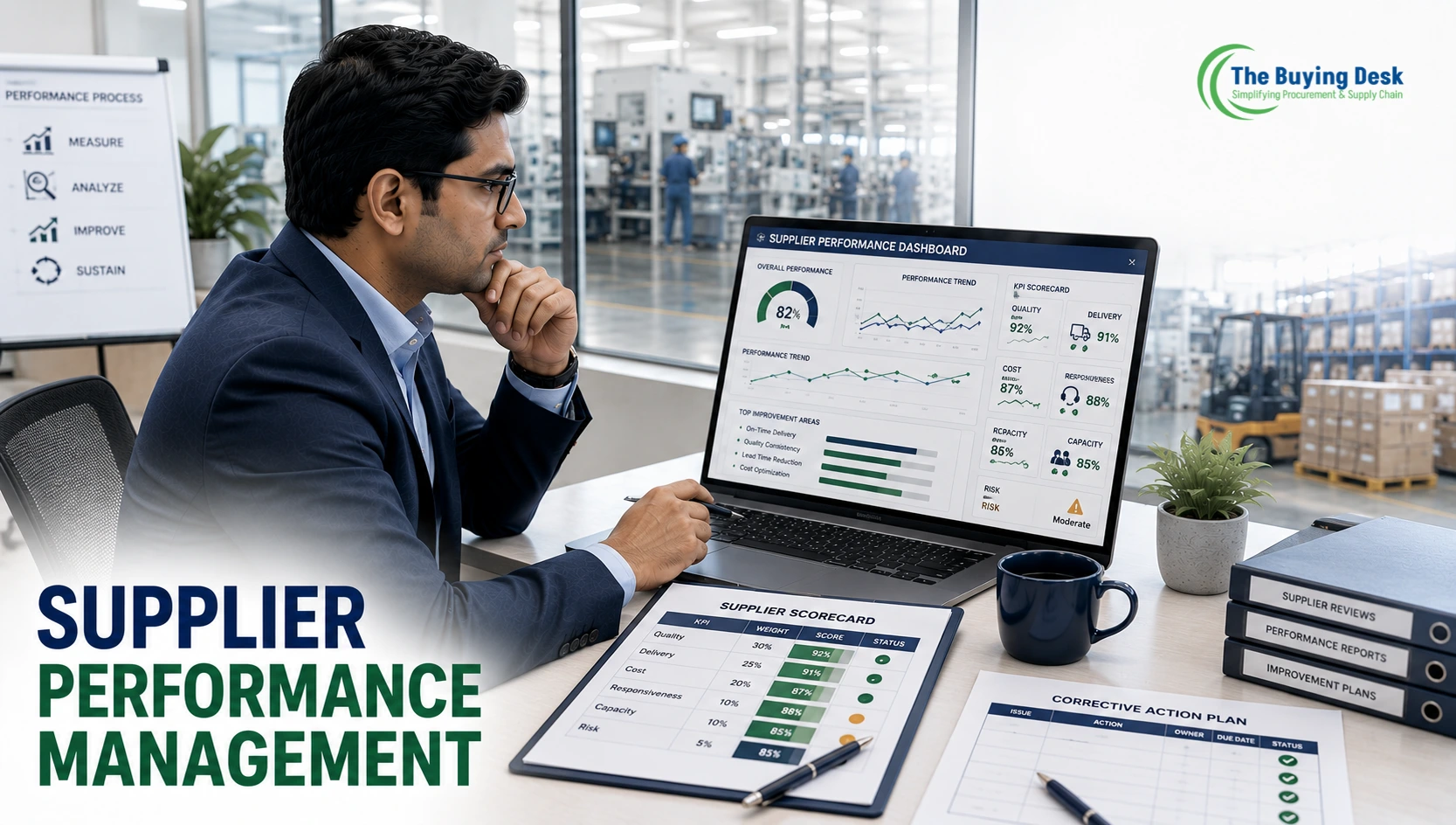
A supplier scorecard combines multiple KPIs into one structured performance view.
A basic scorecard could include:
| Performance Area | Weight |
|---|---|
| Quality | 30% |
| Delivery | 25% |
| Cost | 20% |
| Responsiveness | 10% |
| Capacity | 10% |
| Compliance | 5% |
The organization can then calculate an overall supplier performance score based on the agreed methodology.
One month’s performance may not tell the complete story.
Procurement should examine trends.
For example:
January → 97%
February → 95%
March → 91%
The declining trend may indicate a developing supplier problem even if the supplier has not yet become critical.
Regular reviews should be conducted according to supplier criticality.
Reviews may cover:
Compare actual performance with agreed targets.
For example:
Target OTD = 98%
Actual OTD = 91%
Gap = -7 percentage points
The next step is to understand the reason for the gap.
Performance gaps should lead to specific actions.
A corrective action should define:
Closing an action on paper is not enough.
Procurement should verify whether the supplier’s performance actually improved.
A supplier should demonstrate sustained improvement, not temporary recovery.
The final objective is continuous improvement.
Once basic performance is stable, procurement can work with strategic suppliers on:
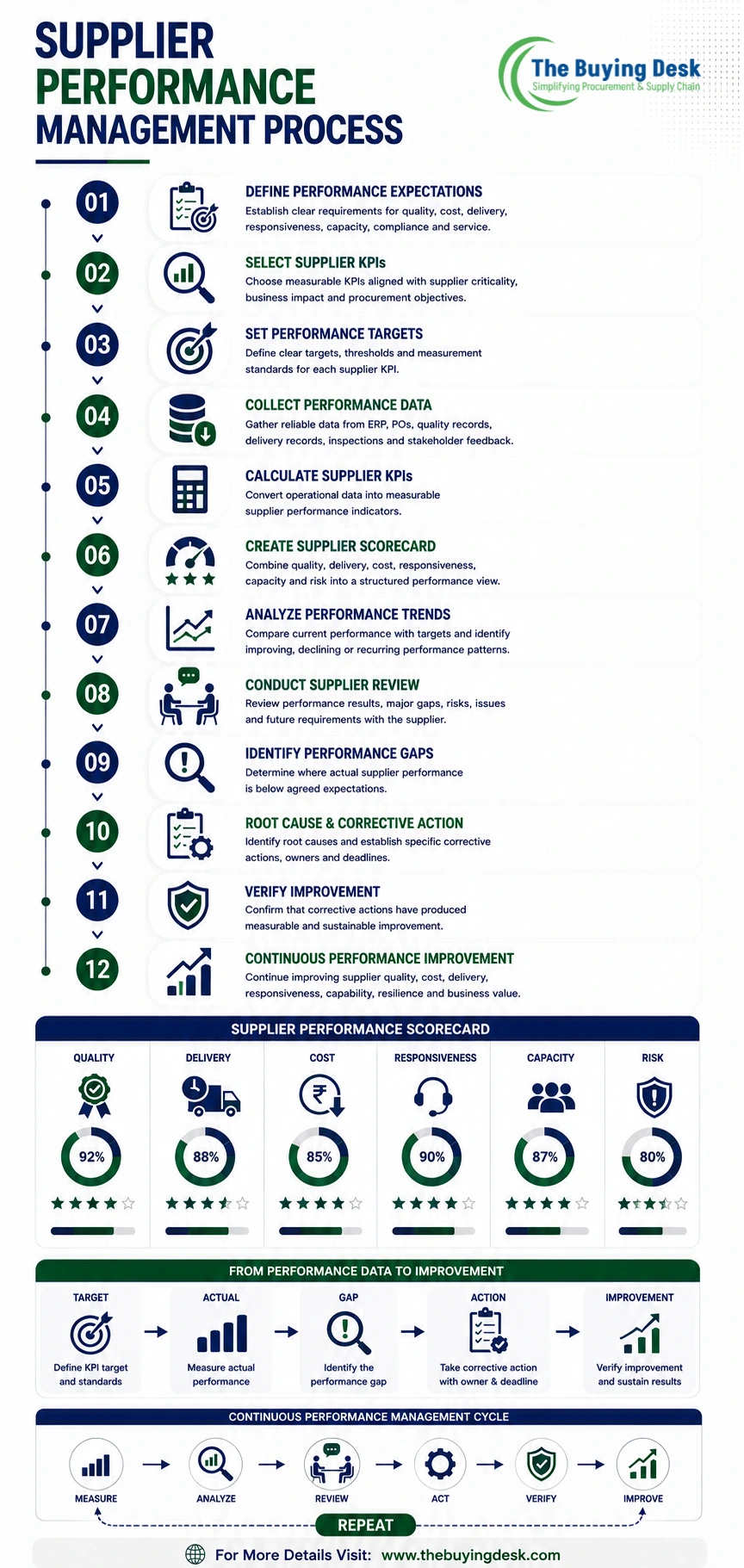
The right KPIs depend on the supplier and category, but the following are widely useful.
Measures whether the supplier delivers according to the agreed delivery date.
Formula:
On-Time Delivery % = On-Time Deliveries ÷ Total Deliveries × 100
Can be measured through:
Monitor:
Measure how quickly suppliers respond to:
Evaluate whether the supplier can consistently support required volumes.
This becomes especially important during:
Measure the actual lead time against the agreed lead time.
Track whether supplier corrective actions are completed within agreed timelines.
Monitor adherence to:
Monitor:
Internal users can provide feedback regarding:
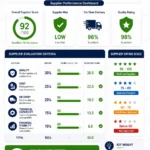
A practical supplier scorecard could look like this:
| KPI | Weight | Target | Supplier Result | Status |
|---|---|---|---|---|
| Quality | 30% | ≥ 98% | 96% | Needs Improvement |
| Delivery | 25% | ≥ 98% | 94% | Needs Improvement |
| Cost | 20% | Target | Achieved | Good |
| Responsiveness | 10% | ≥ 95% | 97% | Good |
| Capacity | 10% | ≥ 100% | 100% | Good |
| Compliance | 5% | 100% | 100% | Good |
The scorecard should not simply rank suppliers.
It should help procurement answer:
Where is the problem?
Why is it happening?
What action is required?
Has performance improved?
Organizations can create simple supplier performance categories.
For example:
90–100% — Excellent
Maintain relationship and identify strategic improvement opportunities.
80–89% — Good
Continue normal performance management and monitor gaps.
70–79% — Needs Improvement
Create corrective actions and increase review frequency.
Below 70% — Critical
Develop a formal recovery plan and assess alternative sourcing or escalation.
The thresholds should be customized according to the organization’s requirements and supplier category.
A supplier performance review should be structured rather than becoming a general discussion.
A practical agenda is:
Review objectives and previous action items.
Review:
Discuss major performance gaps and recurring issues.
Identify the actual reasons behind poor performance.
Agree on:
Discuss:
Identify opportunities for:
Confirm actions, owners and next review date.
Poor supplier performance should not automatically lead to supplier replacement.
The correct response depends on:
Possible improvement actions include:
Work directly with the supplier to improve processes and capability.
Use structured problem-solving methods such as:
Audit supplier processes when performance problems are linked to operational controls.
Provide technical, quality or process training where appropriate.
Work with the supplier to improve:
Create a time-bound plan for critical suppliers.
Develop alternate suppliers when performance risk cannot be sufficiently controlled.
More KPIs do not automatically mean better management.
Focus on metrics that actually influence business performance.
Different suppliers have different risk profiles and business requirements.
A dashboard without action is simply reporting.
A supplier with a low purchase price may create higher total cost through poor quality and delivery.
A declining performance trend can be more important than one isolated poor result.
Incorrect delivery dates, incomplete quality records or inconsistent definitions can distort performance results.
Suppliers should understand how they are being measured and why.
Corrective actions should be verified for effectiveness.
Strategic supplier management requires prioritization.
Performance data should also support supplier development and joint improvement.
A strong supplier performance management system should follow these principles:
Keep KPIs measurable.
Avoid vague indicators such as “good service.”
Align KPIs with business objectives.
Supplier metrics should connect with quality, cost, delivery, risk and customer requirements.
Use consistent definitions.
For example, define exactly what counts as an on-time delivery.
Segment suppliers.
Critical suppliers may require more detailed monitoring than low-risk suppliers.
Use trends rather than isolated results.
Look at performance over time.
Make scorecards actionable.
Every major gap should lead to a clear decision or action.
Collaborate with suppliers.
Performance improvement works better when procurement and suppliers solve problems together.
Verify improvement.
Confirm that performance has improved and remained stable.
Supplier Performance Management and Supplier Relationship Management are closely connected.
Supplier Performance Management focuses primarily on:
Measure → Analyze → Correct → Improve
Supplier Relationship Management focuses more broadly on:
Align → Collaborate → Develop → Create Value
Performance management provides the factual performance data that supports relationship management.
Together, they create a stronger supplier-management framework.
Modern procurement teams increasingly use technology to automate supplier performance monitoring.
Technology can help with:
ERP, procurement and supplier-management systems can connect operational data with supplier performance dashboards.
The goal is not simply to create another dashboard.
The goal is to provide procurement teams with better information for faster and better decisions.
Consider a manufacturing company that buys critical components from five suppliers.
The company defines three major KPIs:
Quality = 35%
Delivery = 40%
Responsiveness = 25%
Supplier A achieves:
Supplier B achieves:
Although Supplier B may offer a lower purchase price, its delivery performance creates a significant operational risk.
The procurement team therefore:
This demonstrates why supplier performance should be evaluated beyond purchase price.
Procurement teams can use the following checklist:
☐ Supplier KPIs defined
☐ Performance targets established
☐ Data sources identified
☐ KPI definitions standardized
☐ Supplier scorecard created
☐ Supplier performance measured regularly
☐ Performance trends reviewed
☐ Performance gaps identified
☐ Corrective actions assigned
☐ Action closure monitored
☐ Supplier reviews conducted
☐ Improvement effectiveness verified
☐ Supplier risk monitored
☐ Strategic improvement opportunities identified
What is Supplier Performance Management?
Supplier Performance Management is the continuous process of measuring, reviewing and improving supplier performance against agreed KPIs and business requirements.
What are the main supplier performance KPIs?
Common KPIs include quality, on-time delivery, cost, responsiveness, capacity, lead time, corrective-action closure, compliance and supplier risk.
What is a supplier scorecard?
A supplier scorecard is a structured tool that combines multiple supplier KPIs into a single performance view.
How often should supplier performance be reviewed?
The frequency should depend on supplier criticality and risk. Critical suppliers may require monthly or more frequent reviews, while lower-risk suppliers may be reviewed quarterly or less frequently.
Should supplier performance focus only on cost?
No. Supplier performance should consider total business impact, including quality, delivery, cost, capacity, responsiveness, risk and compliance.
What should happen when a supplier performs poorly?
Procurement should identify the performance gap, determine the root cause, agree on corrective actions and monitor improvement. Alternative sourcing may be considered when performance cannot be sustainably improved.
What is the difference between supplier evaluation and supplier performance management?
Supplier evaluation assesses supplier capability or performance at a particular point in time. Supplier performance management is an ongoing process of measurement, action and improvement.
Supplier Performance Management transforms supplier management from reactive problem-solving into a structured and measurable process.
The objective is not simply to rank suppliers.
The real objective is to understand performance, identify gaps, solve problems, develop suppliers and continuously improve business results.
A mature supplier performance management system connects:
KPIs → Scorecards → Reviews → Corrective Actions → Supplier Development → Continuous Improvement
When procurement teams consistently measure what matters and act on the results, suppliers can become more reliable, responsive and capable business partners.
The most effective approach is simple:
Measure performance.
Understand the gaps.
Take action.
Verify improvement.
Create long-term value.