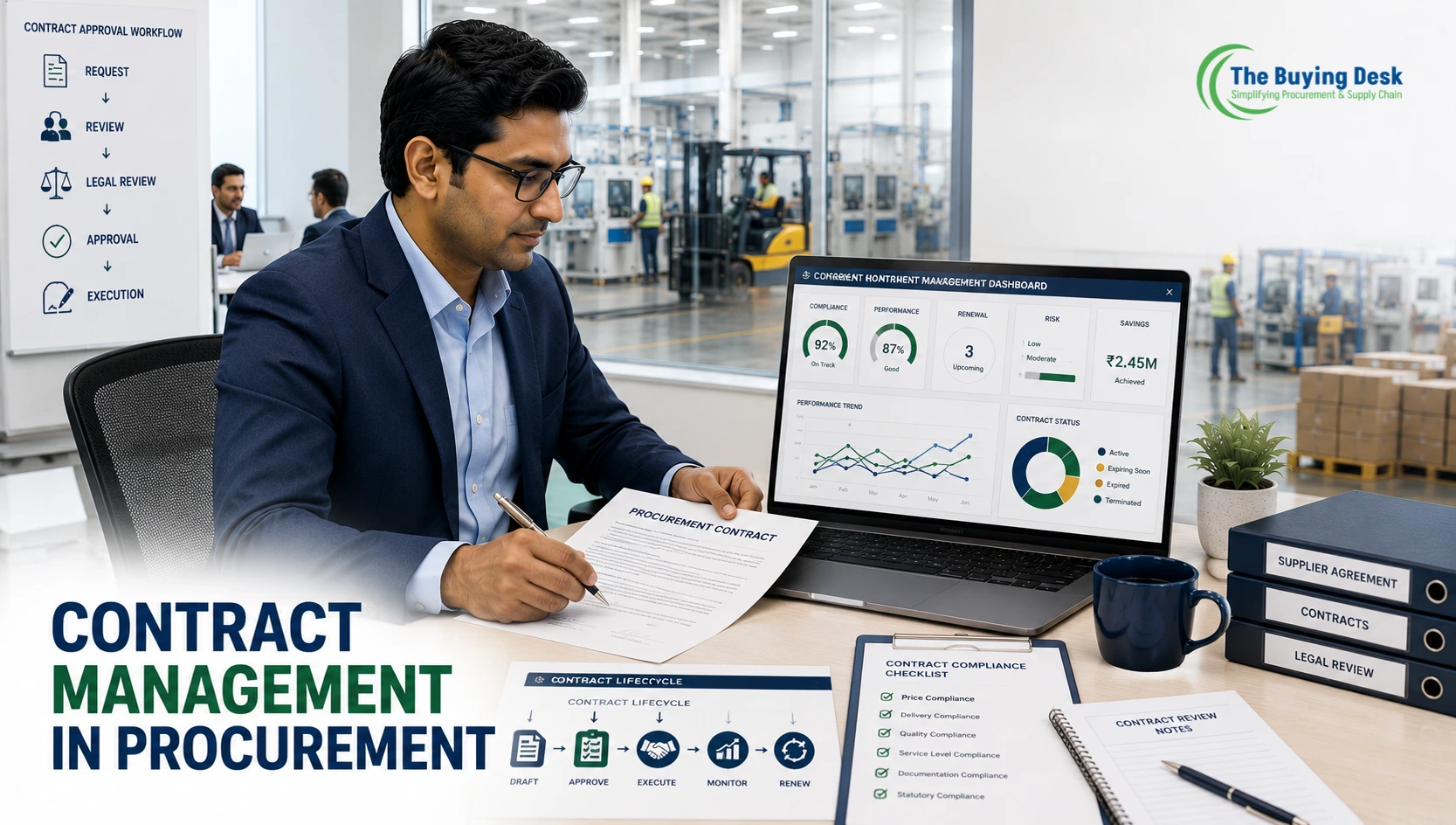
Contract management is one of the most important activities in procurement because a negotiated agreement only creates value when its terms are properly implemented, monitored and maintained.
A procurement team may negotiate the right price, payment terms, delivery conditions, quality requirements and service levels. However, if those commitments are not monitored after the contract is signed, the expected benefits can quickly disappear.
This is why contract management in procurement goes beyond storing signed agreements.
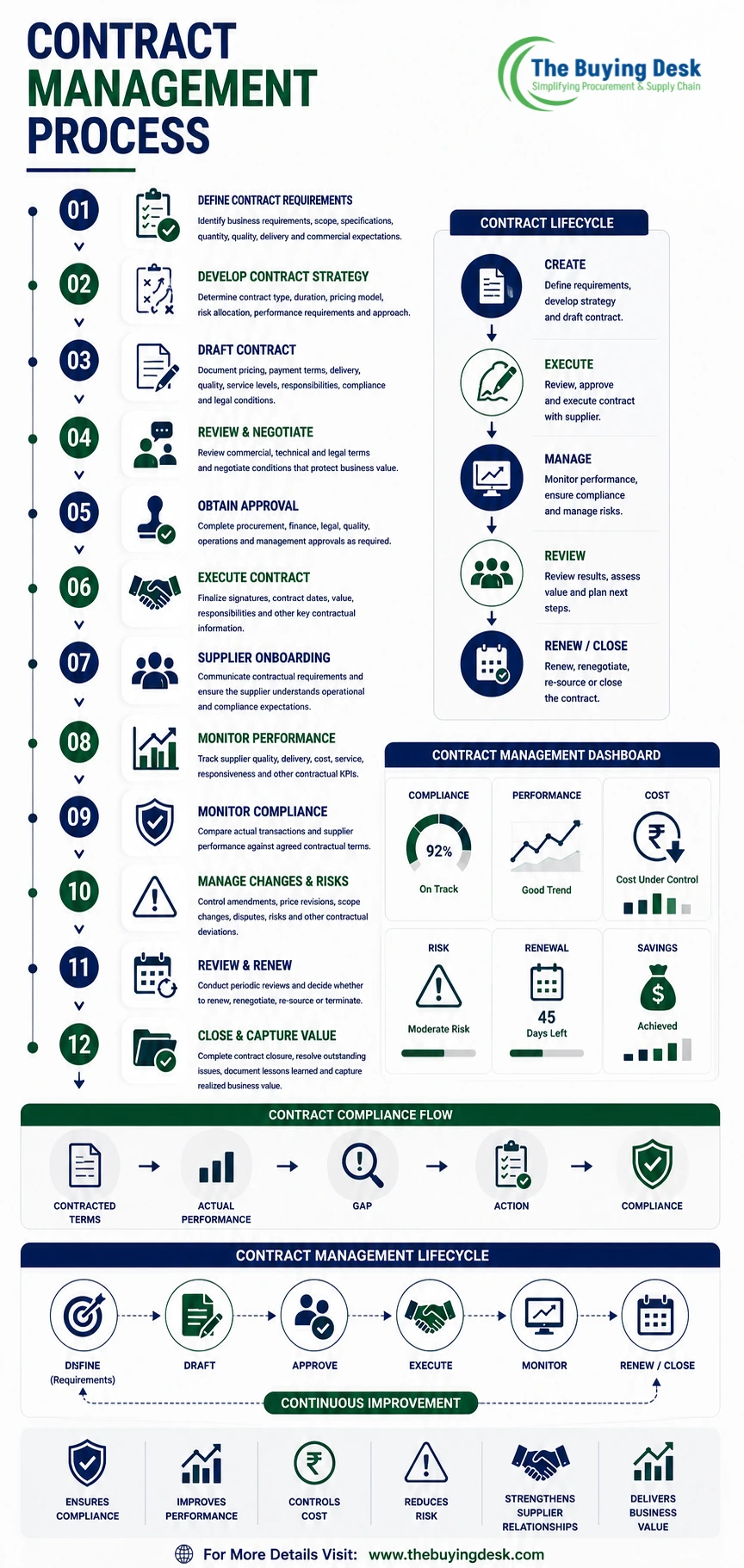
It involves managing the complete contract lifecycle from requirement definition and drafting to approval, execution, performance monitoring, compliance, renewal and closure.
Effective contract management helps organizations control costs, improve supplier performance, reduce risk and ensure that suppliers deliver according to agreed commercial and operational requirements.
Stay updated with procurement tips, sourcing strategies, supplier management insights, negotiation techniques and supply chain knowledge.
💬 Join The Buying Desk on WhatsApp →Contract management in procurement is the systematic process of creating, executing, monitoring and managing procurement contracts to ensure that suppliers and internal stakeholders meet agreed terms and business requirements.
A procurement contract typically defines important commercial and operational conditions such as:
Contract management ensures these commitments are actually followed throughout the relationship.
In simple terms:
Procurement negotiates the deal. Contract management ensures the deal delivers the expected value.
A signed contract does not automatically guarantee savings or supplier performance.
For example, suppose procurement negotiates a 5% price reduction with a supplier.
If purchase orders continue to use the previous price, the organization may never realize the negotiated saving.
Similarly, a supplier may agree to a 30-day delivery lead time but repeatedly deliver after 45 days.
Without effective contract monitoring, such deviations can continue unnoticed.
Strong contract management helps procurement:
Control Cost → Ensure Compliance → Manage Performance → Reduce Risk → Protect Business Value
These terms are often used interchangeably, but there is a useful distinction.
Contract Management focuses on managing an individual contract and ensuring that its terms are properly executed and monitored.
Contract Lifecycle Management (CLM) takes a broader view and manages the complete lifecycle of contracts from initiation through renewal, expiry or termination.
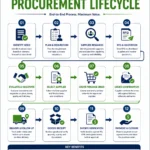
A typical contract lifecycle includes:
Requirement → Draft → Review → Approve → Sign → Execute → Monitor → Renew / Close
A structured contract management process helps procurement maintain control throughout the agreement lifecycle.
The process begins by clearly defining what the business needs from the supplier.
Requirements may include:
Poorly defined requirements can create disputes later.
Procurement should determine the appropriate contract structure based on the category, supplier relationship, risk and commercial environment.
The strategy may include decisions regarding:
The commercial and legal terms are documented in the contract.
Depending on the organization, procurement may work with legal, finance, quality, engineering, operations and other stakeholders.
The contract should clearly define responsibilities and expectations.
Before signing, the contract should be reviewed by the relevant stakeholders.
Procurement may negotiate:
The objective is not simply to obtain the lowest price.
The objective is to create an agreement that balances cost, performance, risk and business requirements.
Contracts often require approvals based on organizational authority levels.
Approvals may involve:
An approval matrix helps ensure that contracts are authorized appropriately.
Once all parties agree, the contract is formally executed.
Important information should be captured accurately in the organization’s contract or ERP system.
This may include:
The supplier must understand the contractual requirements before regular business begins.
Procurement should communicate important obligations related to:
Once the contract is active, procurement must monitor whether agreed conditions are being followed.
Typical areas include:
Cost + Quality + Delivery + Service + Compliance
This is where contract management connects closely with supplier performance management.
Procurement should identify deviations between contractual terms and actual transactions.
Examples include:
Business requirements can change during the contract period.
Changes may involve:
Changes should be formally documented and approved rather than handled through informal communication.
Periodic reviews help procurement identify whether the contract is delivering the expected value.
Review topics may include:
As the contract approaches expiry, procurement should determine whether to:
Renew → Renegotiate → Re-source → Terminate
The decision should be based on supplier performance, market conditions, business requirements and future strategy.
Different procurement situations require different contract structures.
The supplier provides goods or services at an agreed price.
Useful when:
The buyer pays the supplier’s allowable costs plus an agreed fee or margin.
This structure may be used where costs are difficult to establish upfront.
Payment is based on actual time and materials used.
This is common in certain professional services, maintenance and project environments.
A framework establishes commercial terms for future purchases without necessarily committing the buyer to a specific quantity.
It can be useful for recurring procurement requirements.
A predefined price or rate is agreed for a specified period.
This can simplify recurring purchases.
A long-term agreement establishes commercial and operational conditions for an extended period.
It can support strategic supplier relationships and supply continuity.
A buyer establishes agreed terms with a supplier for repeated purchases over a specified period.
This can reduce repetitive procurement administration.
A strong procurement contract should clearly define important commercial and operational conditions.
Contract compliance means ensuring that actual transactions and supplier activities follow the agreed contractual terms.
A simple way to think about it is:
Contracted Terms vs Actual Performance = Compliance Check
For example:
| Contract Requirement | Actual Result | Status |
|---|---|---|
| Price ₹100 | Invoice ₹100 | Compliant |
| Delivery 10 days | Delivery 16 days | Non-compliant |
| Payment 60 days | Payment 60 days | Compliant |
| Quality PPM target | Target exceeded | Review Required |
Contract compliance should be monitored continuously rather than only when a contract is about to expire.
Procurement can use KPIs to measure the effectiveness of contract management.
Measures the percentage of transactions or activities that follow contractual terms.
Formula:
Contract Compliance % = Compliant Transactions ÷ Total Applicable Transactions × 100
Measures how much of the available contracted business is actually being used.
Measures whether negotiated savings are actually achieved.
Measures spend or activity occurring outside agreed contractual conditions.
Tracks the percentage of contracts renewed within the required timeframe.
Measures contracts that have expired without appropriate renewal, replacement or closure.
Measures the time required to create, review and execute a contract.
Measures supplier performance against contractual requirements.
Tracks the frequency of disputes related to contractual terms.
Measures the level of financial, operational and compliance risk associated with active contracts.
Many organizations have contracts but still struggle to obtain their full value.
Contracts may be stored across emails, folders and individual computers.
This makes it difficult to know:
A contract can expire simply because nobody received a timely reminder.
This can create commercial and operational risk.
Suppliers may continue charging old prices or non-contractual rates.
Contracts may contain KPIs that nobody actively tracks.
Informal changes through emails or verbal agreements can create ambiguity.
If nobody clearly owns the contract after signature, compliance can deteriorate.
Without reliable procurement and supplier data, contract performance becomes difficult to measure.
Maintain a centralized system containing active contracts and key metadata.
Every important contract should have a clearly defined owner.
Set automated reminders for:
Where possible, connect contract terms with ERP, purchasing and supplier-management systems.
Do not allow contractual KPIs to remain only inside the agreement.
Convert them into measurable supplier-performance indicators.
Compare purchase orders and invoices against contracted prices.
Strategic and critical suppliers should be reviewed periodically against contractual requirements.
Use formal amendments or approved change processes.
Do not wait until the final few days before contract expiry.
For important contracts, procurement should begin renewal or sourcing analysis well in advance.
Contract management should not operate separately from supplier performance, supplier risk and supplier relationship management.
Modern procurement organizations increasingly use digital tools to manage contracts.
A contract management system can help with:
The goal is not technology for its own sake.
The objective is to make contracts visible, measurable and actionable.
Procurement plays a central role throughout the contract lifecycle.
Procurement professionals may be responsible for:
However, contract management is usually cross-functional.
Legal, finance, operations, quality, engineering and other departments may also have important responsibilities.
These activities are closely connected but not identical.
Contract Management focuses on whether the agreed contractual terms are being followed.
Supplier Management focuses more broadly on supplier performance, relationship, development, risk and business value.
For example:
A supplier may comply with the contract but still have poor strategic value.
Conversely, a supplier may have a strong relationship but fail to meet contractual requirements.
Effective procurement manages both dimensions together.
Supplier performance management measures areas such as:
Contract management ensures that the agreed requirements, obligations and commercial terms supporting these performance expectations are properly controlled.
Therefore:
Contract Management defines and protects the agreement.
Supplier Performance Management measures how well the supplier performs against expectations.
Procurement contracts can create significant business risk if poorly managed.
Important contract risks include:
Procurement should identify important risks during contract development and continue monitoring them during execution.
A procurement contract dashboard can include:
| Metric | Purpose |
|---|---|
| Active Contracts | Monitor current contract portfolio |
| Expiring Contracts | Identify upcoming renewals |
| Contract Compliance | Measure adherence |
| Contract Leakage | Identify off-contract activity |
| Savings Realization | Track negotiated savings |
| Supplier Performance | Monitor contractual performance |
| Open Disputes | Track unresolved issues |
| Risk Exposure | Monitor contract risks |
| Renewal Pipeline | Plan future actions |
A dashboard converts contract information into actionable procurement intelligence.
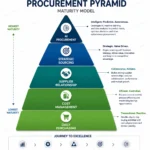
Organizations can think about contract management maturity in five stages.
Level 1 — Reactive
Contracts are mainly stored as documents.
Level 2 — Organized
Contracts are centrally stored with basic expiry tracking.
Level 3 — Controlled
Compliance, performance and renewal processes are established.
Level 4 — Integrated
Contracts are connected with procurement, supplier and ERP systems.
Level 5 — Strategic
Contract data supports cost optimization, risk management, supplier strategy and business decisions.
The objective should be to move from document storage to strategic contract management.
Imagine a manufacturing company has an annual contract with a key raw-material supplier.
The contract specifies:
Procurement can monitor:
Price Compliance
Are purchase orders using the agreed price?
Delivery Compliance
Is the supplier delivering according to schedule?
Quality Compliance
Are rejection and defect levels within agreed limits?
Volume Utilization
Is the contracted volume being utilized?
Savings Realization
Are negotiated savings actually being achieved?
Contract Expiry
Is renewal or re-sourcing being initiated early?
This turns the contract from a static document into an active procurement management tool.
Contract management in procurement is the process of turning negotiated agreements into measurable business value.
A strong contract management system ensures that:
Terms Are Clear → Responsibilities Are Defined → Performance Is Measured → Compliance Is Controlled → Risks Are Managed → Value Is Realized
The best procurement teams do not consider contract signing the finish line.
They treat the signed contract as the beginning of a structured process for managing cost, performance, compliance, risk and supplier value.
Stay updated with procurement tips, sourcing strategies, supplier management insights, negotiation techniques and supply chain knowledge.
💬 Join The Buying Desk on WhatsApp →