Strategic sourcing is most effective when procurement follows a structured process rather than simply sending quotations to suppliers and selecting the lowest price.
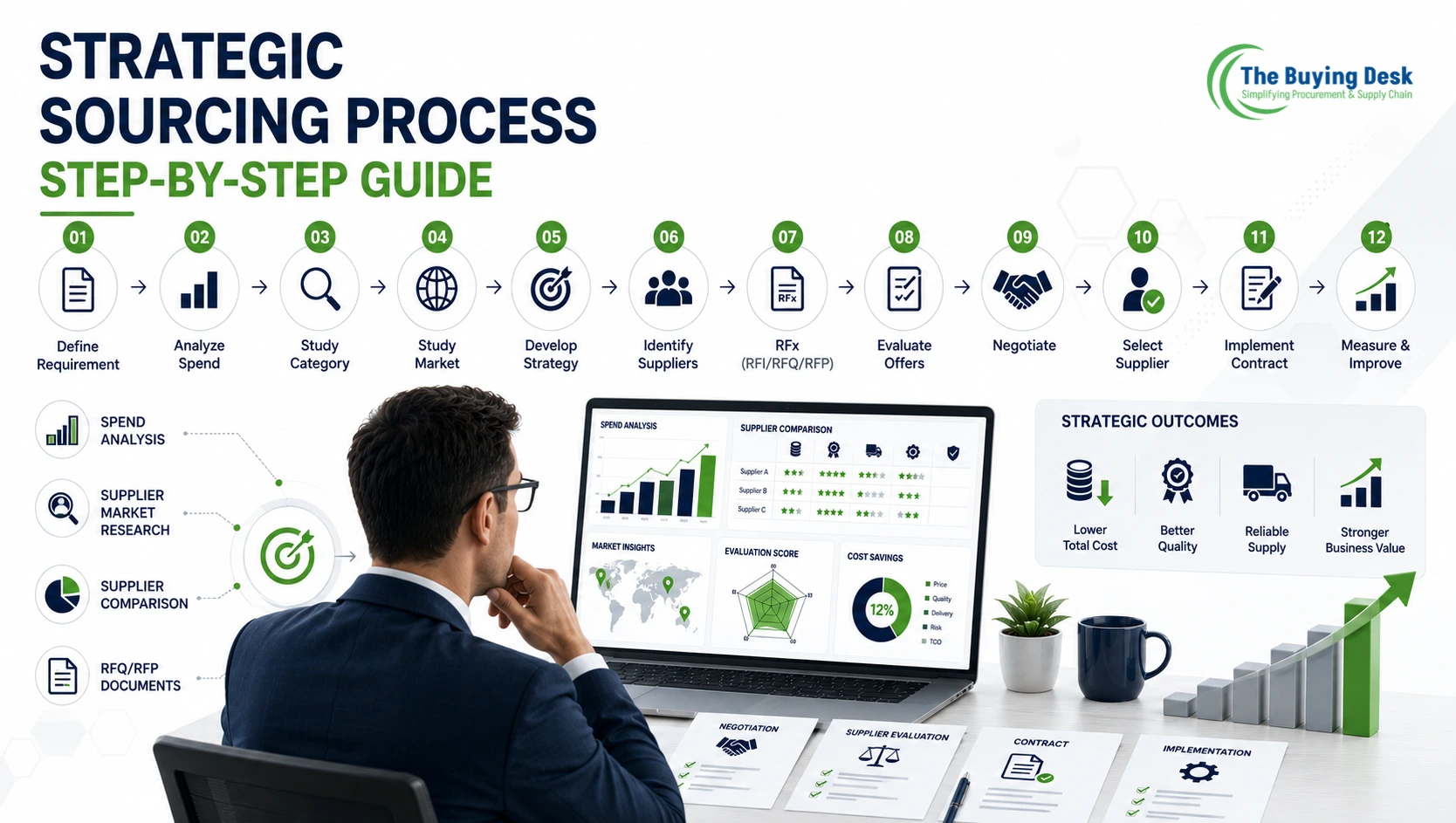
The strategic sourcing process provides a systematic framework for understanding business requirements, analyzing spend, studying the supplier market, developing a sourcing strategy, identifying potential suppliers, conducting RFx events, evaluating offers, negotiating commercial terms, selecting suppliers and implementing the final sourcing decision.
A well-designed process helps procurement teams achieve more than purchase-price savings. It can improve quality, delivery, supply continuity, supplier capability, risk management and Total Cost of Ownership (TCO).
In simple terms:
Strategic sourcing is a structured journey from understanding the requirement to selecting and implementing the best supply solution.
This article explains the complete strategic sourcing process step by step.
The strategic sourcing process is a series of analytical and commercial activities used to determine the best way to source a product, material or service.
A typical process follows:
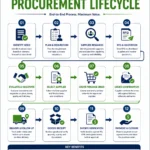
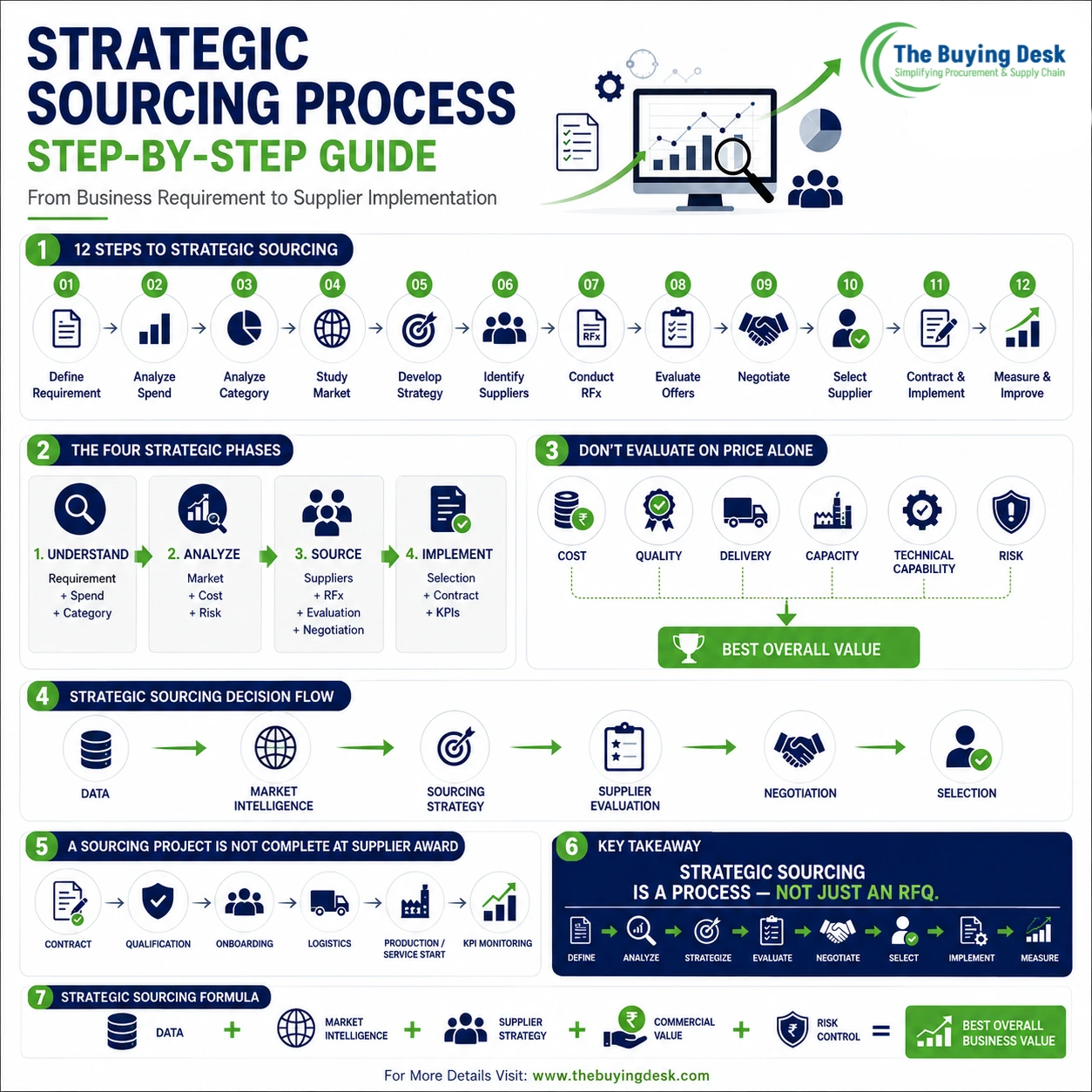
Define Requirement → Analyze Spend → Analyze Category → Study Market → Develop Strategy → Identify Suppliers → Conduct RFx → Evaluate Offers → Negotiate → Select Supplier → Contract & Implement → Measure Results
The exact sequence may vary depending on the category, business requirement, risk and sourcing model.
For example, sourcing a standard office supply may require a relatively simple process, while sourcing a critical automotive component may require detailed technical qualification, supplier audits, capacity validation and commercial analysis.
Without a structured process, sourcing decisions can become heavily dependent on historical suppliers, individual buyer experience or quoted price.
A structured approach helps procurement:
Strategic sourcing therefore requires both analytical discipline and commercial judgment.
The complete process can be divided into twelve major steps:
| Step | Strategic Sourcing Activity | Primary Purpose |
|---|---|---|
| 1 | Define Business Requirement | Understand what is required |
| 2 | Analyze Spend | Understand current expenditure |
| 3 | Analyze Category | Understand the purchasing category |
| 4 | Analyze Supplier Market | Understand external supply options |
| 5 | Develop Sourcing Strategy | Decide how to source |
| 6 | Identify Potential Suppliers | Build supplier options |
| 7 | Prepare & Conduct RFx | Obtain supplier information/offers |
| 8 | Evaluate Supplier Offers | Compare suppliers |
| 9 | Negotiate | Improve commercial and operational terms |
| 10 | Select Supplier | Make the sourcing decision |
| 11 | Contract & Implement | Put the decision into operation |
| 12 | Measure & Improve | Track results and sustain value |
Each step contributes to the final sourcing decision.
The sourcing process should begin with a clear understanding of what the organization actually needs.
Procurement should not immediately ask suppliers for prices.
First, the requirement should be defined.
Determine:
Procurement should also ask:
Depending on the category, procurement may need input from:
A sourcing strategy based on an incomplete requirement can create problems later.
Once the requirement is understood, procurement should analyze historical and current spend.
Spend analysis answers an important question:
Where, how much and with whom are we spending money?
Procurement may analyze:
Spend analysis can reveal opportunities that are not obvious from individual purchase orders.
For example:
Plant A purchases:
₹40 lakh
Plant B purchases:
₹35 lakh
Plant C purchases:
₹25 lakh
Total category spend:
₹1 crore
If all three plants purchase independently from different suppliers, procurement may have an opportunity to consolidate volumes and improve commercial leverage.
Look for:
Spend analysis provides the internal fact base for the sourcing project.
Spend data tells procurement where the money is going.
Category analysis explains why the spending behaves the way it does.
Study:
For a manufactured component, cost drivers could include:
For a service, cost drivers may include:
Understanding cost drivers improves negotiation quality.
After understanding internal requirements and spend, procurement should study the external supply market.
The objective is to understand:
Who can supply what we need, at what capability, capacity, risk and commercial level?
Procurement may investigate:
Market intelligence may include:
Ask:
This information helps procurement develop a realistic sourcing strategy.
Now procurement combines the internal and external information.
The sourcing strategy determines how the organization should approach the market.
Possible options include:
The strategy should balance:
Cost + Quality + Delivery + Risk + Capacity + Flexibility + Innovation + TCO
For example, a critical production component may justify dual sourcing even if single sourcing provides a slightly lower price.
Objectives could include:
Objectives should be measurable wherever possible.
Once the sourcing strategy is established, procurement identifies potential suppliers.
Potential suppliers can be identified through:
Not every supplier should automatically enter the RFx process.
Screen suppliers based on:
The objective is to create a qualified supplier pool.
The sourcing event should use the appropriate RFx format.
An RFI is generally used when procurement wants to understand the market and supplier capabilities before requesting a formal quotation.
It may ask about:
An RFQ is appropriate when the requirement is clearly defined and suppliers can provide comparable commercial quotations.
Typical RFQ information includes:
An RFP is useful when procurement wants suppliers to propose a broader solution rather than simply quote a price.
It may evaluate:
The detailed differences between RFI, RFQ and RFP will be covered in later Cluster 3 articles.
Receiving quotations is not the end of the sourcing process.
The offers need to be evaluated systematically.
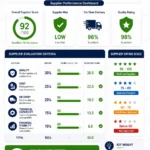
Typical criteria include:
A weighted evaluation can make the decision more objective.
Example:
| Evaluation Factor | Weight |
|---|---|
| Cost | 30% |
| Quality | 20% |
| Delivery | 15% |
| Technical Capability | 15% |
| Capacity | 10% |
| Risk | 10% |
| Total | 100% |
Each supplier can then be scored against the defined criteria.
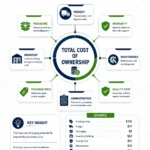
A supplier quotation may not represent the actual economic cost.
Consider:
This is where Total Cost of Ownership becomes important.
Once suppliers have been evaluated, procurement can begin commercial negotiations.
Negotiation should be based on facts.
Understand:
Commercial negotiation can include:
Procurement should ideally define:
Target → Acceptable Position → Negotiation Boundary
This creates discipline during negotiations.
After evaluation and negotiation, procurement makes the supplier selection decision.
The final decision should consider the entire sourcing objective.
A supplier with the lowest unit price may not provide the lowest total cost.
The final selection should therefore answer:
Which supplier provides the best overall value while meeting the organization’s risk and operational requirements?
Supplier selection is not the final step.
The sourcing decision must be converted into an operational supply arrangement.
Document:
Implementation may require:
A sourcing project is only successful when the selected supplier can actually deliver the required result.
Strategic sourcing should not end when the contract is signed.
Procurement should measure whether the sourcing strategy delivered the expected outcome.
Monitor:
Monitor:
Track:
Measurement creates a feedback loop for future sourcing projects.
Consider a manufacturer sourcing a critical machined component.
Annual demand:
100,000 units
Current purchase price:
₹250 per unit
Annual purchase spend:
₹2.5 crore
The company currently depends on one supplier.
Procurement works with engineering and quality to confirm:
Procurement analyzes three years of:
The analysis identifies significant annual expenditure and supplier dependency.
Procurement identifies five potential suppliers.
Three appear technically capable.
Two require additional qualification.
The team decides to:
Three suppliers receive the same technical and commercial requirements.
The procurement team evaluates:
| Factor | Weight |
|---|---|
| Price/TCO | 30% |
| Quality | 20% |
| Delivery | 15% |
| Technical Capability | 15% |
| Capacity | 10% |
| Risk | 10% |
The preferred supplier initially quotes:
₹235/unit
After negotiation:
₹225/unit
Potential purchase-price improvement:
₹10 × 100,000 = ₹10 lakh annually
However, procurement also negotiates:
The alternate supplier completes qualification.
The organization now has a more resilient sourcing model rather than simply a lower price.
This demonstrates how strategic sourcing combines cost improvement with risk reduction and supply continuity.
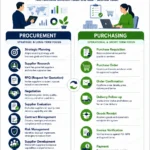
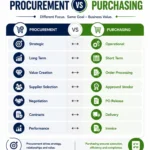
The difference becomes clearer when the two processes are compared.
| Traditional Purchasing | Strategic Sourcing |
|---|---|
| Requirement driven | Business-strategy driven |
| Obtain quotation | Analyze category and market |
| Focus on price | Focus on total value |
| Often reactive | Proactive |
| Transaction oriented | Project oriented |
| Limited supplier research | Extensive market research |
| Supplier selection based heavily on quote | Multi-criteria evaluation |
| Short-term focus | Long-term focus |
| PO execution | Strategy + contract + implementation |
| Limited post-sourcing analysis | KPI-based performance measurement |
Traditional purchasing remains necessary for daily procurement operations.
Strategic sourcing determines how the organization should approach the supply market before those transactions occur.
Even a well-designed process can encounter challenges.
Incorrect supplier names, duplicate categories or incomplete historical data can make analysis difficult.
Ambiguous specifications make supplier quotations difficult to compare.
Some categories may have very few qualified suppliers.
Existing suppliers and internal stakeholders may resist changes to established sourcing arrangements.
Savings targets should reflect market conditions, cost drivers and actual supplier economics.
A supplier may offer an attractive price but lack sufficient capacity.
A sourcing decision can fail if supplier onboarding, qualification or logistics planning is incomplete.
Procurement teams can improve sourcing effectiveness by following several principles.
Use reliable spend, volume, price and supplier-performance data before entering negotiations.
Where possible, standardize specifications and quotation formats so suppliers can be compared fairly.
Engineering, quality, finance, logistics and operations should be involved before supplier selection.
Develop multiple qualified sources wherever the category and risk profile allow it.
Do not compare suppliers only on unit price.
Use weighted evaluation criteria when multiple factors matter.
Understand qualification, tooling, logistics, systems and ramp-up requirements before final supplier selection.
Track whether negotiated savings actually appear in purchasing and financial results.
Before closing a sourcing project, procurement should verify:
The strategic sourcing process is not simply:
Send RFQ → Receive Quotes → Negotiate → Select Supplier
A mature process is:
Define → Analyze → Research → Strategize → Discover → Evaluate → Negotiate → Select → Implement → Measure
Each step contributes to the final result.
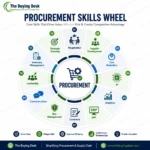
The most effective procurement teams use strategic sourcing to combine spend intelligence, market intelligence, supplier capability, cost analysis, risk management and commercial negotiation.
The ultimate objective is not necessarily to find the cheapest supplier.
It is to find and implement the best sourcing solution for the business.
What are the main steps in strategic sourcing?
The main steps are requirement definition, spend analysis, category and market analysis, strategy development, supplier identification, RFx, evaluation, negotiation, supplier selection, implementation and performance measurement.
How long does a strategic sourcing process take?
The timeline depends on category complexity, supplier availability, qualification requirements and contract value. Simple categories may take weeks, while complex strategic sourcing projects can take several months.
What is the most important step in strategic sourcing?
There is no single most important step, but strong requirement definition and data analysis are foundational because they influence the sourcing strategy, supplier evaluation and negotiation.
Why is spend analysis used in strategic sourcing?
Spend analysis helps procurement understand current expenditure, supplier concentration, purchasing patterns, price trends and potential consolidation opportunities before approaching the market.
Should procurement always use an RFQ?
No. An RFQ works best when requirements are clearly defined and suppliers can provide comparable quotations. An RFI or RFP may be more appropriate for other sourcing situations.
How are suppliers evaluated in strategic sourcing?
Suppliers can be evaluated using weighted criteria such as cost, quality, delivery, technical capability, capacity, risk, financial strength and Total Cost of Ownership.
Is the lowest-price supplier always selected?
No. Strategic sourcing evaluates overall value. A supplier with a higher price may provide lower TCO, better quality, stronger delivery performance or lower supply risk.
What happens after supplier selection?
After selection, procurement completes contracting and implementation, including onboarding, qualification, logistics setup and operational readiness, followed by KPI and savings monitoring.