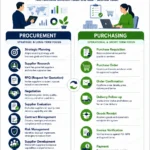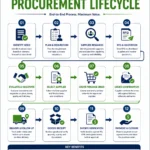
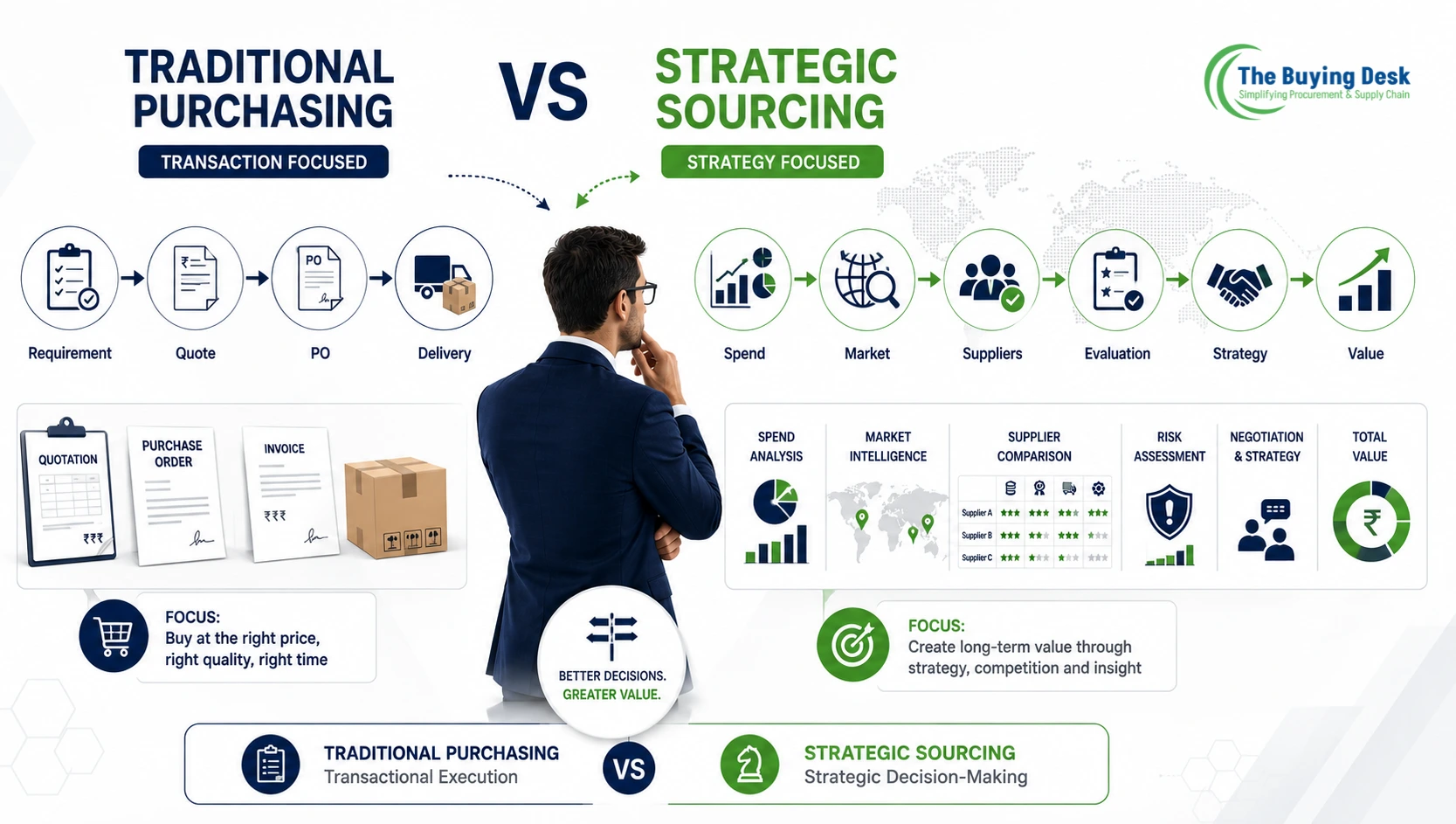
Strategic sourcing and traditional purchasing are both important parts of procurement, but they operate at different levels.
Traditional purchasing is primarily concerned with obtaining the required goods or services at the right price, quantity, quality and time. It is often transaction-focused and closely connected with purchase orders, supplier quotations, order processing and delivery.
Strategic sourcing, on the other hand, takes a broader and more analytical approach. It examines spend, supplier markets, cost structures, supply risks, supplier capabilities, competition and long-term business requirements before deciding how and from whom to source.
The difference can be summarized simply:
Traditional purchasing executes buying transactions. Strategic sourcing determines the best way to approach the supply market and create long-term value.
Understanding this difference is essential for procurement professionals who want to move from transactional buying toward strategic procurement.
Traditional purchasing is the process of obtaining goods or services required by an organization.
It typically involves activities such as:
The primary objective is usually to ensure that the required item or service is purchased:
At the right price + quality + quantity + time + source
Traditional purchasing remains essential because organizations need an efficient operational mechanism to convert requirements into actual purchases.
Strategic sourcing is a structured approach to analyzing purchasing requirements, spend, supplier markets, cost drivers, risks and supplier capabilities before selecting a sourcing strategy.
It may involve:
The objective is not simply to buy at the lowest quoted price.
Instead, strategic sourcing seeks the best overall business value.
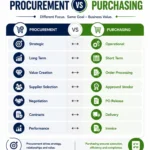
| Factor | Traditional Purchasing | Strategic Sourcing |
|---|---|---|
| Primary focus | Buying transactions | Sourcing strategy |
| Approach | Reactive or requirement driven | Proactive and analytical |
| Main objective | Fulfill requirement | Create long-term value |
| Price | Major consideration | One part of total value |
| Spend analysis | Limited or occasional | Core activity |
| Market research | Limited | Extensive |
| Supplier search | Often existing suppliers | Existing + alternative suppliers |
| Supplier evaluation | Basic | Multi-dimensional |
| Risk assessment | Often limited | Formal consideration |
| Negotiation | Transaction based | Strategy and value based |
| Cost analysis | Quotation focused | Cost-driver and TCO focused |
| Time horizon | Short term | Medium to long term |
| Supplier relationship | Transactional | Strategic where appropriate |
| Technology | Transaction processing | Analytics + sourcing technology |
| KPIs | Price, delivery, order status | Savings, TCO, risk, quality, delivery and value |
The fundamental difference is the level at which the procurement decision is made.
Traditional purchasing asks:
“We need this item. Who can supply it at an acceptable price?”
Strategic sourcing asks:
“What is the best sourcing strategy for this requirement, considering cost, market conditions, supplier capability, risk and long-term business needs?”
The second question requires more analysis before the purchasing transaction takes place.
Traditional purchasing generally focuses on:
The emphasis is operational execution.
Strategic sourcing focuses on:
The emphasis is strategic decision-making.
One of the clearest differences is the time horizon.
The focus may be:
Today → This order → This delivery
A buyer may need to ensure that a specific quantity reaches the plant on time.
The focus may be:
Today → Next year → Next three years → Future business requirements
Strategic sourcing considers future demand, supplier capacity, market conditions, technology, risk and long-term commercial arrangements.
Traditional purchasing may rely heavily on existing suppliers.
For example:
Requirement → Existing Supplier → Quotation → PO
This can be efficient for routine purchases.
Strategic sourcing asks whether the existing supplier remains the best option.
It may evaluate:
The objective is to ensure that the supplier base remains competitive and resilient.
Spend analysis is a core component of strategic sourcing.
A buyer may look at:
Current item → Current supplier → Current price
A sourcing team may analyze:
This broader view can reveal opportunities that are invisible at individual purchase-order level.
Traditional purchasing does not always require detailed market analysis, especially for routine and low-risk purchases.
Strategic sourcing usually requires understanding the external supply market.
This allows procurement to understand its position before entering negotiations.
Traditional purchasing often compares supplier quotations.
Strategic sourcing goes deeper into the cost structure.
Supplier A:
₹100
Supplier B:
₹97
Supplier C:
₹102
Supplier B appears to be the winner.
Procurement may examine:
After evaluating the complete cost structure, Supplier A could potentially provide the better overall value.
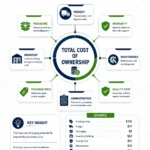
This is why strategic sourcing often uses Should-Cost Analysis and Total Cost of Ownership.
Supplier evaluation may focus mainly on:
Supplier evaluation can include:
The evaluation becomes more comprehensive because the sourcing decision may have long-term consequences.
Negotiation also changes significantly.
The discussion may be:
“Can you reduce the price by 5%?”
This can be effective for straightforward transactions.
The discussion may involve:
The negotiation is based on the overall commercial relationship rather than only the immediate quotation.
Traditional purchasing can involve transactional supplier relationships.
The organization buys what it needs and manages the transaction.
Strategic sourcing may classify suppliers according to their importance.
For example:
Transactional Supplier → Preferred Supplier → Strategic Supplier
Strategic suppliers may receive greater attention because their performance can materially affect the organization’s business.
Traditional purchasing may address risk when an issue occurs.
Strategic sourcing attempts to identify risk before supplier selection.
Procurement can then determine whether to:
Traditional purchasing may use a quotation request mainly to obtain price.
Strategic sourcing uses RFx events as structured market-engagement tools.
Used to understand supplier capabilities and the supply market.
Used to obtain comparable quotations for clearly defined requirements.
Used when suppliers need to propose broader solutions.
The objective is to gather the information needed to make a sourcing decision.
Traditional purchasing may compare a limited number of suppliers.
Strategic sourcing deliberately examines whether additional competition can improve the sourcing outcome.
This may involve:
Market Research → Supplier Identification → Qualification → Competitive RFx → Evaluation
Competition can help procurement discover:
Competition, however, should not be created at the expense of supplier quality or supply continuity.
Traditional purchasing often monitors operational indicators such as:
Strategic sourcing measures broader outcomes.
This creates a connection between sourcing decisions and business performance.
Technology can support both traditional purchasing and strategic sourcing, but the applications are different.
Common applications include:
Strategic sourcing platforms can support:
The difference is not simply whether technology is used.
It is how technology supports the procurement decision.
It is important to understand that strategic sourcing and purchasing are not competing functions.
They work together.
A simplified relationship is:
Strategic Sourcing
↓
Determines:
What to buy + Where to source + From whom + Under what commercial strategy
↓
Purchasing
↓
Executes:
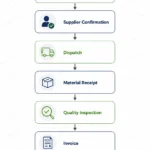
Requisition + PO + Delivery + Receipt + Invoice
Strategic sourcing establishes the strategic direction.
Purchasing executes the operational transactions.
Consider a manufacturing company purchasing a machined component.
Annual requirement:
100,000 units
Current supplier quotation:
₹250 per unit
A traditional purchasing approach may be:
Requirement → Request quotation → Compare price → Negotiate → Purchase Order
The buyer negotiates the supplier down to:
₹245 per unit
The immediate saving is:
₹5 × 100,000 = ₹5 lakh
The transaction is successfully completed.
But the broader supply strategy may remain unchanged.
The strategic sourcing team starts with the same requirement.
Annual spend:
100,000 × ₹250 = ₹2.5 crore
The team identifies five potential suppliers.
Three are technically capable.
The team studies:
Suppliers are assessed on:
The preferred supplier reaches:
₹225 per unit
Potential price improvement:
₹25 × 100,000 = ₹25 lakh
The team also negotiates:
The outcome is broader than purchase-price reduction.
It includes:
Cost improvement + supply resilience + better commercial terms + competitive supplier positioning
That is the strategic sourcing difference.
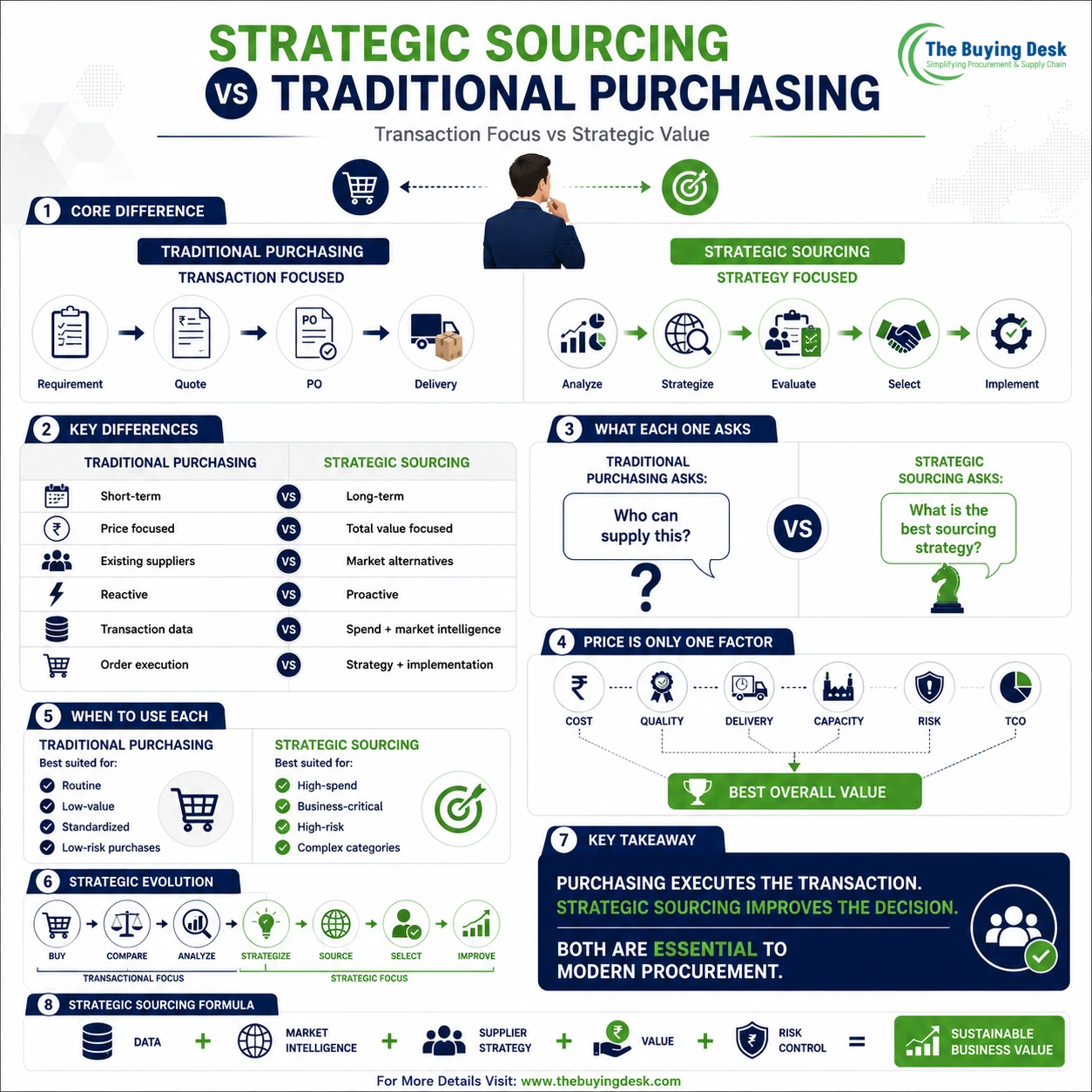
Strategic sourcing is not necessary for every single purchase.
Traditional purchasing can be highly appropriate when:
For example, routine office consumables may not require a major strategic sourcing project every time they are purchased.
Strategic sourcing is particularly valuable when:
Examples include:
Procurement can use a simple decision framework.
Is the category financially significant?
Could supplier disruption seriously affect operations?
Are qualified alternative suppliers available?
Does the category require technical, commercial or operational analysis?
Would a better sourcing decision materially improve business performance?
If the answers are largely yes, a strategic sourcing approach is usually justified.
A common misconception is that strategic sourcing always means changing suppliers.
It does not.
A strategic sourcing project may conclude that the existing supplier is already the best option.
The difference is that the decision is supported by:
The outcome may be:
“Stay with the existing supplier, but improve the commercial and contractual arrangement.”
That is still strategic sourcing.
Traditional purchasing remains essential for operational procurement.
Organizations of different sizes can apply strategic sourcing principles.
The real difference is broader than price.
It includes data, market analysis, strategy, risk, supplier evaluation and long-term value.
Not every low-value purchase requires extensive market analysis.
Procurement should apply the appropriate level of effort based on value, risk and complexity.
Supplier management focuses on managing supplier performance and relationships.
Strategic sourcing focuses on deciding the best sourcing approach and supplier strategy.
Both functions are connected but have different purposes.
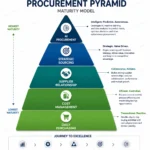
A mature procurement organization can use the following structure:
Purchase → Order → Delivery → Invoice
Focus:
Efficiency
Quotation → Comparison → Negotiation → Supplier Selection
Focus:
Commercial competitiveness
Spend → Category → Market → Strategy → Suppliers → RFx → Evaluation → Negotiation → Selection
Focus:
Long-term business value
This three-level view helps procurement teams understand where strategic sourcing fits within the broader procurement function.
| Dimension | Traditional Purchasing | Strategic Sourcing |
|---|---|---|
| Question | What do we need to buy? | What is the best sourcing strategy? |
| Timing | After requirement arises | Before sourcing decision |
| Data | Transaction data | Spend + market + supplier + cost data |
| Supplier pool | Often existing | Existing + market alternatives |
| Cost | Quoted price | Cost structure + TCO |
| Competition | Limited | Deliberately evaluated |
| Risk | Issue response | Preventive assessment |
| Negotiation | Transaction focused | Value and strategy focused |
| Contract | Purchase-focused | Long-term commercial framework |
| Relationship | Transactional | Strategic where appropriate |
| Measurement | Order performance | Business and sourcing outcomes |
Organizations that mature their procurement approach can potentially achieve:
Procurement gains greater visibility into category costs and cost drivers.
Market research can uncover qualified alternative suppliers.
Dual sourcing, supplier development and contingency planning can strengthen supply continuity.
Supplier capability becomes a deliberate selection criterion.
Negotiations can address the complete commercial relationship rather than only unit price.
Sourcing decisions can be aligned with growth, technology, quality and supply-chain objectives.
Moving toward strategic sourcing does not require abandoning transactional purchasing.
Instead, procurement teams can progressively increase their strategic capabilities.
Build reliable category and supplier spend data.
Prioritize categories based on:
Spend + Risk + Business Impact + Opportunity
Understand suppliers, competitors, capacity, technologies and cost drivers.
Decide whether categories should be:
Use consistent commercial, technical, quality, delivery and risk criteria.
Track not only savings but also:
The difference can ultimately be summarized as follows:
Traditional Purchasing
Requirement → Quotation → Negotiation → PO → Delivery
Strategic Sourcing
Requirement → Spend Analysis → Category Analysis → Market Analysis → Strategy → Supplier Discovery → RFx → Evaluation → Negotiation → Selection → Contract → Implementation → Measurement
Traditional purchasing is essential for execution.
Strategic sourcing is essential for decision quality.
A mature procurement organization needs both.
Is strategic sourcing the same as purchasing?
No. Purchasing focuses primarily on executing procurement transactions, while strategic sourcing focuses on analyzing markets, suppliers, costs and risks to develop the best sourcing strategy.
What is the main difference between strategic sourcing and traditional purchasing?
Traditional purchasing is generally transaction-focused, while strategic sourcing is proactive and analytical, considering spend, market conditions, supplier capability, risk and long-term value.
Does strategic sourcing always reduce price?
No. Strategic sourcing may improve total value through lower TCO, better quality, improved delivery, reduced risk, better payment terms or stronger supplier capability.
Can the existing supplier remain after strategic sourcing?
Yes. Strategic sourcing does not automatically mean changing suppliers. Market and cost analysis may confirm that the existing supplier remains the best overall option.
Is traditional purchasing still important?
Yes. Purchasing is essential for executing purchase orders, managing deliveries, receiving goods and completing day-to-day procurement transactions.
When should a company use strategic sourcing?
Strategic sourcing is particularly useful for high-spend, high-risk, business-critical or complex categories where supplier selection can materially affect cost, quality or supply continuity.
How does strategic sourcing improve supplier selection?
It uses broader evaluation criteria such as cost, quality, delivery, capacity, technical capability, financial strength, risk and Total Cost of Ownership rather than relying mainly on quotation price.
Can small businesses use strategic sourcing?
Yes. Small businesses can apply strategic sourcing principles by analyzing spend, comparing suppliers, understanding markets, evaluating TCO and developing appropriate supplier strategies.
Traditional purchasing and strategic sourcing are not alternatives where one must replace the other.
They perform different roles.
Traditional purchasing keeps procurement transactions moving.
Strategic sourcing improves the decisions behind those transactions.
The evolution can be represented as:
Buy → Compare → Analyze → Strategize → Source → Negotiate → Select → Implement → Improve
The goal is not to make every purchase complicated.
The goal is to apply the right level of strategic thinking to the categories where it can create meaningful business value.
For procurement teams, this means moving beyond:
“Who has the lowest price?”
toward:
“Which sourcing strategy and supplier combination delivers the best overall value at an acceptable level of risk?”
That is the fundamental shift from traditional purchasing to strategic sourcing.