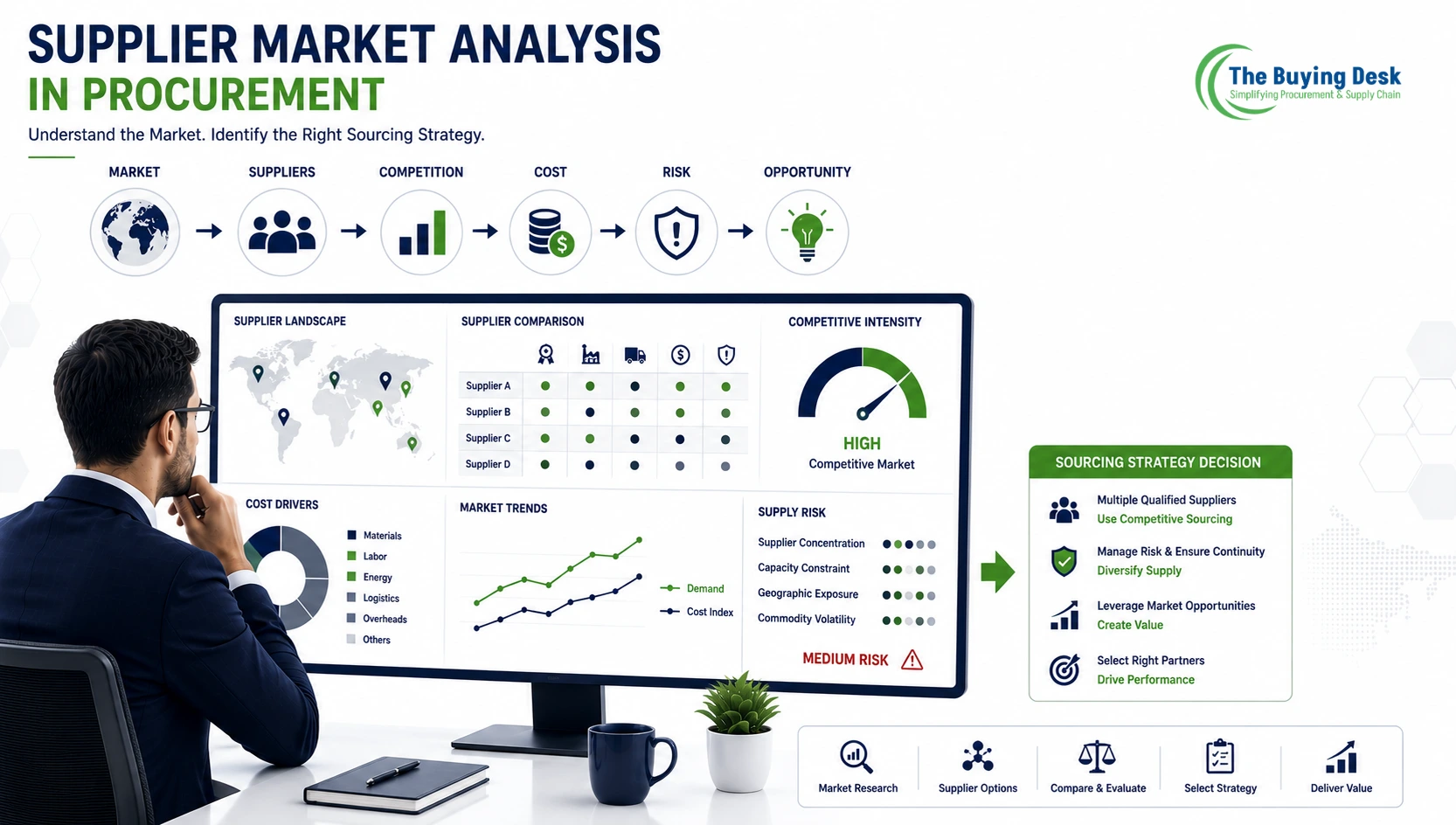
Supplier market analysis is a critical part of strategic sourcing and category management. It helps procurement teams understand the external supply market before making important sourcing, supplier selection or negotiation decisions.
Instead of looking only at existing suppliers and historical prices, supplier market analysis examines the broader market:
Who can supply?
How competitive is the market?
What are the major cost drivers?
What risks exist?
What alternatives are available?
How is the market changing?
These insights allow procurement professionals to develop sourcing strategies based on market intelligence rather than assumptions.
For organizations managing significant spend, complex categories or business-critical materials, supplier market analysis can improve supplier selection, negotiation leverage, supply continuity and long-term procurement value.
Supplier market analysis is the systematic process of researching and evaluating the suppliers, competitive environment, market structure, capabilities, costs, risks and trends associated with a procurement category.
A simple framework is:
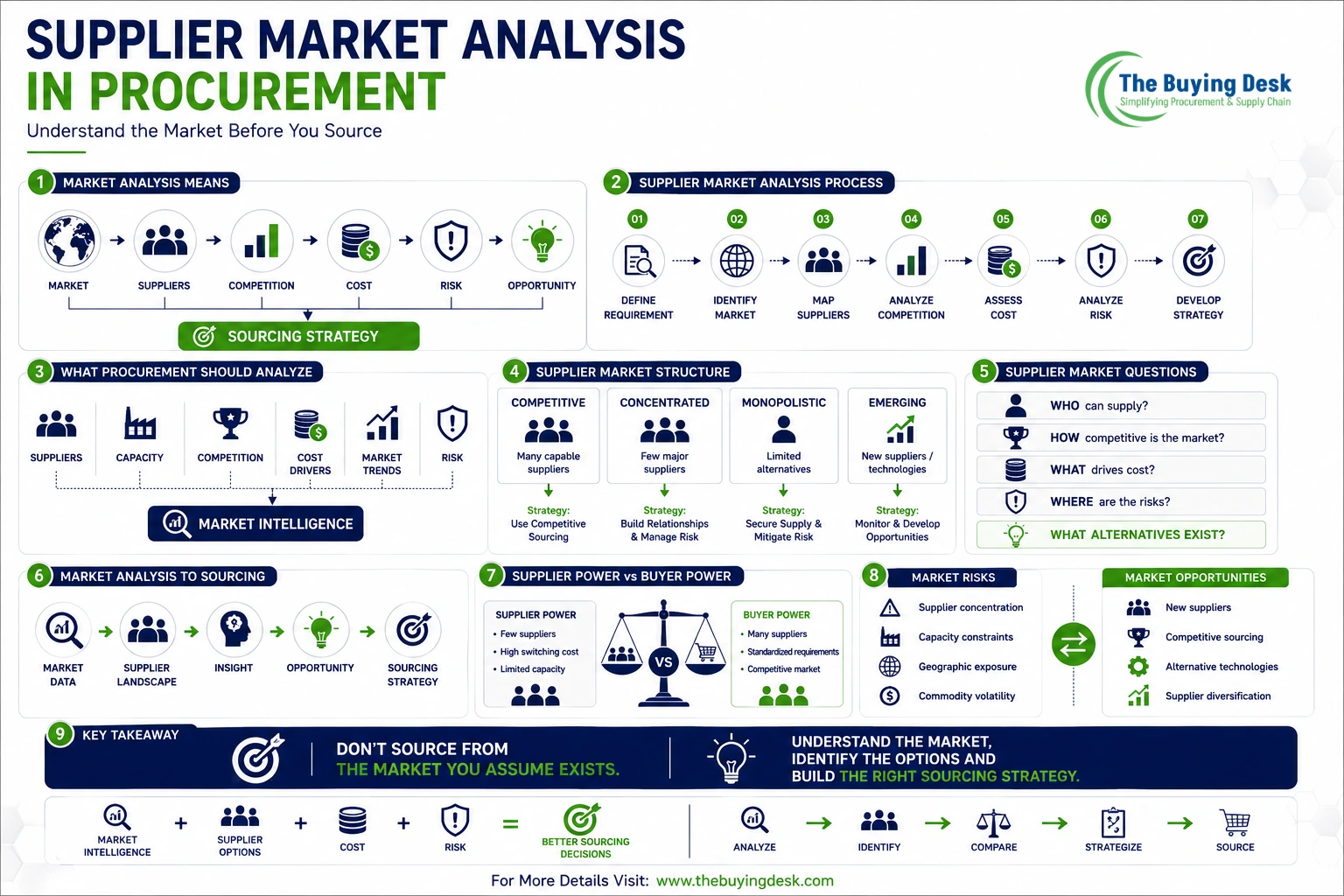
Market Data → Supplier Landscape → Competition → Cost Drivers → Risk → Opportunities → Sourcing Strategy
The objective is not simply to create a list of suppliers.
The objective is to understand how the supply market works and how procurement should respond.
Procurement decisions are strongly influenced by external market conditions.
For example, procurement may believe that only two suppliers are available. Market research may reveal several qualified alternatives.
Similarly, a supplier may request a price increase because of higher material costs. Market analysis may show that the relevant commodity price has actually declined.
Supplier market analysis therefore provides context for:
These activities are related but different.
Looks at the overall supply market.
It asks:
What suppliers and market conditions exist?
Looks at a specific supplier.
It asks:
How capable and suitable is this supplier for our requirements?
The relationship is:
Market Analysis → Supplier Discovery → Supplier Evaluation → Supplier Selection
This distinction is important because evaluating only current suppliers can prevent procurement from discovering better alternatives.
A comprehensive market analysis may examine:
The exact analysis depends on the category.
A practical supplier market analysis can follow this sequence:
01 Define Category
→ 02 Define Requirements
→ 03 Identify Market
→ 04 Map Suppliers
→ 05 Analyze Competition
→ 06 Analyze Cost Drivers
→ 07 Assess Risk
→ 08 Identify Opportunities
→ 09 Develop Sourcing Strategy
Before researching suppliers, procurement must clearly define what is being sourced.
The category definition may include:
A vague requirement can produce misleading market research.
Procurement should understand what the business actually needs.
Important questions include:
Market analysis is useful only when suppliers are assessed against real business requirements.
The next step is determining the relevant market.
This may involve:
For example, the relevant market for a specialized industrial component may be global, while the market for a facility service may be primarily regional.
Procurement can use multiple sources to identify potential suppliers.
Sources may include:
The objective is to create a sufficiently broad supplier landscape before narrowing the field.
The supplier landscape should provide a structured view of potential suppliers.
Useful information includes:
| Supplier Information | Examples |
|---|---|
| Location | Country / region |
| Capability | Products / services |
| Capacity | Production capability |
| Technology | Manufacturing / service technology |
| Customers | Relevant market experience |
| Certifications | Quality / industry certifications |
| Geographic reach | Local / regional / global |
| Financial position | Stability indicators |
| Strategic fit | Business compatibility |
This makes supplier discovery more systematic.
Market structure describes how suppliers compete within the market.
Procurement may encounter:
Highly Competitive Market
Many capable suppliers compete for business.
Typical strategy:
Competitive sourcing
Concentrated Market
A small number of suppliers dominate.
Typical strategy:
Relationship management + risk mitigation
Monopolistic Market
One supplier may control most or all available supply.
Typical strategy:
Alternative development + risk management
Emerging Market
New suppliers or technologies are entering the market.
Typical strategy:
Market monitoring + supplier qualification
Supplier concentration is important because it can affect procurement leverage and supply risk.
If only a few suppliers control most market capacity, switching may be difficult.
Procurement should examine:
Number of Suppliers + Market Share + Capacity + Switching Difficulty
A highly concentrated supply market may require stronger contingency planning.
Competitive intensity can be influenced by:
The more competitive the market, the more opportunities procurement may have to use competitive sourcing.
Understanding supplier costs is essential for strategic sourcing.
Typical cost drivers may include:
A simplified cost structure might look like:
Material + Labor + Conversion + Logistics + Overhead + Margin = Supplier Price
The actual structure varies by category.
Markets change continuously.
Procurement should monitor:
A sourcing strategy based on outdated market information can quickly become ineffective.
Supplier market analysis should identify external risks.
Potential risks include:
Risk should be assessed alongside commercial opportunity.
Procurement should not assume that the current product or technology is the only solution.
Potential alternatives may include:
Substitution can sometimes create greater value than simply negotiating with existing suppliers.
A supplier market map can classify suppliers according to factors such as:
Capability
Geographic Coverage
Capacity
Technology
Cost Position
Strategic Fit
For example:
High Capability + High Capacity
→ Potential strategic supplier
High Capability + Low Capacity
→ Potential but capacity-constrained
Low Capability + High Capacity
→ Suitable only for selected requirements
Low Capability + Low Capacity
→ Limited strategic relevance
Porter’s Five Forces can be used as a strategic framework for understanding competitive market dynamics.
The five forces are:
How much influence do suppliers have over price, terms and availability?
How much influence does the buying organization have?
How strongly do suppliers compete with one another?
How difficult is it for new suppliers to enter the market?
Can alternative products, technologies or solutions replace the requirement?
The framework can help procurement understand the broader competitive environment.
Supplier power may increase when:
In such situations, procurement may need to focus more strongly on:
Risk Management + Supplier Development + Alternative Sources
Buyer power may increase when:
This can create stronger opportunities for:
Competition + Negotiation + Supplier Benchmarking
High barriers to entry may exist because of:
High entry barriers can reduce supplier competition.
Switching suppliers may involve:
Therefore, the theoretical number of suppliers may be much larger than the number of practically usable suppliers.
Procurement can gather market intelligence from:
No single source should automatically be treated as complete.
Information collected directly from market participants.
Examples:
Information collected from existing sources.
Examples:
Using both can improve the quality of market intelligence.
An RFI can be useful when procurement needs information directly from suppliers.
It can help establish:
However, an RFI should be structured carefully.
The goal is market intelligence, not simply collecting marketing brochures.
Market analysis directly influences sourcing strategy.
For example:
Competitive Market
→ Multi-supplier competition
Concentrated Market
→ Supplier relationship + risk management
High-Risk Market
→ Dual sourcing / contingency planning
Emerging Technology Market
→ Supplier innovation + market monitoring
High-Switching-Cost Market
→ Long-term supplier strategy
Thus:
Market Intelligence → Sourcing Strategy
Market intelligence strengthens negotiation preparation.
Procurement can understand:
This makes negotiations more evidence-based.
Instead of saying:
“Your price is too high.”
procurement can discuss the relevant market factors supporting the expected commercial position.
Market analysis can support benchmarking by comparing:
Benchmarking should account for differences in specifications, volumes, geography and service requirements.
A simple price comparison without context can produce misleading conclusions.
Market intelligence can reveal risks before they become supply disruptions.
For example:
Market Concentration
→ Limited alternatives
Capacity Shortage
→ Longer lead times
Commodity Volatility
→ Price uncertainty
Geographic Concentration
→ Regional disruption exposure
Technology Dependence
→ Switching difficulty
Procurement can then develop appropriate mitigation actions.
Market analysis can support make-or-buy decisions.
If external suppliers offer:
then external sourcing may be attractive.
If the external market is:
internal production may deserve further consideration.
This connects supplier market analysis with make-or-buy analysis.
Market analysis is particularly valuable when an organization wants to introduce new suppliers.
It helps procurement determine:
The goal is to expand the qualified supplier pipeline, not simply create a larger supplier database.
Global sourcing requires additional market considerations.
Procurement may assess:
A lower supplier price does not automatically mean a lower total sourcing cost.
Procurement may compare:
| Factor | Local Market | Global Market |
|---|---|---|
| Lead time | Often shorter | Often longer |
| Logistics | Simpler | More complex |
| Supplier pool | Potentially smaller | Potentially larger |
| Currency exposure | Lower | Potentially higher |
| Geographic risk | More concentrated | Potentially diversified |
| Communication | Often easier | May be more complex |
The appropriate sourcing geography depends on the category and business requirements.
Category management relies heavily on external market intelligence.
The category manager needs to understand:
Internal Spend
Business Demand
External Market
Supplier Landscape
Cost Drivers
Risk
=
Category Strategy
Without market analysis, category strategies can become overly dependent on historical purchasing patterns.
Useful measures may include:
Number of relevant suppliers identified.
Number of suppliers meeting initial qualification requirements.
Percentage of priority categories with updated market analysis.
Percentage of sourcing events with meaningful supplier competition.
Percentage of critical requirements with viable alternatives.
Percentage of strategic categories with documented market-risk assessments.
This limits competition and may reinforce the status quo.
A large supplier list is not useful if most suppliers cannot meet requirements.
A supplier may be technically capable but unable to support required volume.
Market analysis should include supply, cost, risk, technology and capability.
Markets change quickly.
Alternative technologies or materials may provide better solutions.
The most attractive supplier may not be practical because of logistics or country risk.
External reports should be validated against supplier and internal intelligence.
Define the product, service and requirements before researching the market.
Combine internal data, supplier information and external research.
Understand current, potential and emerging suppliers.
Determine whether the market genuinely supports competitive sourcing.
Know what drives supplier pricing.
Capability without capacity may not create a viable sourcing option.
Commercial attractiveness should be balanced with supply resilience.
Evaluate substitutes, new technologies and alternative specifications.
Market analysis should be refreshed when conditions change.
The final output should influence sourcing and category strategy.
Before completing a supplier market analysis, procurement should be able to answer:
A practical market analysis can be structured into seven sections:
Define requirements, spend and business importance.
Identify current and potential suppliers.
Assess competition, concentration and entry barriers.
Understand the economics behind supplier pricing.
Monitor demand, supply, technology and external conditions.
Identify vulnerabilities and potential disruption factors.
Convert the findings into sourcing and supplier strategy.
Supplier market analysis gives procurement a view of the world outside the organization.
Spend analysis tells procurement:
“What are we currently buying?”
Supplier market analysis adds:
“What does the external market make possible?”
When these perspectives are combined, procurement can make stronger sourcing decisions.
The complete logic is:
REQUIREMENT → MARKET → SUPPLIERS → COMPETITION → COST → RISK → OPPORTUNITY → STRATEGY
Effective supplier market analysis helps procurement move from:
Known Suppliers
to:
Known Market Options
and ultimately to:
Better Sourcing Decisions.
What is supplier market analysis in procurement?
Supplier market analysis is the process of studying suppliers, competition, market conditions, capabilities, costs and risks within a sourcing market. It helps procurement develop better sourcing and supplier strategies.
Why is supplier market analysis important?
It helps procurement understand available alternatives and the competitive environment before making sourcing decisions. This can improve supplier selection, negotiation leverage, risk management and sourcing outcomes.
What is the difference between supplier market analysis and supplier evaluation?
Supplier market analysis examines the broader market and potential supplier landscape. Supplier evaluation assesses individual suppliers against defined requirements and selection criteria.
What information is included in supplier market analysis?
It can include supplier capabilities, capacity, market concentration, competition, cost drivers, geographic factors, technology, market trends, substitutes and supply risks.
How does supplier market analysis support strategic sourcing?
It provides external market intelligence that helps procurement choose the right sourcing approach. The findings can influence competition, supplier diversification, negotiation, risk mitigation and supplier selection.
How often should supplier market analysis be performed?
The frequency depends on category risk and market volatility. Strategic or volatile categories should generally be monitored more frequently than stable, low-risk categories.
What are common sources of supplier market intelligence?
Sources include supplier discussions, RFIs, industry associations, trade events, market reports, publications, commodity information, internal spend data and other credible industry sources.
Can supplier market analysis reduce procurement risk?
Yes. It can identify supplier concentration, capacity constraints, geographic exposure, substitutes and other market vulnerabilities. Procurement can then develop appropriate mitigation strategies.