A supplier’s quoted price tells procurement what the supplier wants to charge. It does not necessarily explain what the product or service should reasonably cost.
This is where should-cost analysis becomes valuable.
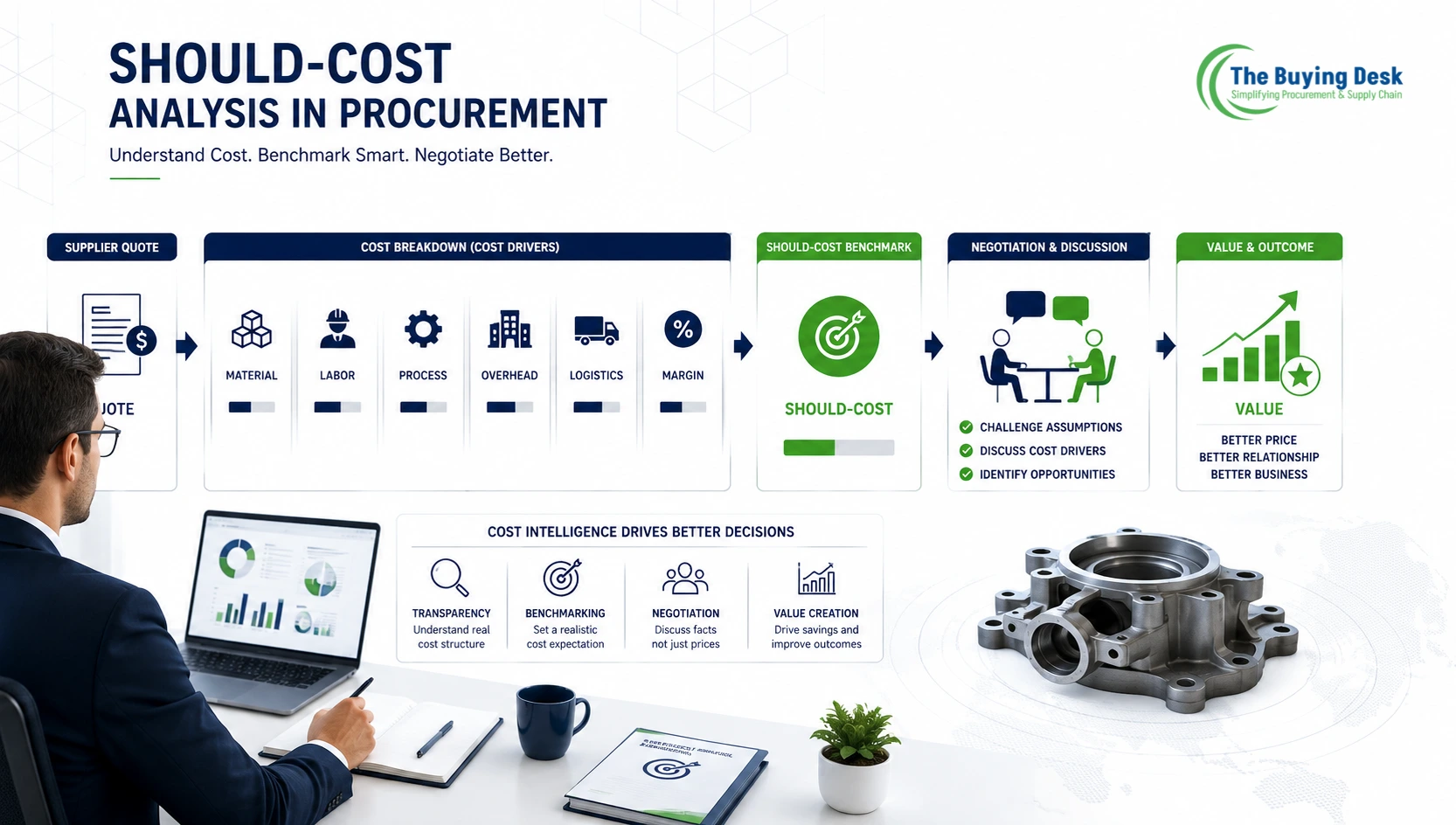
Should-cost analysis is a structured procurement method used to estimate the reasonable cost of a product, component, service or process by examining its underlying cost drivers.
Instead of asking only, “What price did the supplier quote?”, procurement can ask:
“What should this item reasonably cost based on materials, labor, overhead, processing, logistics and other relevant factors?”
This provides a stronger foundation for supplier evaluation, negotiation, sourcing strategy and cost improvement.
Should-cost analysis is the process of estimating the reasonable cost of a product, component, service or activity by analyzing its underlying cost elements, operational assumptions and relevant market factors.
The objective is not to determine an exact universal price.
The objective is to establish a credible cost benchmark that helps procurement understand supplier economics and evaluate whether a quotation is commercially reasonable.
Suppose a supplier quotes $100 for a manufactured component.
Procurement could simply compare that quotation with previous prices.
A should-cost analysis would instead examine factors such as:
The resulting estimate may indicate that the component should reasonably cost around $85–$90, depending on the assumptions used.
The difference does not automatically mean the supplier is overcharging. It creates a question for further analysis and negotiation.
Supplier quotations often combine many cost elements into a single commercial price.
Should-cost analysis breaks the price into understandable components.
This helps procurement see what is driving the supplier’s economics.
A negotiation based only on a target price can become subjective.
A should-cost model provides a fact-based discussion around:
Material + Labor + Process + Overhead + Logistics + Profit
This allows procurement to challenge assumptions rather than simply demand a lower price.
Should-cost analysis can help procurement determine whether an opportunity is genuinely competitive.
It can support decisions such as:
The analysis may reveal that the largest opportunity is not the supplier’s margin.
The real opportunity could be:
This shifts the discussion from price reduction to cost improvement.
The quoted price represents the supplier’s commercial offer.
It may include:
Cost + Overhead + Profit + Risk Premium + Commercial Factors
Should-cost analysis attempts to estimate:
Reasonable Cost + Reasonable Operating Assumptions + Appropriate Margin
The two figures serve different purposes.
The supplier quotation answers:
“What will the supplier charge?”
The should-cost model asks:
“What should the product or service reasonably cost?”
The difference can provide valuable negotiation and sourcing insight.
Material is often one of the largest cost drivers in manufactured products.
Procurement may analyze:
A change in material price can significantly affect the expected cost.
Labor analysis can consider:
The objective is to understand how much direct labor is reasonably required to produce the item.
For manufactured components, procurement may analyze:
This helps connect the manufacturing process to the expected cost.
Overhead can include costs associated with operating the production environment.
Examples include:
Care is required because overhead allocation methods can differ between suppliers.
Material utilization can have a significant impact on cost.
For example, two suppliers using the same raw material may have different yields because of differences in:
Should-cost analysis can therefore expose improvement opportunities beyond material price.
The total cost may also include:
These factors become particularly important when suppliers operate across different regions.
A should-cost model may include a reasonable supplier margin.
The purpose is not to eliminate supplier profitability.
A sustainable sourcing strategy requires suppliers to remain commercially viable while providing competitive value to the buyer.
Clearly define what is being analyzed.
This could be:
A clearly defined scope prevents inconsistent assumptions.
Study the technical and operational requirements.
For a manufactured product, this may include:
For services, the analysis may focus on labor, resources, technology and service-level requirements.
Determine which factors materially influence cost.
Typical drivers include:
Material + Labor + Processing + Overhead + Logistics + Margin
Not every cost driver has equal importance.
Procurement should focus particularly on the elements with the greatest impact.
Data may come from:
The quality of the should-cost model depends heavily on the quality of its assumptions.
Develop a structured model showing how the total expected cost is calculated.
A simplified model could be:
Should Cost = Material + Labor + Processing + Overhead + Logistics + Other Costs + Reasonable Margin
The model should be transparent enough that assumptions can be challenged and updated.
Review the model with relevant stakeholders.
Depending on the category, this may include:
Cross-functional validation reduces the risk of building a theoretically attractive but unrealistic cost model.
Compare the estimated should-cost with:
This creates a broader commercial picture.
The difference between expected cost and quoted price can be analyzed.
For example:
Quoted Price − Should-Cost = Cost Gap
The gap should then be investigated rather than automatically treated as supplier profit.
Use the analysis to have a fact-based supplier conversation.
Questions may include:
The final objective is not simply to create a spreadsheet.
Procurement should convert the findings into actions such as:
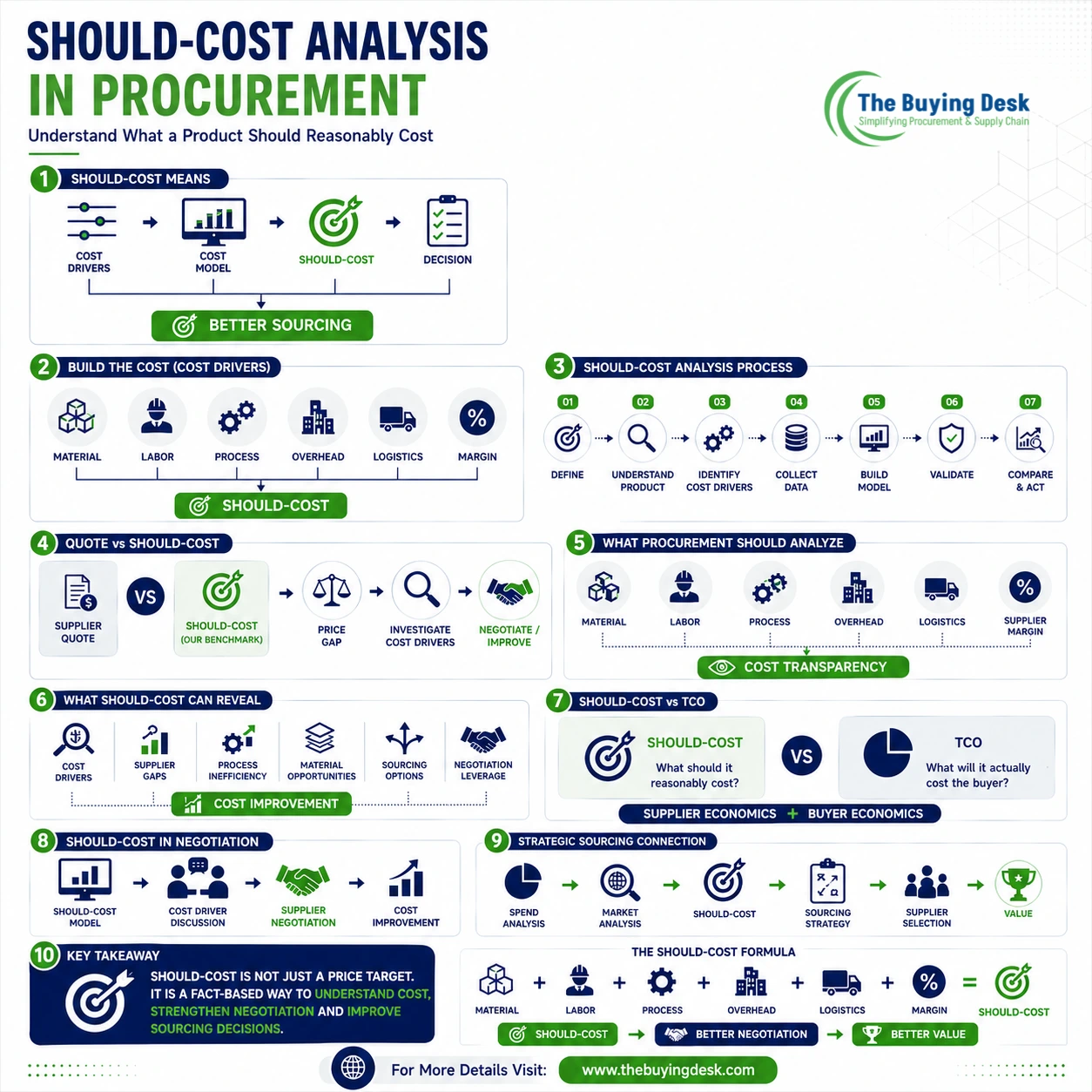
This approach builds the expected cost from individual components.
For example:
Material → Labor → Machine → Overhead → Logistics → Margin
It can provide strong visibility when reliable technical and operational data are available.
Procurement can compare costs against:
This can be useful when detailed supplier cost information is unavailable.
Parametric models estimate cost based on measurable variables.
Examples could include:
This approach can be particularly useful when analyzing large product portfolios.
Certain cost elements can be linked to external market indices.
For example, a component with significant metal content may be affected by changes in the relevant commodity market.
Index-based analysis helps procurement distinguish market-driven movements from supplier-specific changes.
The should-cost model provides procurement with a defensible commercial reference.
Instead of saying:
“Your price is too high.”
Procurement can discuss:
“Our analysis indicates that material, labor and processing assumptions support a different cost position.”
This creates a more constructive negotiation.
A common mistake is to focus entirely on supplier profit.
However, the largest opportunity may sit elsewhere.
For example:
Material = 50%
Labor = 15%
Processing = 20%
Overhead = 10%
Margin = 5%
Reducing margin alone may have limited impact.
Improving material yield or manufacturing efficiency could create a much larger opportunity.
A should-cost model is based on assumptions.
Suppliers may have legitimate differences in:
Therefore, procurement should use should-cost analysis as a decision-support tool, not as an unquestionable price target.
Material is important, but it is not the entire cost structure.
Ignoring labor, process efficiency, logistics and overhead can produce misleading conclusions.
A should-cost model based on old commodity prices or labor rates may no longer represent current market conditions.
Models should be refreshed when significant cost drivers change.
A theoretical model may not reflect the actual supplier environment.
Supplier capacity, location, technology and operational constraints can materially affect cost.
Should-cost analysis should support fact-based negotiation.
Using it simply to pressure suppliers can damage trust and reduce the willingness to share cost information.
A model does not become better simply because it contains more variables.
The best models are transparent, relevant and explainable.
Should-cost analysis asks:
“What should this product or service reasonably cost?”
It focuses primarily on the underlying cost structure.
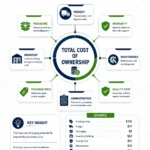
TCO asks:
“What will this purchase actually cost the organization over its lifecycle?”
TCO may include:
The two approaches can complement each other.
Should-cost helps understand supplier economics.
TCO helps understand buyer economics.
Together, they provide a stronger sourcing perspective.
Spend analysis identifies categories where cost analysis may create significant value.
Market analysis provides context around supplier capabilities, competition and cost structures.
Should-cost analysis establishes a fact-based cost benchmark.
The findings can influence:
Cost insight can then be combined with:
This creates a more balanced supplier decision.
Product + Process + Requirements
Material + Labor + Processing + Overhead + Logistics
Market + Suppliers + Historical Data + Internal Data
Cost Drivers + Assumptions + Reasonable Margin
Should-Cost vs Quoted Price vs Market Alternatives
Negotiate + Improve + Source + Monitor
This framework helps procurement move from price comparison to cost intelligence.
A company is sourcing a machined metal component.
The incumbent supplier quotes $42 per unit.
Procurement develops a should-cost model based on:
The analysis produces an estimated cost of $37 per unit.
The $5 difference should not automatically be treated as excess supplier margin.
Procurement should investigate:
Is the material assumption accurate?
Is the machining time realistic?
Are labor rates appropriate?
Is supplier utilization different?
Are there unique quality or tooling requirements?
Is freight included consistently?
The goal is to understand why the gap exists.
That insight can then support negotiation or process improvement.
Procurement enters negotiations with stronger cost intelligence.
Supplier quotations can be evaluated against a structured benchmark.
The organization gains greater understanding of what drives purchase prices.
Cost insights can influence sourcing models, supplier competition and category strategy.
Engineering, procurement, finance and operations can work from a common cost framework.
The analysis can reveal opportunities for product, process and specification improvements.
Should-cost analysis helps procurement move beyond the question:
“What price did the supplier quote?”
toward a more strategic question:
“What should this product or service reasonably cost?”
The strongest should-cost models combine technical understanding, market intelligence, cost-driver analysis and commercial judgment.
When used correctly, should-cost analysis becomes a powerful tool for strategic sourcing, supplier negotiation and long-term cost management.
What is should-cost analysis in procurement?
Should-cost analysis estimates what a product or service should reasonably cost based on its underlying cost drivers. It helps procurement evaluate supplier pricing and negotiate from a fact-based position.
Why is should-cost analysis important?
It improves cost transparency and gives procurement a structured benchmark for supplier quotations. It can also reveal cost-reduction and sourcing opportunities.
Is should-cost the same as supplier price?
No. Supplier price is the supplier’s commercial quotation, while should-cost is an analytical estimate of reasonable cost. The difference between them can provide useful insight for procurement.
What costs are included in a should-cost model?
Common elements include material, labor, processing, overhead, scrap, logistics and an appropriate supplier margin. The exact structure depends on the product, service and category.
How does should-cost analysis help negotiations?
It gives procurement evidence for discussing cost drivers rather than simply asking for a lower price. This can make supplier negotiations more objective and constructive.
Is should-cost analysis only for manufacturing?
No. It is especially useful in manufacturing, but the principle can also be applied to services, logistics, packaging, technology and other categories where underlying cost drivers can be analyzed.
What is the difference between should-cost and TCO?
Should-cost focuses on estimating the reasonable underlying cost of a product or service. TCO evaluates the broader cost to the buying organization across the purchase and lifecycle.
Can should-cost analysis determine the exact fair price?
Not necessarily. It provides an analytical benchmark based on assumptions and available data. Supplier capabilities, market conditions, capacity and risk can all affect the final commercial price.
Should-cost analysis is one of the most valuable analytical tools in strategic procurement.
It transforms a supplier quotation from a standalone number into something procurement can investigate, understand and challenge.
By breaking cost into its underlying drivers and combining that analysis with market intelligence, procurement can make better sourcing decisions, conduct stronger negotiations and identify sustainable cost-improvement opportunities.
The objective is not simply to pay less.
The objective is to understand cost, create value and build commercially sound sourcing decisions.