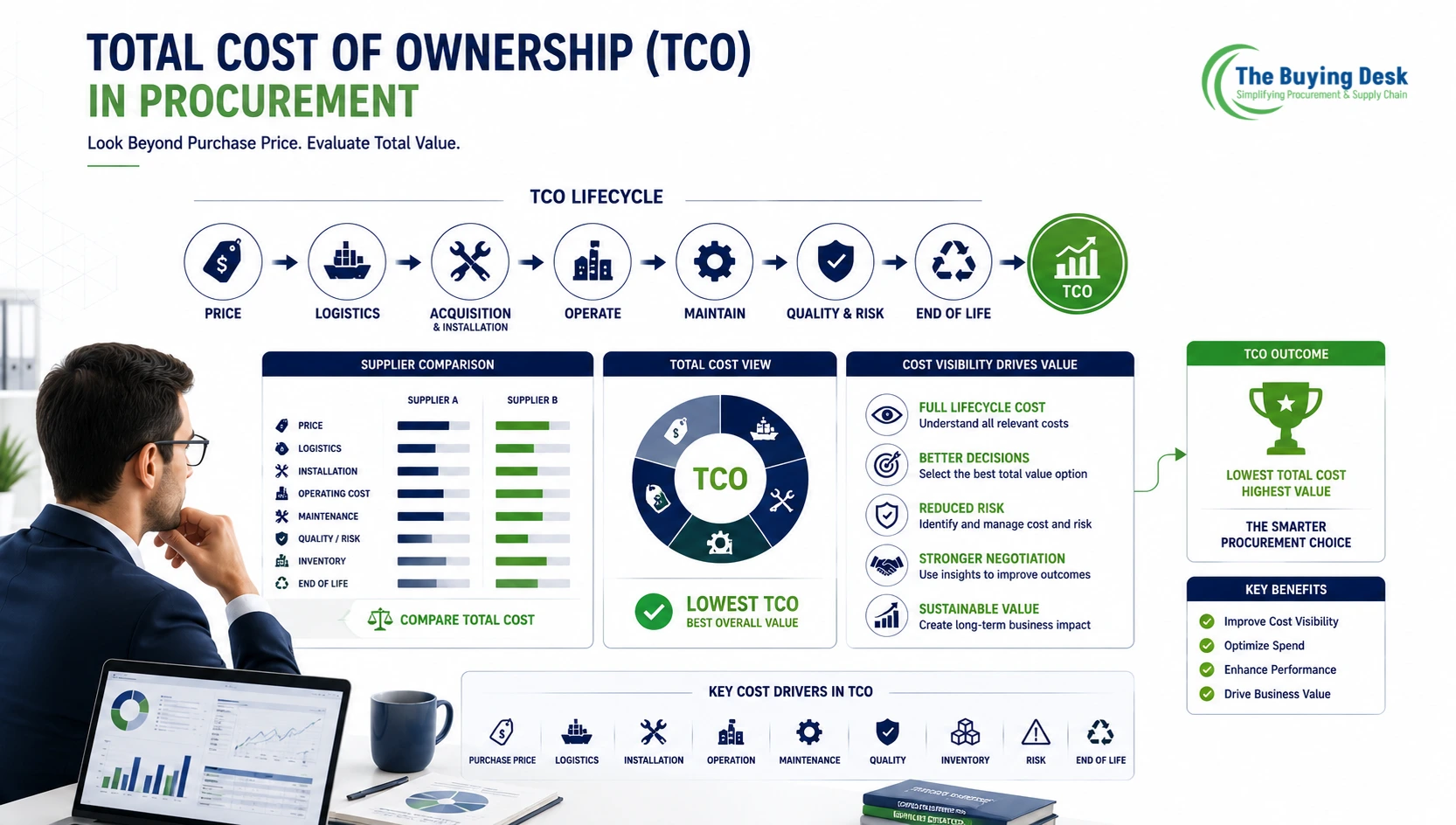
A supplier offering the lowest price is not necessarily offering the lowest overall cost.
A lower purchase price may come with higher freight, inventory, quality, maintenance, operating, administrative or end-of-life costs. Total Cost of Ownership, commonly called TCO, provides a broader view by evaluating the costs associated with a purchase across its relevant lifecycle.
CIPS describes TCO as an estimate used to determine the end-to-end cost of providing a service or manufacturing a product, including procurement, acquisition, usage and end-of-life costs.
For procurement, this changes the question from:
“Which supplier has the lowest price?”
to:
“Which option creates the lowest overall cost and the best business value?”
That distinction is particularly important for strategic sourcing, capital equipment, complex components, long-term services and purchases where logistics, quality, operating or lifecycle costs can materially affect the final outcome.
Total Cost of Ownership is a method for evaluating the complete economic cost of a product, service, asset or sourcing option over its relevant lifecycle.
It goes beyond the supplier’s quoted price and considers costs that occur before, during and after acquisition.
A practical TCO view can include:
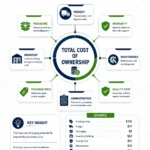
Purchase → Acquisition → Operation → Maintenance → Quality → Risk → End of Life
The exact components depend on the category being analyzed. CIPS groups TCO into procurement, acquisition, usage and end-of-life costs.
The objective is not to include every imaginable cost.
The objective is to identify the costs that materially influence the procurement decision.
Purchase price is often the easiest cost to see and compare.
However, other costs can significantly change the economics of a sourcing decision. For example, freight, installation, energy consumption, maintenance, downtime, quality problems and disposal may all affect the true cost of an option.
TCO helps procurement teams:
Purchase price answers:
“How much do we pay the supplier?”
TCO answers:
“How much will this decision cost us overall?”
These are not always the same.
A supplier with a higher quoted price may still have a lower TCO if it offers better quality, shorter lead times, lower logistics costs, lower maintenance requirements or better operational performance.
Therefore, procurement should avoid treating unit price as the complete economic picture when additional lifecycle costs are material.
A useful TCO model normally organizes costs into logical categories rather than treating all costs as one number.
Acquisition costs are the costs required to obtain the product, service or asset and make it available for use.
They may include:
The exact scope depends on the category and sourcing model.
Operating costs arise while the product, equipment or service is being used.
Examples include:
For equipment-intensive categories, operating costs can become an important part of the overall ownership economics.
Maintenance costs cover the resources required to keep the product or asset performing as expected.
These may include:
A low purchase price can lose its advantage if ongoing maintenance requirements are significantly higher.
Quality performance can also influence TCO.
Potential costs include:
The cost impact of poor quality should be considered when it is relevant to the sourcing decision.
Logistics can have a significant impact on the economics of supplier selection.
Relevant factors may include:
A lower supplier price may be offset by higher logistics or inventory requirements.
Risk is more difficult to quantify, but it can still be relevant to TCO.
Potential sources include:
Not every risk should automatically be converted into a monetary value. However, material risk differences should be considered in the decision.
Some purchases create costs after their useful life ends.
Examples include:
Government procurement guidance similarly describes TCO as the purchase price plus other lifecycle costs, with disposal and residual value potentially affecting the overall calculation.
A structured process helps prevent important cost elements from being overlooked.
Start by clearly defining what is being evaluated.
Specify:
A clear scope prevents the TCO model from becoming unnecessarily complicated.
List the cost categories that can materially affect the decision.
For example:
Purchase Price + Logistics + Quality + Inventory + Operation + Maintenance + End of Life
Not every category will apply to every purchase.
Gather information from the appropriate functions and sources.
Potential sources include:
The quality of the TCO result depends heavily on the quality of the underlying assumptions and data.
Structure the costs in a consistent model.
A simplified framework is:
TCO = Acquisition Costs + Operating Costs + Maintenance Costs + Quality Costs + Other Relevant Lifecycle Costs + End-of-Life Costs − Relevant Residual Value
The exact formula should be adapted to the procurement category.
Apply the same logic to each supplier or sourcing option.
For example:
| Cost Area | Supplier A | Supplier B |
|---|---|---|
| Purchase | Evaluate | Evaluate |
| Logistics | Evaluate | Evaluate |
| Quality | Evaluate | Evaluate |
| Inventory | Evaluate | Evaluate |
| Operating | Evaluate | Evaluate |
| Maintenance | Evaluate | Evaluate |
| Risk | Evaluate | Evaluate |
| End of Life | Evaluate | Evaluate |
| Total Cost | Compare | Compare |
The purpose is to compare alternatives on a consistent basis rather than simply comparing quotations.
TCO models often contain assumptions.
Review assumptions such as:
Sensitivity analysis can help determine which assumptions have the greatest influence on the result.
The final decision should not automatically go to the supplier with the lowest calculated TCO.
Procurement should also consider:
TCO is a decision-support framework, not a replacement for professional judgment.
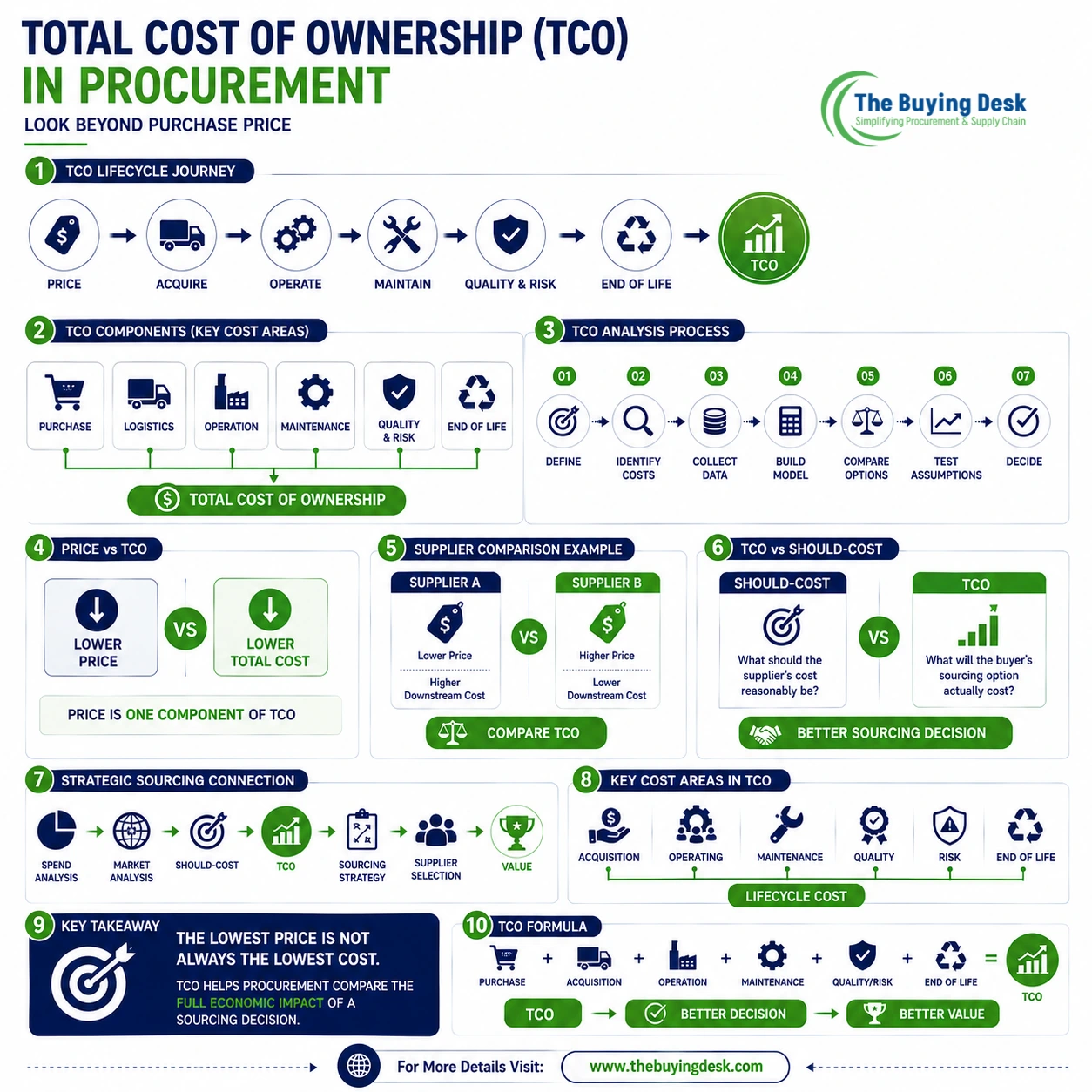
Consider two suppliers offering the same type of component.
Supplier A offers a lower purchase price.
Supplier B offers a somewhat higher purchase price but has:
If procurement evaluates only the quoted price, Supplier A may appear to be the better option.
When relevant downstream costs are included, Supplier B may have the lower overall TCO.
The lesson is simple:
Lower price does not automatically mean lower total cost.
TCO can be particularly useful during supplier evaluation.
Instead of evaluating:
Price → Supplier Ranking
procurement can evaluate:
Price → Lifecycle Costs → TCO → Risk → Business Value
This creates a more complete basis for supplier comparison.
It can also help procurement explain supplier-selection decisions to finance, engineering, operations and management.
TCO is closely connected to strategic sourcing because strategic sourcing looks beyond individual transactions.
A sourcing strategy may involve decisions around:
TCO provides a cost perspective for evaluating these alternatives.
TCO and should-cost analysis are related, but they answer different questions.
“What should this product or service reasonably cost based on its underlying cost structure?”
Should-cost analysis focuses on cost drivers such as material, labor, process, overhead, logistics and supplier margin.
“What will this sourcing option cost us across its relevant lifecycle?”
TCO considers the buyer’s broader economic impact, including acquisition, operation, maintenance, quality and end-of-life costs.
Therefore:
Should-Cost = Supplier Cost Economics
TCO = Buyer Lifecycle Economics
Using both can provide a stronger sourcing and negotiation framework.
TCO is especially useful when the purchase price does not represent the majority of the economic impact.
Good applications include:
For simple, low-value commodity purchases where downstream costs are negligible, a detailed TCO model may add little decision value.
The most common mistake is treating the supplier quotation as the complete cost.
Better approach: Identify the lifecycle costs that materially influence the decision.
A TCO model can become difficult to maintain if every possible cost is included.
Better approach: Focus on relevant and decision-changing cost drivers.
Poor data can produce a misleading TCO result.
Better approach: Make assumptions visible and validate them with finance, operations, engineering and suppliers where appropriate.
Quality problems, downtime and additional handling can create real costs.
Better approach: Include material operational cost drivers where reliable evidence exists.
The lowest TCO option may still carry unacceptable strategic or supply risk.
Better approach: Combine TCO with quality, risk, capability, capacity and business requirements.
TCO can strengthen procurement’s commercial position.
Instead of negotiating only:
“Can you reduce the unit price?”
procurement can discuss the broader cost structure.
For example:
Price → Freight → Lead Time → Inventory → Quality → Service → Total Cost
This can reveal improvement opportunities that are not visible in the supplier’s headline quotation.
TCO can therefore support both commercial negotiation and strategic supplier selection.
TCO should not be treated as procurement’s calculation alone.
Different functions may own different cost drivers.
Procurement: Price, contracts, supplier terms
Logistics: Freight, transportation, warehousing
Quality: Inspection, defects, rework
Operations: Productivity, downtime, process impact
Engineering: Technical requirements, maintenance, lifecycle
Finance: Cost assumptions, financial impact and business case
A cross-functional approach improves the credibility and usefulness of the TCO model.
A practical decision sequence is:
1. PRICE
What does the supplier charge?
↓
2. ACQUISITION
What does it cost to get the product ready for use?
↓
3. OPERATION
What does it cost to use?
↓
4. MAINTENANCE
What does it cost to keep it performing?
↓
5. QUALITY & RISK
What additional costs could arise?
↓
6. END OF LIFE
What happens when the lifecycle ends?
↓
7. TCO
What is the overall economic impact?
↓
8. DECISION
Which option provides the best overall value?
A well-designed TCO approach can help procurement:
The core principle is straightforward:
Procurement should optimize the economics of the decision—not simply the price on the quotation.
Total Cost of Ownership provides a broader view of what a sourcing decision actually costs across its relevant lifecycle.
Purchase Price + Acquisition + Operation + Maintenance + Quality + Risk + End of Life = TCO
TCO should help procurement compare alternatives, identify cost drivers, strengthen negotiations and select options that create better overall business value.
The goal is not always the lowest price.
The goal is the best overall economic outcome.
What is Total Cost of Ownership in procurement?
Total Cost of Ownership is the estimated full cost of acquiring, using, maintaining and disposing of a product, service or asset over its relevant lifecycle. It goes beyond purchase price.
Why is TCO important in procurement?
TCO helps procurement identify costs that may not appear in the supplier quotation. This supports better supplier comparison, sourcing decisions and commercial negotiations.
What costs are included in TCO?
TCO can include purchase, acquisition, logistics, operating, maintenance, quality, risk-related and end-of-life costs. The exact components depend on the category.
Is TCO the same as purchase price?
No. Purchase price represents what the buyer pays the supplier, while TCO considers the broader costs associated with the procurement decision across its lifecycle.
What is the difference between TCO and should-cost analysis?
Should-cost estimates what a product or service should reasonably cost based on its underlying cost structure. TCO estimates the broader cost to the buyer over the relevant lifecycle.
How is TCO calculated?
A simplified model adds relevant acquisition, operating, maintenance, quality, risk and end-of-life costs to the purchase cost, while considering applicable residual value. The exact model should match the category.
When should procurement use TCO analysis?
TCO is particularly useful for complex, high-value, long-life, maintenance-intensive, logistics-intensive or strategically important purchases where lifecycle costs can materially affect the decision.
Does the supplier with the lowest TCO always win?
Not necessarily. TCO is an important economic input, but procurement should also consider quality, supply risk, capability, capacity, strategic fit and other business requirements.