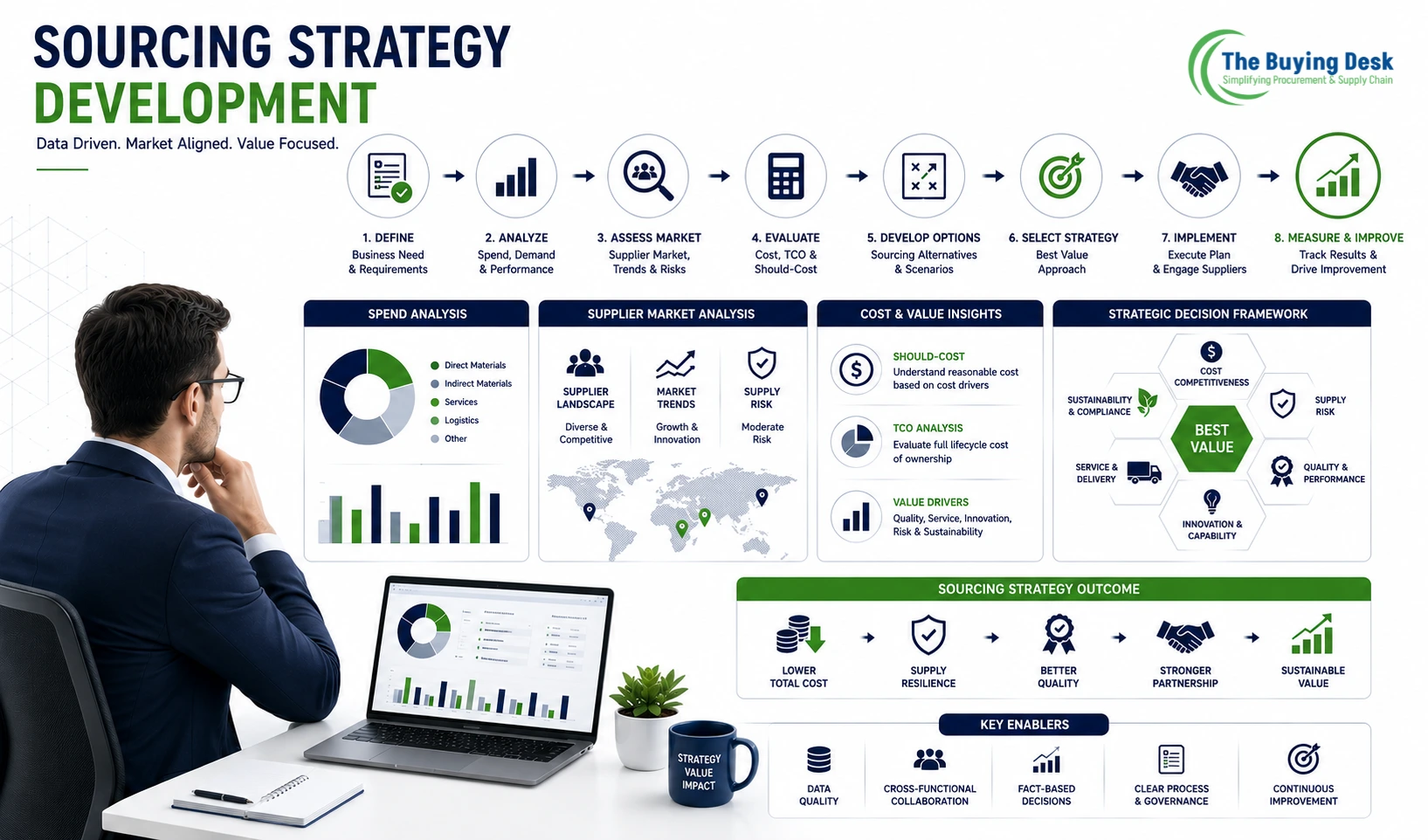
A procurement team can analyze spend, study supplier markets and evaluate costs, but these activities create limited value unless they lead to a clear sourcing strategy.
Sourcing strategy development is the process of converting procurement intelligence into a structured plan for how, where, and from whom an organization should source goods or services.
A strong sourcing strategy considers more than price. It brings together business requirements, demand, spend, market conditions, supplier capabilities, total cost, supply risk, competition and long-term business objectives.
The goal is simple:
Choose the sourcing approach that creates the best overall business value.
Sourcing strategy development is the structured process of deciding how a category, product or service should be sourced based on business requirements, market conditions, supplier capabilities, cost economics and risk.
It answers important questions such as:
Without a defined sourcing strategy, procurement can become reactive.
Buyers may simply request quotations, compare prices and select suppliers without understanding the broader commercial or supply-market context.
A sourcing strategy creates a structured connection between business requirements and supplier decisions.
It helps procurement determine the right sourcing model before launching an RFQ, RFP or other sourcing event.
A sourcing strategy normally brings together several areas of procurement analysis.
The strategy starts by understanding what the business actually needs.
Requirements may include specifications, quality expectations, delivery requirements, service levels, capacity, technology and regulatory considerations.
Procurement should understand historical spend as well as future demand.
This helps identify the size of the opportunity and determine whether the category requires competitive sourcing, supplier consolidation, demand management or another approach.
Understanding the external market is essential.
Procurement should examine the number of capable suppliers, competitive intensity, geographic availability, capacity, technology, market trends and barriers to entry.
Purchase price alone may not represent the economic impact of a sourcing decision.
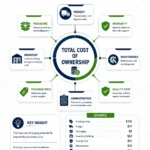
The strategy should consider cost drivers, should-cost where appropriate, logistics, inventory, quality, maintenance, risk and other relevant components of total cost of ownership.
A low-cost sourcing strategy can create problems if it increases supply disruption or dependency.
The strategy should therefore consider supplier concentration, geographic exposure, capacity constraints, financial or operational risks and availability of alternatives.
Suppliers should be evaluated against the capabilities required by the business.
These may include technical expertise, manufacturing capacity, quality systems, innovation capability, service infrastructure and scalability.
A structured process makes sourcing decisions more consistent and defensible.
Clearly define what the organization needs to purchase.
Review historical consumption, forecast demand, specifications and future business requirements.
Examine current suppliers, categories, prices, volumes, contracts and purchasing patterns.
Map the supplier landscape and understand competition, capacity, market trends and available alternatives.
Understand the major cost drivers and evaluate the broader economic impact of different sourcing options.
Identify vulnerabilities such as supplier concentration, limited capacity, geographic dependency and switching difficulty.
Develop realistic sourcing alternatives based on the available evidence.
Compare the alternatives and select the approach that best supports business objectives.
Translate the strategy into supplier engagement, RFx activities, evaluation criteria, negotiation plans and implementation actions.
Execute the sourcing strategy and track results through agreed commercial, operational and supplier-performance measures.
A sourcing strategy should be evidence-based rather than driven by assumptions.
Spend data provides visibility into current purchasing patterns.
It can reveal supplier concentration, fragmented spending, price differences, contract leakage and potential sourcing opportunities.
Market analysis helps procurement understand the external supply environment.
It can reveal competitive alternatives, supplier power, emerging technologies, geographic opportunities and supply constraints.
Should-cost analysis can help procurement understand what a product or service should reasonably cost based on its underlying cost drivers.
This can strengthen sourcing decisions and commercial discussions.
TCO helps procurement evaluate costs beyond the supplier’s quoted price.
It is particularly useful when alternatives have different logistics, quality, maintenance, inventory or lifecycle-cost characteristics.
Risk analysis helps determine whether the sourcing strategy creates unacceptable dependency or exposure.
A strategy should balance commercial opportunity with supply resilience.
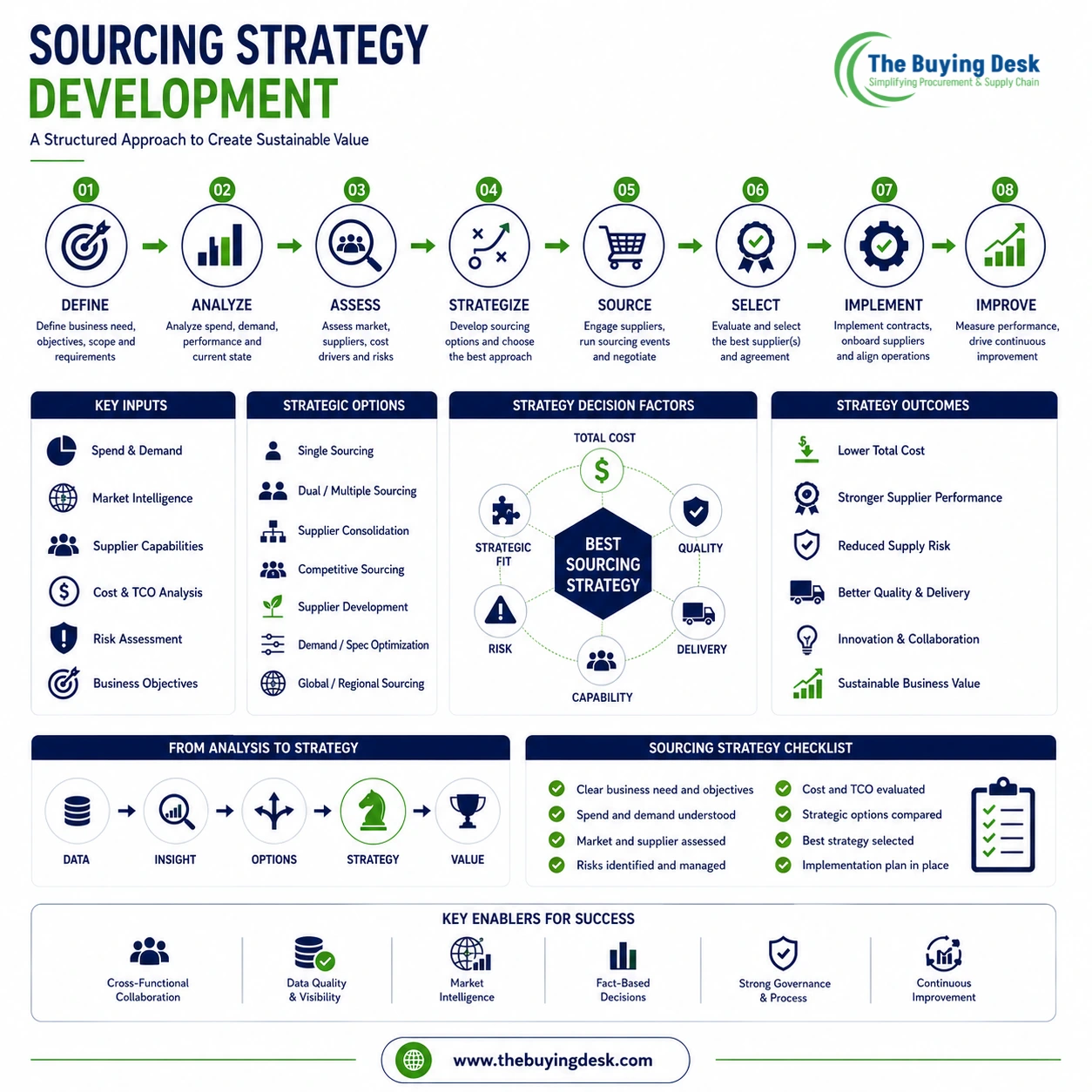
There is no single sourcing strategy suitable for every category.
One supplier provides the majority or all of the requirement.
This may create advantages in scale, coordination and supplier relationships but can increase dependency.
The requirement is divided among two or more suppliers.
This can improve resilience and competition while potentially reducing the volume advantage available to each supplier.
Multiple suppliers are reduced to a smaller strategic supplier base.
This can simplify supplier management and create volume leverage when the market supports it.
Multiple capable suppliers are invited to compete.
This can be effective when the market has sufficient competition and requirements can be clearly defined.
Procurement works with existing or potential suppliers to improve capability, quality, capacity, cost or technology.
This approach can be valuable when capable alternatives are limited.
Procurement works with internal stakeholders to challenge demand or specifications.
Reducing unnecessary complexity can create value before the supplier negotiation even begins.
The sourcing footprint can be designed around cost, availability, risk, lead time, capability and business requirements.
The lowest-cost geography is not automatically the best sourcing location.
A practical sourcing strategy should connect analysis to action.
Understand current spend, suppliers, contracts, demand, performance and supply risks.
Assess competition, supplier capacity, cost drivers, technology, market trends and external risks.
Define cost, quality, delivery, innovation, capacity, resilience and other critical requirements.
Develop sourcing alternatives such as consolidation, competition, dual sourcing, supplier development or specification optimization.
Compare options using cost, TCO, quality, supply risk, capacity, capability and strategic fit.
Consider purchase price and relevant lifecycle costs rather than focusing only on quoted price.
Determine whether suppliers can consistently meet required quality and technical standards.
Evaluate lead times, logistics requirements, service levels and delivery reliability.
Confirm that suppliers can support current and future demand.
Consider supplier dependency, geographic exposure, capacity constraints and availability of alternatives.
Evaluate whether the sourcing approach supports broader business objectives.
A sourcing strategy should come before the sourcing event.
Determines:
What → Why → Where → How → From Whom
Executes the chosen approach through activities such as:
RFI → RFQ/RFP → Evaluation → Negotiation → Selection
The sourcing event is therefore an execution mechanism within the broader sourcing strategy.
The previous articles in the Strategic Sourcing cluster provide the analytical foundation for strategy development.
What are we currently buying and spending?
How should the category be managed strategically?
What does the external supplier market look like?
Should the requirement be produced internally or externally?
What should the underlying cost reasonably be?
What will the sourcing option actually cost over its relevant lifecycle?
Together, these inputs help procurement move from information to strategy.
Imagine a manufacturer purchases an important production component from several suppliers.
Spend analysis shows fragmented purchasing.
Market analysis identifies several capable suppliers.
TCO analysis shows that logistics and quality performance significantly affect the economic outcome.
The sourcing strategy could therefore combine:
Supplier Consolidation + Competitive Sourcing + TCO Evaluation + Dual-Sourcing for Critical Supply
The important point is that the strategy is based on analysis rather than simply asking suppliers for lower prices.
Launching an RFQ before understanding the category can produce a price comparison without a sourcing strategy.
A low quotation may create higher logistics, quality, inventory or risk costs.
Procurement needs alignment with operations, engineering, finance, quality and other relevant functions.
Existing suppliers represent only the currently known supply base.
Market research may identify better alternatives.
Different categories require different approaches based on spend, risk, complexity and market structure.
A strategy has limited value if supplier onboarding, contracts, logistics and performance management are not addressed.
Bring procurement together with relevant business, technical, finance, quality and operations stakeholders.
Use spend, demand, cost, supplier and market information to support strategic decisions.
Compare sourcing alternatives instead of assuming that one approach is automatically best.
Do not evaluate sourcing opportunities without considering supply continuity and resilience.
Establish measurable commercial and operational objectives before launching the sourcing event.
A well-developed sourcing strategy can help organizations:
The exact benefits depend on the category, market and quality of implementation.
Before launching a sourcing event, procurement should be able to answer:
If these questions cannot be answered, the sourcing strategy may not yet be mature enough for execution.
A strong sourcing strategy connects the complete analytical chain:
Business Requirement
→ Demand
→ Spend
→ Market
→ Suppliers
→ Cost & TCO
→ Risk
→ Strategic Options
→ Sourcing Strategy
→ RFx
→ Negotiation
→ Supplier Selection
→ Implementation
→ Value
This creates a logical bridge between procurement analysis and supplier action.
Spend analysis tells procurement where the money goes.
Market analysis explains the external supply environment.
Cost and TCO analysis reveal the economics.
Risk analysis highlights vulnerabilities.
A sourcing strategy brings these insights together and determines how procurement should approach the market.
The objective is to select the right sourcing model for the category and business requirement.
That may mean competing suppliers, consolidating demand, diversifying supply, developing suppliers, optimizing specifications, changing the sourcing footprint or combining several approaches.
The best strategy is the one that balances cost, quality, delivery, capability, risk and long-term business value.
DEFINE → ANALYZE → UNDERSTAND → OPTIONS → STRATEGIZE → SOURCE → SELECT → IMPLEMENT → IMPROVE
And the core principle is:
Better Analysis → Better Strategy → Better Sourcing Decisions → Better Business Value
What is sourcing strategy development?
Sourcing strategy development is the process of deciding how an organization should source a category, product or service. It uses spend, market, supplier, cost and risk information to select the best sourcing approach.
Why is sourcing strategy important in procurement?
It helps procurement move beyond transactional buying and make structured, evidence-based sourcing decisions. A strong strategy can improve cost, supply security, supplier performance and business value.
What are the main steps in developing a sourcing strategy?
The process generally includes defining requirements, analyzing spend, studying the market, assessing suppliers, evaluating cost and risk, developing options and selecting a strategy. The strategy is then converted into a sourcing and implementation plan.
What factors should be considered in a sourcing strategy?
Key factors include cost, quality, delivery, capacity, supplier capability, market competition, supply risk and total cost of ownership. Business requirements and long-term strategic objectives should also be considered.
Is sourcing strategy the same as an RFQ?
No. A sourcing strategy determines how procurement should approach the market. An RFQ is one possible sourcing event used to obtain commercial quotations after the sourcing approach has been defined.
What are common sourcing strategies?
Common approaches include competitive sourcing, supplier consolidation, single sourcing, dual sourcing, supplier development and demand or specification optimization. The appropriate approach depends on category characteristics and business requirements
How does spend analysis support sourcing strategy?
Spend analysis shows what the organization buys, from whom, at what level and across which categories. This visibility helps identify sourcing opportunities, supplier concentration and areas requiring strategic action.
How does TCO influence sourcing strategy?
TCO helps procurement compare sourcing options using the broader economic impact rather than purchase price alone. This can change which supplier or sourcing model represents the best overall value.