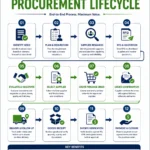
Procurement is no longer simply about purchasing materials at the lowest possible price.
Modern procurement professionals influence:
This has made procurement an increasingly important function within manufacturing, automotive, engineering, technology, healthcare, retail, infrastructure, FMCG and many other industries.
For someone considering a career in procurement, there are many possible paths.
You can start in purchasing or procurement operations and eventually move into:
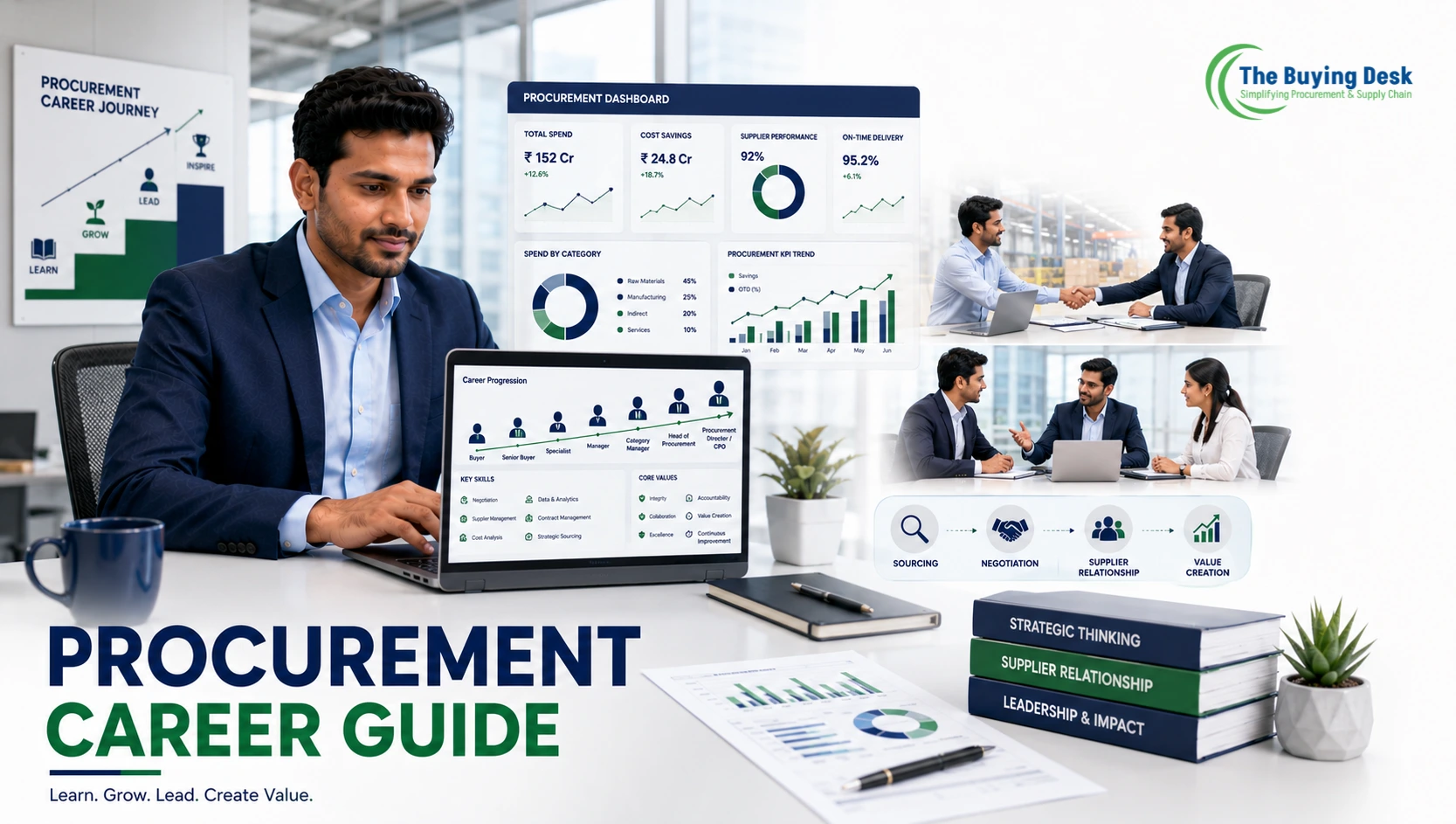
Buyer → Procurement Executive → Procurement Specialist → Senior Buyer → Procurement Manager → Category Manager → Head of Procurement → Procurement Director / CPO
There are also opportunities to specialize in:
This guide explains how procurement careers work, what skills employers look for, how professionals can progress and how to build long-term value in the profession.
A procurement career involves managing the process of obtaining goods, services and materials required by an organization while balancing:
Cost + Quality + Delivery + Risk + Compliance + Business Value
Depending on the organization, procurement professionals may be responsible for:
The exact responsibilities depend on the person’s level and specialization.
Procurement offers an interesting combination of commercial, analytical, operational and relationship-management skills.
Procurement interacts with many functions:
This gives procurement professionals a broad understanding of how businesses operate.
A procurement professional can specialize in different areas rather than following only one career path.
Procurement decisions can directly affect:
Procurement skills are useful across industries.
A professional may move between:
Procurement increasingly contributes to strategic decisions involving supplier risk, cost structure, supply resilience, digitalization and sustainability.
A common question is:
“Should I build a career in purchasing or procurement?”
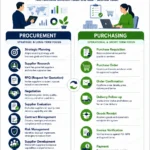
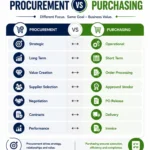
Purchasing is generally more transaction-focused.
Typical purchasing activities include:
Procurement has a broader scope.
It may include:
A purchasing professional can therefore develop into a broader procurement professional by gradually building strategic skills.
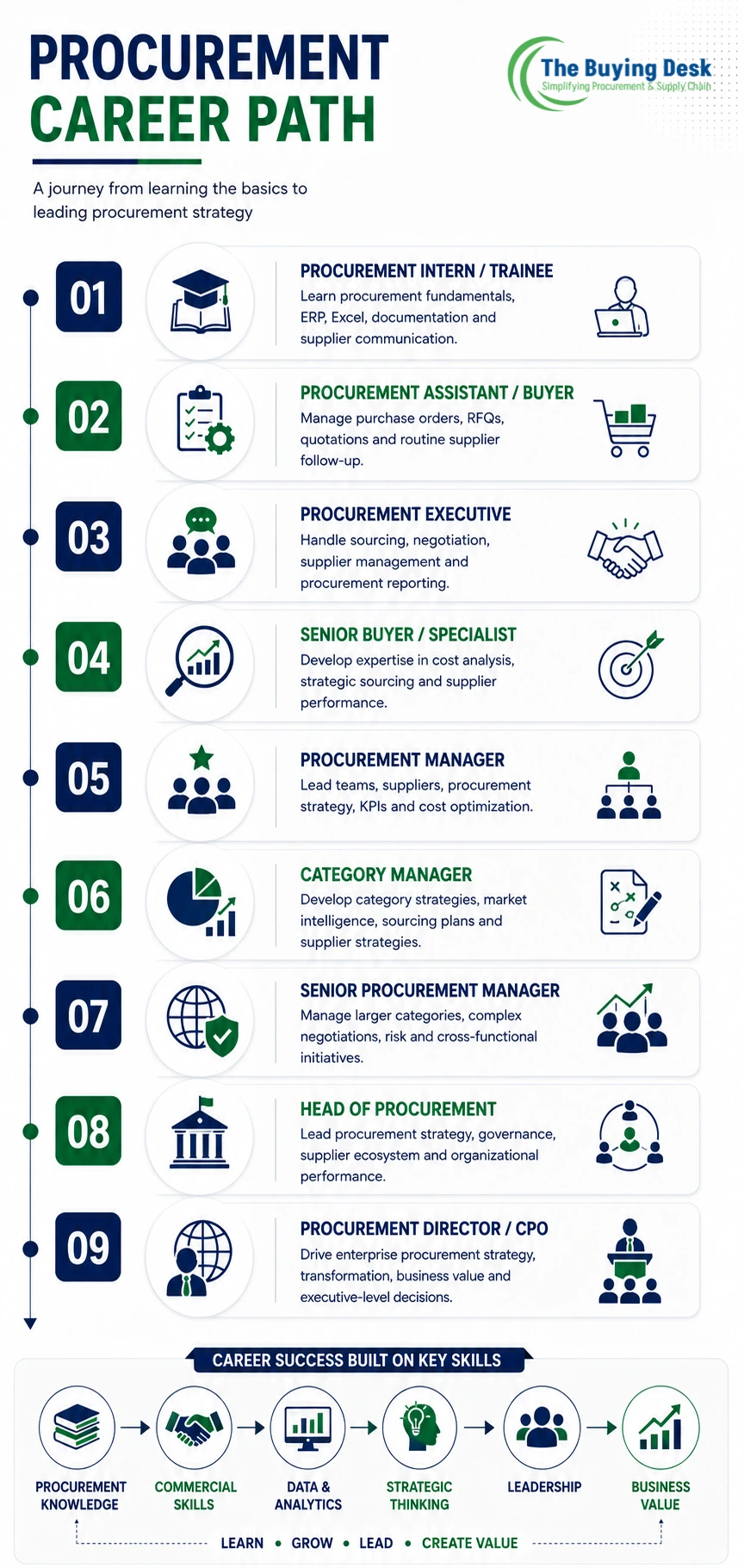
The exact titles vary between organizations, but a typical progression looks like this:
Procurement Trainee / Intern
↓
Procurement Assistant / Purchasing Assistant
↓
Buyer / Procurement Executive
↓
Senior Buyer / Procurement Specialist
↓
Assistant Procurement Manager
↓
Procurement Manager
↓
Senior Procurement Manager / Category Manager
↓
Head of Procurement
↓
Procurement Director / Chief Procurement Officer
Not everyone follows this exact route.
Some professionals move into:
An internship can provide exposure to:
The objective at this stage should be to understand the complete procurement process.
Typical responsibilities include:
A junior buyer may begin managing specific categories or suppliers.
Typical responsibilities include:
A procurement executive typically manages purchasing activities more independently.
Responsibilities may include:
A specialist usually develops deeper expertise in a particular area.
Examples:
A senior buyer may manage:
A procurement manager typically moves beyond individual transactions and manages people, suppliers, categories and performance.
Responsibilities can include:
A procurement manager must combine technical procurement knowledge with leadership skills.
A category manager manages a specific spend category strategically.
Examples:
Category management often involves:
Spend Analysis → Market Analysis → Supplier Strategy → Sourcing → Negotiation → Contract → Performance Management
The Head of Procurement is responsible for procurement performance across a significant part of the organization.
Typical responsibilities include:
A procurement director generally manages procurement strategy at a broader organizational or regional level.
The role may involve:
The CPO is a senior executive responsible for the organization’s procurement strategy and performance.
At this level, procurement is closely connected to:
Negotiation is one of the most important procurement skills.
A strong procurement professional understands that negotiation is not simply:
“Get the lowest price.”
It may involve:
The goal should be to achieve the best overall commercial outcome.
Procurement professionals need to build productive supplier relationships.
This includes:
A good supplier relationship is not necessarily one where procurement always agrees with the supplier.
It is one where both parties understand expectations and resolve problems professionally.
Procurement generates large amounts of data.
Professionals need to analyze:
Strong analytical ability can differentiate a procurement professional from a purely transactional buyer.
Procurement professionals communicate with:
Clear communication is essential when requirements, prices, delivery dates or commercial conditions change.
A procurement professional should understand how suppliers make money.
Important concepts include:
This allows procurement to challenge quotations intelligently.
Excel remains highly useful in procurement.
Important skills include:
Advanced professionals can also benefit from:
Many organizations use ERP systems for procurement.
Examples of procurement-related ERP activities include:
Understanding the organization’s ERP system can significantly improve productivity.
Procurement professionals should learn to understand why a price is what it is.
For a manufactured component, for example:
Material + Conversion + Labor + Overhead + Tooling + Logistics + Margin = Commercial Price
Cost analysis becomes particularly valuable in strategic sourcing and negotiation.
Procurement frequently deals with unexpected problems:
A strong procurement professional focuses on:
Problem → Root Cause → Options → Decision → Action → Prevention
Modern procurement must understand supply risk.
Examples include:
Risk management is becoming increasingly important for strategic procurement professionals.
Procurement professionals should understand important commercial terms.
These may include:
You do not necessarily need to be a lawyer, but you should understand the commercial implications of the agreements you manage.
As procurement professionals progress, leadership becomes increasingly important.
Leadership includes:
Technical procurement skills may get you into management.
Leadership skills help you succeed there.
| Career Level | Primary Skills |
|---|---|
| Entry Level | Excel, ERP, communication, PO process |
| Junior Buyer | RFQ, supplier follow-up, quotation analysis |
| Buyer | Negotiation, sourcing, supplier management |
| Senior Buyer | Cost analysis, supplier strategy, category knowledge |
| Specialist | Strategic sourcing, analytics, contracts |
| Manager | Strategy, leadership, KPIs, stakeholder management |
| Category Manager | Category strategy, market intelligence, negotiation |
| Head of Procurement | Leadership, governance, transformation, business strategy |
| CPO | Enterprise strategy, risk, financial impact, executive leadership |
There is no single degree required for every procurement job.
Common educational backgrounds include:
For manufacturing procurement, an engineering background can be particularly useful when dealing with:
For indirect procurement, business, commerce, finance or management backgrounds may be highly relevant.
Professional certifications can help strengthen knowledge and credibility.
Depending on your career goals and location, you may explore recognized procurement and supply-chain certifications from professional bodies and training organizations.
Before selecting a certification, evaluate:
A certification should complement practical experience rather than replace it.
Yes, it is possible to build a procurement career without a specialized procurement degree.
Professionals often enter procurement from:
The important thing is to build practical procurement knowledge.
For example:
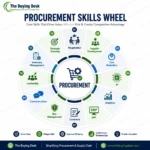
Excel → ERP → RFQ → Supplier Evaluation → Negotiation → Cost Analysis → Contracts → Strategic Sourcing
If you are starting from zero, follow a structured approach.
Understand:
These fundamentals create the foundation for everything else.
Start with:
Then progress toward:
Learn how procurement transactions move through an ERP system.
Practice comparing:
Start with commercial fundamentals before attempting complex negotiation techniques.
Learn how to:
Understand the cost structure behind the products you purchase.
Choose an industry or category and become knowledgeable about its suppliers, materials, processes and market dynamics.
Moving into management requires more than being good at purchasing.
You need to demonstrate broader capabilities.
You may be measured on:
You may be measured on:
Therefore, start developing management capabilities before receiving the management title.
A strategic procurement professional thinks beyond individual POs.
Instead of asking:
“How can I buy this item cheaper?”
Ask:
“How can we improve the total cost, supply security, quality and long-term value of this category?”
This requires:
Focuses on materials and components that directly support the organization’s products or core operations.
Common in:
Manages supporting goods and services such as:
Focuses on long-term sourcing strategy and value creation.
Focuses on developing strategy for a defined spend category.
Focuses on:
Focuses on:
Focuses heavily on:
Procurement compensation varies significantly by country, industry, company, location, experience and role.
Instead of focusing only on a salary number, professionals should understand the factors that typically influence compensation.
More relevant experience generally increases career opportunities.
Some industries have more complex procurement requirements and may value specialized expertise.
High-value or technically complex categories can require advanced skills.
Compensation varies by geography and local labor market.
Large multinational organizations may have different compensation structures from smaller organizations.
Managing a strategic category or large supplier portfolio generally requires a different skill set from transactional purchasing.
Managerial and senior leadership responsibilities can significantly change compensation expectations.
Skills such as:
can strengthen career opportunities.
A procurement resume should focus on business impact, not just responsibilities.
Weak statement:
Responsible for purchasing raw materials.
Stronger statement:
Managed strategic sourcing and supplier negotiations for key raw-material categories while improving commercial competitiveness and supply continuity.
Weak statement:
Followed up with suppliers for delivery.
Stronger statement:
Managed supplier delivery performance for critical materials and coordinated recovery actions to minimize production risk.
Whenever possible, quantify results.
For example:
Candidates should prepare for questions such as:
Focus on:
Develop:
Focus on:
Develop:
This is only a general framework. Career progression depends heavily on individual performance, organization and industry.
Procurement is changing rapidly.
Professionals should increasingly understand:
Procurement decisions are becoming more data-driven.
AI can support areas such as:
Knowledge of e-RFQ, supplier portals, digital approvals and procurement platforms is increasingly useful.
Organizations increasingly consider:
Recent supply disruptions have reinforced the importance of resilience and supplier risk management.
AI can automate many repetitive activities.
But procurement still requires:
Therefore, procurement professionals should learn to work with technology rather than compete against it.
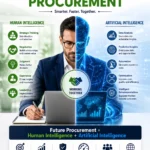
The strongest future procurement professional may be someone who combines:
Procurement Knowledge + Business Understanding + Data + Technology + Human Judgment
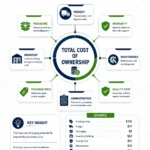
Procurement is about total value, not simply the lowest quoted price.
If your entire career is limited to PO processing, your growth may become restricted.
Develop strategic skills.
For direct procurement, understanding materials, processes and specifications can create a major advantage.
Procurement professionals who cannot analyze data may struggle as procurement becomes more analytical.
Even excellent commercial decisions can fail if stakeholders and suppliers do not understand them.
Keep evidence of:
A strong career is built through capability.
Skills create opportunities. Titles follow.
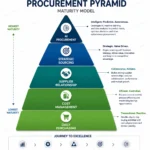
A high-value procurement professional should gradually move through four stages.
Perform procurement transactions accurately.
Identify inefficiencies and improve processes.
Develop sourcing and supplier strategies.
Use procurement knowledge to influence business decisions.
This progression transforms procurement from:
Order Processing
into:
Business Value Creation
Ask yourself:
Your answers can help identify your next learning priority.
A useful way to think about procurement career development is:
Procurement Knowledge
Commercial Skills
Data Skills
Supplier Management
Technology
Leadership
=
High-Value Procurement Professional
Procurement offers far more career opportunities than traditional purchasing.
A professional can begin with transactional activities and gradually move into strategic sourcing, category management, supplier management, procurement analytics and leadership.
The most important career principles are:
The strongest procurement professionals are not simply people who know how to raise a purchase order.
They understand how procurement decisions affect cost, quality, delivery, risk and business performance.
And that is what creates a long-term procurement career.
Is procurement a good career?
Procurement can offer a broad career path because it combines commercial, analytical, operational and strategic responsibilities across many industries.
What qualification is required for procurement?
There is no single qualification required for every procurement role. Degrees in business, commerce, engineering, supply chain, finance, operations and related areas can all be relevant.
Is procurement the same as purchasing?
No. Purchasing is generally more transaction-focused, while procurement includes broader activities such as sourcing, supplier management, contracts, risk and strategic value creation.
What skills are most important for procurement?
Important skills include negotiation, supplier management, communication, Excel, analytics, cost analysis, problem solving, commercial awareness and risk management.
Can an engineer become a procurement professional?
Yes. Engineering knowledge can be particularly valuable in technical and manufacturing procurement because it helps professionals understand materials, processes, specifications and supplier capabilities.
Can I move from purchasing to strategic procurement?
Yes. A purchasing professional can build strategic capabilities through sourcing, cost analysis, supplier management, category management, negotiation and risk management.
Is Excel important for procurement?
Yes. Excel remains widely useful for quotation analysis, spend analysis, supplier comparisons, procurement reports, forecasting and dashboards.
Is procurement a part of supply chain?
Procurement is an important component of the broader supply chain function. Procurement focuses primarily on acquiring goods and services, while supply chain can encompass a much wider range of activities from planning through sourcing, production, logistics and delivery.
What is the career path in procurement?
A typical path can be:
Buyer → Senior Buyer → Procurement Specialist → Procurement Manager → Category Manager / Senior Manager → Head of Procurement → Procurement Director / CPO
Actual titles and progression vary by organization.
How can I grow faster in procurement?
Focus on developing skills beyond routine purchasing: negotiation, cost analysis, supplier strategy, data analytics, category management, contracts, risk management and leadership.