A supplier may offer competitive pricing, strong capabilities and attractive delivery commitments, but procurement teams still need to verify whether the supplier can consistently meet business requirements.
This is where a supplier audit becomes important.
A supplier audit is a structured assessment of a supplier’s processes, systems, capabilities, quality controls, compliance and operational practices. It allows procurement and supply chain teams to move beyond supplier claims and evaluate what is actually happening within the supplier’s organization.
A well-designed supplier audit can help identify operational weaknesses, quality risks, capacity constraints, compliance gaps and opportunities for supplier development before they become major business problems.
In simple terms:
Supplier qualification asks whether a supplier is capable of doing the job. Supplier auditing verifies whether the supplier is actually operating as expected.
A supplier audit is a systematic examination of a supplier’s facilities, processes, systems, documentation and performance against predefined requirements.
The audit may evaluate areas such as:
The objective is not simply to find mistakes.
The real objective is to determine whether the supplier has the systems, processes and capabilities required to consistently deliver the expected business outcome.
Supplier performance directly affects procurement cost, production continuity, product quality and customer satisfaction.
A supplier problem can create consequences far beyond the purchasing department.
For example:
Supplier Process Problem → Quality Failure → Production Disruption → Delivery Delay → Customer Impact
Supplier audits help procurement teams identify weaknesses earlier.
A supplier may claim that it has sufficient machines, manpower or production capacity.
An audit allows procurement to verify these claims through physical observation, records and objective evidence.
Auditing quality systems and production controls can reveal weaknesses before they result in recurring defects or customer complaints.
Production planning, capacity utilization, maintenance, material availability and scheduling practices can directly influence supplier delivery performance.
Audits can verify whether suppliers are following contractual, regulatory, customer and internal requirements.
An audit can identify the root causes behind poor quality, delayed deliveries, high costs or inadequate responsiveness.
The audit can become the starting point for a structured supplier improvement plan.
Critical suppliers should not be evaluated only on price.
Their operational resilience and ability to maintain supply continuity also matter.
These concepts are related but different.
| Activity | Main Purpose |
|---|---|
| Supplier Qualification | Determine whether a supplier is capable of becoming an approved supplier |
| Supplier Evaluation | Assess supplier performance and suitability using defined criteria |
| Supplier Audit | Verify actual processes, systems and compliance through structured examination |
| Supplier Development | Improve supplier capability and performance |
| Supplier Performance Management | Continuously monitor and improve supplier results |
A supplier may pass an initial qualification assessment but still require periodic audits to verify ongoing performance.
Different business situations require different types of audits.
Focuses on the supplier’s quality management system and production controls.
Typical areas include:
Focuses specifically on how a product or service is produced.
The auditor evaluates whether actual processes are being performed according to defined standards and procedures.
Reviews the supplier’s overall management systems.
This can include:
Checks whether the supplier complies with contractual, regulatory and customer-specific requirements.
Evaluates whether the supplier has sufficient capacity to meet current and future demand.
Areas may include:
Where appropriate, procurement may assess supplier financial stability and commercial risk.
This becomes particularly important for strategic or single-source suppliers.
Evaluates areas such as:
Conducted after corrective actions to verify whether previously identified issues have actually been resolved.
A professional supplier audit should follow a structured process rather than an informal factory visit.
Start by clearly defining why the audit is being conducted.
Possible objectives include:
Determine which areas will be audited.
For example:
Quality + Production + Capacity + Delivery + Compliance + Documentation
The scope should match the supplier’s importance and the purpose of the audit.
Define the standards against which the supplier will be assessed.
These may come from:
Create a structured checklist covering the relevant audit areas.
A good checklist ensures consistency between different suppliers and different auditors.
Before visiting the supplier, review available performance information.
For example:
This helps the auditor focus on areas of actual concern.
Explain the audit objective, scope, schedule and participants.
The supplier should understand that the purpose is to verify and improve processes rather than simply identify faults.
Review the actual supplier operation.
This may include:
Audit conclusions should be based on evidence.
Examples include:
Classify findings according to their significance.
For example:
Critical → Major → Minor → Observation → Opportunity for Improvement
The exact classification system should be defined by the organization.
Discuss the findings with the supplier.
Explain:
Document the audit findings, evidence, responsibilities and expected completion dates.
The audit is not complete when the report is issued.
Corrective actions should be monitored until closure.
Confirm that corrective action has actually eliminated or controlled the underlying problem.
This is critical.
Corrective Action Closed ≠ Problem Solved
The organization should verify whether the improvement is sustainable.
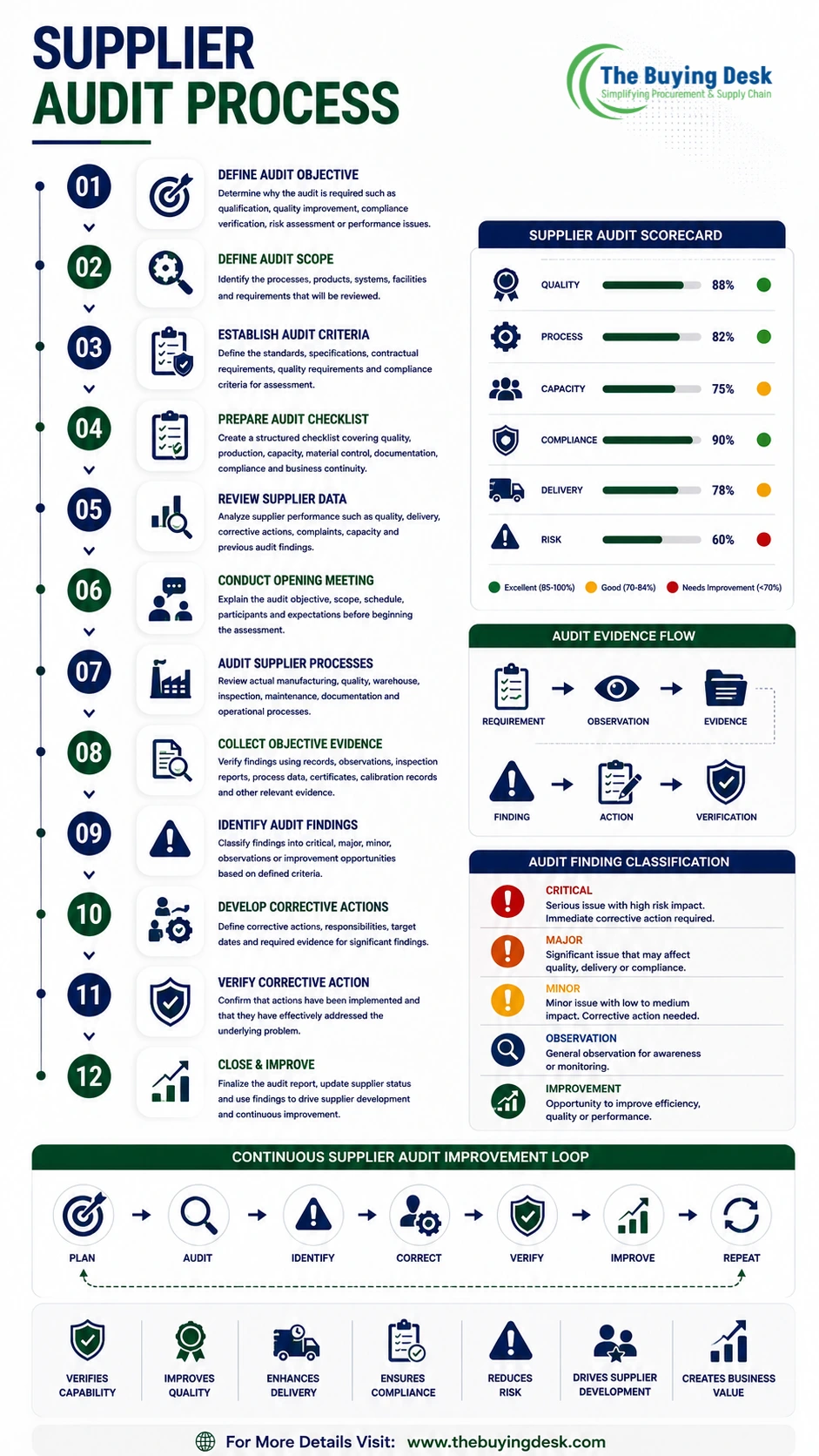
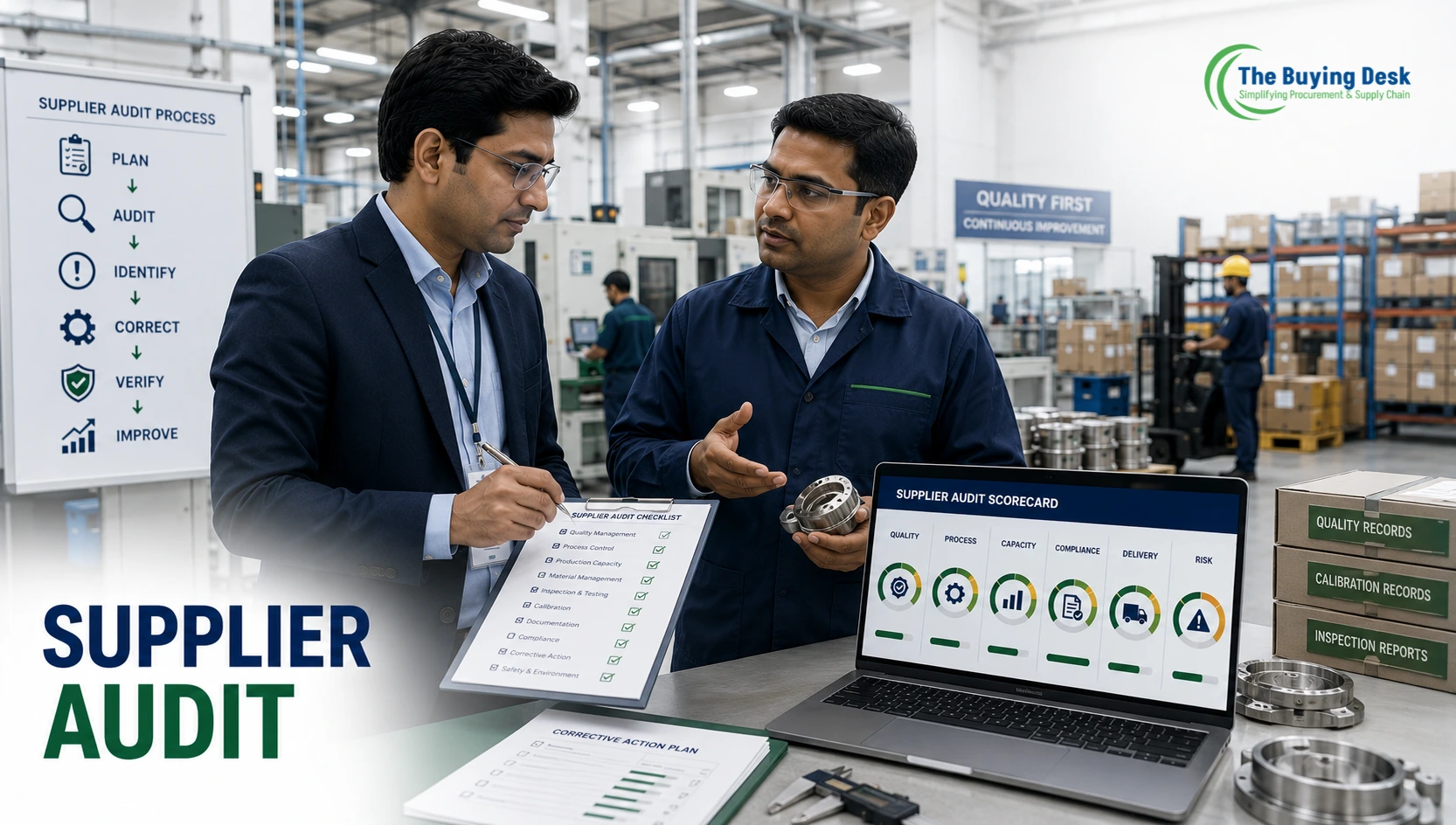
A practical supplier audit checklist can include the following categories.
A structured scoring system can make audit results more objective.
For example:
| Area | Weight |
|---|---|
| Quality Management | 25% |
| Production Capability | 20% |
| Process Control | 15% |
| Delivery & Capacity | 15% |
| Compliance | 10% |
| Material & Inventory Control | 5% |
| Business Continuity | 5% |
| Documentation | 5% |
The actual weighting should depend on the supplier’s category and business criticality.
A supplier producing a safety-critical component may require significantly higher weighting for quality and process controls than a low-risk indirect supplier.
A simple scoring structure could be:
90–100% → Excellent
80–89% → Acceptable
70–79% → Conditional Approval / Improvement Required
Below 70% → Significant Improvement Required
These thresholds are examples only. Each organization should establish its own criteria based on risk and business requirements.
Not every supplier carries the same level of risk.
A strategic single-source supplier may require much deeper auditing than a low-value office-supply supplier.
A supplier may have excellent documentation but weak actual process control.
Always compare:
Documented Process vs Actual Process
An audit should identify opportunities for risk reduction and improvement, not simply create conflict with suppliers.
Historical quality and delivery data should influence the audit focus.
A supplier saying “action completed” does not necessarily mean the issue has been permanently resolved.
An audit report without follow-up is simply a document.
The real value comes from corrective action and measurable improvement.
A checklist with hundreds of irrelevant questions can reduce audit effectiveness.
Focus on risk, relevance and business impact.
Audit frequency and depth should reflect supplier criticality and risk.
Use both supplier performance data and on-site evidence.
Depending on the audit objective, participants may include:
Do not stop at identifying symptoms.
Ask:
Why did the problem occur?
Then continue until the underlying process weakness is identified.
Every significant finding should have:
Not every observation has the same business impact.
Focus resources on issues that can affect:
Quality + Delivery + Cost + Compliance + Continuity
A strong audit should help both procurement and the supplier understand where capability can be improved.
There is no universal audit frequency for every supplier.
A risk-based approach is better.
For example:
| Supplier Risk | Possible Audit Approach |
|---|---|
| Critical | Frequent / annual or risk-triggered audit |
| High | Periodic audit |
| Medium | Scheduled audit based on performance |
| Low | Questionnaire / remote review / occasional audit |
Audit frequency can also increase after:
A professional supplier audit report should generally include:
Supplier Name
Audit Date
Audit Type
Audit Objective
Audit Scope
Audit Team
Supplier Participants
Overall Score
Major Findings
Minor Findings
Observations
Corrective Actions
Responsible Person
Target Completion Date
Verification Status
Final Audit Status
This creates traceability and makes supplier improvement measurable.
Supplier auditing should not be viewed as an isolated procurement activity.
It should connect with the broader supplier-management system:
Supplier Qualification → Supplier Audit → Supplier Evaluation → Supplier Performance Management → Corrective Action → Supplier Development → Continuous Improvement
This creates a closed-loop supplier management approach.
A supplier audit and product inspection are not the same.
Inspection generally checks whether a product meets defined specifications.
Audit evaluates whether the supplier’s processes and systems are capable of consistently producing the required result.
For example:
A product inspection may find 100 defective pieces.
A supplier audit asks:
Why did the supplier’s process allow those defects to occur?
That distinction is important for long-term improvement.
Modern procurement teams can use digital tools to improve supplier audit management.
Examples include:
This can make supplier auditing more consistent and easier to monitor.
Procurement teams can track:
One particularly useful metric is:
Repeat Finding Rate
If the same issue repeatedly appears in supplier audits, the corrective-action process may not be addressing the true root cause.
A supplier audit is much more than a factory visit or checklist.
It is a structured method of verifying whether a supplier’s capability, processes, controls, quality systems, compliance and operational practices can support the organization’s requirements.
The most effective supplier audit approach is:
PLAN → AUDIT → IDENTIFY → CORRECT → VERIFY → IMPROVE
When supplier audits are connected with supplier qualification, performance management, risk management and supplier development, procurement can move from reactive problem-solving toward proactive supplier management.
The goal of a supplier audit is not simply to find problems. The goal is to identify risk, strengthen capability and create more reliable suppliers.
What is a supplier audit?
A supplier audit is a structured assessment of a supplier’s processes, systems, capabilities, quality controls, compliance and operational practices to verify that they meet defined business requirements.
Why is supplier auditing important in procurement?
Supplier auditing helps procurement teams identify quality, delivery, capacity, compliance and operational risks before they significantly affect production or customers.
What are the key steps in a supplier audit?
The typical process is define the objective, establish scope and criteria, prepare the checklist, review supplier data, conduct the audit, collect evidence, identify findings, implement corrective actions, verify improvements and close the audit.
What are the main types of supplier audits?
Common types include supplier quality audits, process audits, system audits, compliance audits, capacity audits, financial risk audits, sustainability audits and follow-up audits.
What should be included in a supplier audit checklist?
A supplier audit checklist may cover quality management, production capability, process control, material management, inspection, calibration, capacity, warehouse operations, documentation, compliance and business continuity.
How is a supplier audit different from supplier evaluation?
Supplier evaluation measures a supplier’s overall suitability or performance against defined criteria. A supplier audit goes deeper by verifying actual processes, systems and evidence, often through an on-site or structured assessment.
How is a supplier audit different from supplier qualification?
Supplier qualification determines whether a supplier is capable of becoming an approved supplier. A supplier audit verifies whether the supplier’s actual processes and systems meet the required standards.
How often should suppliers be audited?
Audit frequency should be risk-based. Critical and high-risk suppliers may require regular audits, while low-risk suppliers may be assessed less frequently through questionnaires, performance reviews or periodic audits.
How is a supplier audit score calculated?
A supplier audit score is usually calculated by assigning weights to important audit categories such as quality, process control, capacity, delivery, compliance and risk, then calculating the supplier’s weighted performance.
What happens after a supplier audit?
The supplier receives an audit report identifying findings and required corrective actions. Procurement and quality teams then track corrective actions and verify their effectiveness before formally closing significant findings.
What are common supplier audit findings?
Common findings include inadequate process controls, poor documentation, expired calibration, weak traceability, insufficient inspection, capacity constraints, ineffective corrective actions and gaps in compliance.
What are the benefits of supplier audits?
Supplier audits can help improve quality, delivery reliability, supplier capability, compliance, supply continuity and risk management, while also providing opportunities for supplier development.
Who should conduct a supplier audit?
Depending on the audit scope, the team may include professionals from Procurement, Quality, Engineering, Production, Supply Chain, EHS, Finance or Operations.
What is objective evidence in a supplier audit?
Objective evidence is verifiable information supporting an audit finding, such as records, inspection reports, production data, certificates, calibration records, process observations or documented procedures.
What is the most important goal of a supplier audit?
The goal is not simply to find supplier problems. The primary objective is to identify risks, verify supplier capability, strengthen processes and create sustainable supplier performance improvement.