Supplier development is an important part of modern procurement and supplier management. Organizations do not always get the required quality, cost, delivery, capacity or responsiveness simply by selecting a supplier.
Sometimes the supplier has the potential to perform well but needs technical support, process improvement, capability development, quality improvement or better planning.
This is where supplier development becomes important.
Supplier development is a structured approach used by procurement and cross-functional teams to improve a supplier’s performance, capabilities and long-term contribution to the organization.
It moves procurement beyond simply buying from suppliers toward developing suppliers as strategic business partners.
Supplier development is the process of working with suppliers to improve their capabilities, performance, processes and overall ability to meet business requirements.
It may involve improvements in:
For example, suppose a supplier consistently delivers components late.
A traditional procurement approach may simply pressure the supplier for faster delivery or search for another supplier.
A supplier development approach asks a deeper question:
Why is the supplier unable to deliver on time, and what can be done to improve the supplier’s capability?
The answer may involve production planning, capacity constraints, raw material availability, process bottlenecks, manpower, equipment or inventory management.
Supplier development attempts to address the underlying problem.
Supplier markets are becoming increasingly complex.
Organizations may depend on suppliers for critical raw materials, components, services, technology and manufacturing capabilities.
A supplier problem can therefore quickly become a business problem.
Effective supplier development can help organizations:
The objective is not simply to make suppliers perform better for one order.
The objective is to create sustainable supplier capability.
Supplier management and supplier development are closely related but are not the same.
Supplier management focuses on managing the existing supplier relationship and monitoring performance.
Supplier development focuses on actively improving supplier capability and performance.
For example:
Supplier management may identify that a supplier has an 82% on-time delivery rate.
Supplier development asks:
What actions are required to improve that performance to an acceptable level?
| Supplier Management | Supplier Development |
|---|---|
| Monitor performance | Improve performance |
| Track KPIs | Develop capabilities |
| Conduct supplier reviews | Implement improvement plans |
| Manage relationship | Build long-term capability |
| Identify problems | Solve root causes |
| Monitor corrective actions | Support sustainable improvement |
A mature procurement organization generally needs both.
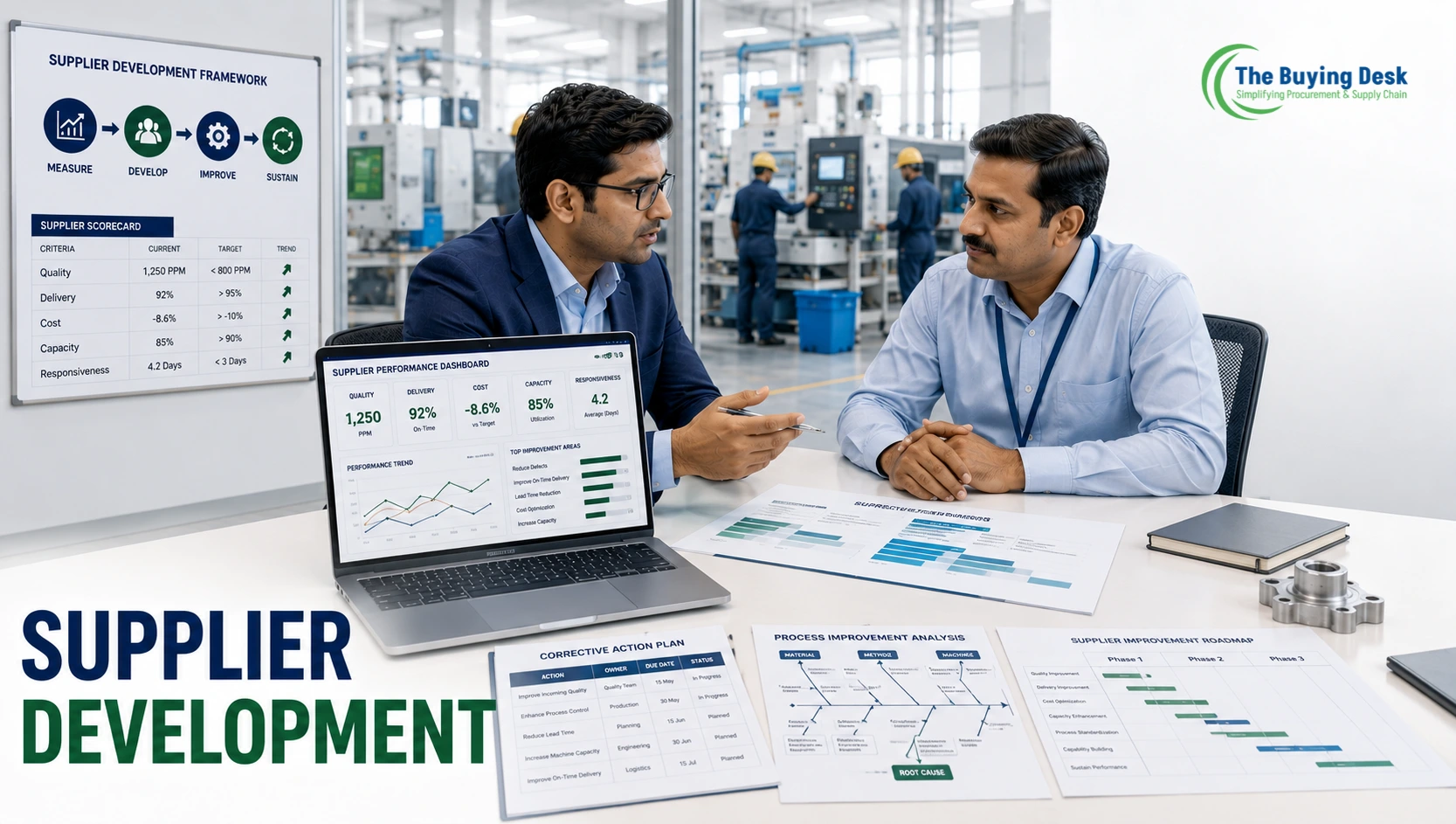
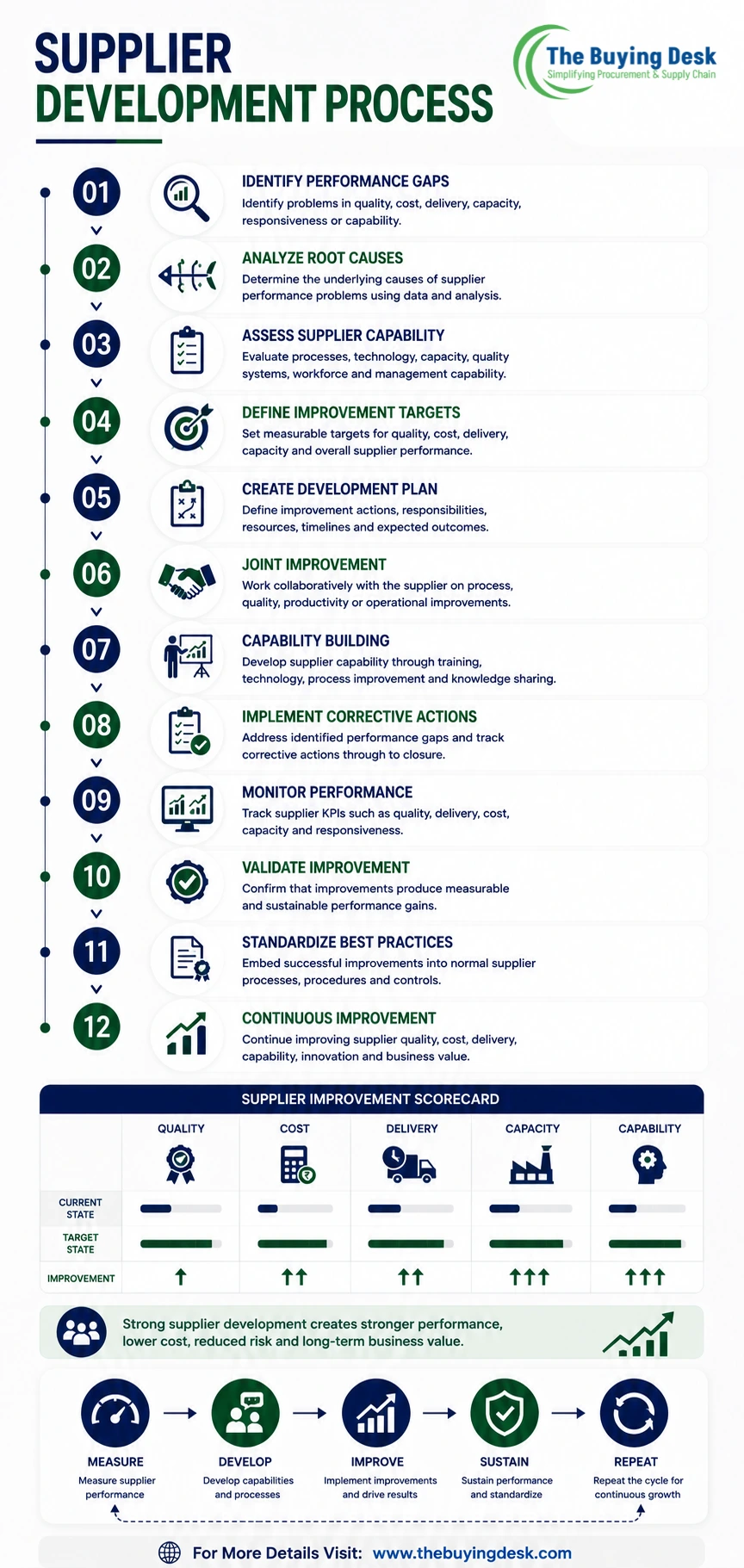
A structured supplier development process can be divided into several stages.
The first step is to understand where the supplier is underperforming.
Typical gaps may include:
Performance should be measured using objective data rather than assumptions.
Once a performance gap has been identified, procurement should determine the underlying cause.
For example:
Problem: Supplier delivery performance is poor.
Possible root causes could include:
Root-cause analysis helps ensure that the improvement plan addresses the actual problem.
The next step is to determine whether the supplier has the capability and willingness to improve.
Assessment may cover:
Not every supplier needs the same level of development.
Clear objectives should be established.
For example:
Current rejection rate: 3.5%
Target rejection rate: Below 1%
Or:
Current on-time delivery: 82%
Target: Above 95%
Specific targets make supplier development measurable.
The supplier and buying organization should agree on specific actions.
An action plan may include:
| Improvement Area | Action | Owner | Target Date |
|---|---|---|---|
| Quality | Improve inspection controls | Supplier Quality | 30 days |
| Delivery | Improve production planning | Supplier | 45 days |
| Capacity | Add production equipment | Supplier | 90 days |
| Cost | Improve process productivity | Supplier + Procurement | 60 days |
The action plan should have clear ownership and deadlines.
The supplier then implements the agreed actions.
Depending on the situation, procurement may support the supplier through:
Supplier development should be collaborative, but accountability should remain clear.
Performance must be measured after implementation.
Typical KPIs include:
The purpose is to determine whether the development activity actually produced measurable improvement.
Once the improvement works, the new process should become part of the supplier’s normal operating system.
Otherwise, performance may improve temporarily and then decline again.
Standardization may involve:
Supplier development should not always end after one successful project.
Strategic suppliers may require continuous improvement in:
This creates a long-term improvement culture.
Different suppliers require different development strategies.
Training can help suppliers improve technical, quality or process capabilities.
Examples include:
Supplier audits help identify gaps between required standards and actual supplier processes.
Audits may examine:
Procurement, engineering, quality and the supplier can work together to improve a specific process.
This is particularly useful for critical components.
Supplier development can also focus on cost.
Examples include:
The focus should be on total cost, not simply demanding a lower supplier price.
A supplier may have strong quality and pricing but insufficient capacity.
Capacity development may involve:
Quality development may include:
Strategic suppliers can become sources of innovation.
Procurement can work with suppliers on:
Supplier development is especially important in strategic procurement.
A supplier that provides a critical component may have significant influence on:
Instead of treating the supplier only as a source of purchased goods, procurement can develop the supplier’s capability and create mutual value.
This changes the procurement relationship from:
Buyer → Seller
to:
Business Partner → Business Partner
Supplier development should be supported by measurable KPIs.
Important indicators include:
Consider a manufacturing company that purchases a critical component from Supplier A.
The supplier’s performance is:
Instead of immediately replacing the supplier, the procurement team conducts a supplier development program.
A supplier audit identifies production planning and capacity constraints.
The supplier develops a new production planning system.
The supplier improves preventive maintenance.
The supplier adds production capacity.
Quality controls are strengthened.
Procurement reviews performance monthly.
After implementation:
This demonstrates the real value of supplier development.
Supplier development programs can fail when organizations make several common mistakes.
Supplier development should not become another exercise in demanding price reductions.
Long-term value comes from improving the entire supplier operation.
Without measurable targets, improvement becomes difficult to evaluate.
Every improvement action should have an owner.
Critical strategic suppliers may require intensive development, while low-value suppliers may only require basic monitoring.
Treating symptoms instead of root causes often results in recurring supplier problems.
A supplier improvement plan without regular monitoring will often lose momentum.
Supplier development works best when both parties see value in the improvement.
A practical supplier development program can follow this framework:
1. Segment Suppliers
Classify suppliers based on spend, criticality, risk and strategic importance.
2. Identify Critical Suppliers
Focus development resources on suppliers that have the greatest impact on business performance.
3. Measure Current Performance
Establish a reliable baseline.
4. Identify Gaps
Determine where performance does not meet expectations.
5. Analyze Root Causes
Find the real reasons behind the performance gap.
6. Define Improvement Projects
Create specific development initiatives.
7. Assign Ownership
Define responsibilities for procurement and suppliers.
8. Set Targets
Establish measurable improvement goals.
9. Monitor Progress
Review performance regularly.
10. Standardize Success
Ensure successful improvements become sustainable processes.
A successful supplier development program can generate benefits for both the buying organization and suppliers.
The strongest supplier development programs therefore create mutual value.
For procurement professionals, the following practices are particularly useful:
Supplier development is more than correcting poor supplier performance.
It is a strategic procurement approach that helps organizations build stronger, more capable and more resilient supply bases.
The most effective supplier development programs focus on:
Quality + Cost + Delivery + Capability + Risk + Continuous Improvement
Procurement professionals who can develop suppliers effectively can move beyond transactional purchasing and create significant long-term business value.
The ultimate objective is simple:
Don’t just manage suppliers. Develop them to become better business partners.
What is supplier development?
Supplier development is the structured process of improving a supplier’s capabilities, performance, quality, delivery, cost, capacity and overall ability to meet business requirements.
What is the difference between supplier development and supplier management?
Supplier management focuses primarily on managing and monitoring supplier relationships and performance. Supplier development actively works to improve supplier capabilities and performance.
What are the main objectives of supplier development?
The main objectives are improving quality, delivery, cost, capacity, capability, responsiveness, risk management and long-term supplier performance.
Which suppliers should be included in supplier development programs?
Strategic, critical, high-risk and high-impact suppliers generally deserve the greatest development attention.
What are common supplier development KPIs?
Common KPIs include on-time delivery, rejection rate, PPM, cost reduction, capacity improvement, corrective-action closure and overall supplier score.
Is supplier development only for poor-performing suppliers?
No. Supplier development can also be used with strong strategic suppliers to improve innovation, productivity, technology, capacity and long-term competitiveness.