Selecting the right supplier is only the beginning of supplier management.
Once a supplier is approved and business starts flowing, procurement needs to continuously determine whether the supplier is actually delivering the expected value.
Are deliveries on time?
Is the quality consistent?
Is the supplier responding quickly to problems?
Are prices competitive?
Does the supplier comply with contractual requirements?
Is the supplier financially and operationally stable?
These questions are answered through a structured supplier evaluation process.
Supplier evaluation is the systematic assessment of supplier performance against predefined criteria such as cost, quality, delivery, capability, responsiveness, compliance and risk.
A properly designed supplier evaluation system helps procurement teams identify strong suppliers, address performance gaps, develop strategic suppliers and reduce supply chain risk.
In this article, we will explain the supplier evaluation process step by step, discuss the most important evaluation criteria, show how to build a supplier scorecard and provide a practical supplier evaluation example.
Supplier evaluation is the process of measuring and assessing a supplier’s performance against agreed business requirements, procurement KPIs and contractual expectations.
The purpose is not simply to give a supplier a rating.
The real objective is to answer:
Is this supplier continuing to provide the required value, performance and supply reliability?
Supplier evaluation can be performed:
The frequency should depend on the supplier’s importance and risk.
A critical supplier supplying a production-stopping component may require monthly performance monitoring, while a low-value office-supply supplier may only require periodic review.
Supplier selection and supplier evaluation are closely connected but serve different purposes.
Supplier Selection answers:
Which supplier should we choose?
Supplier Evaluation answers:
How well is the supplier performing?
The typical lifecycle is:
Supplier Identification → Qualification → Evaluation → Selection → Onboarding → Performance Evaluation → Supplier Development
Therefore, supplier evaluation should continue throughout the supplier relationship.
A supplier may perform well during the sourcing stage and then deteriorate after receiving regular business.
Without structured evaluation, procurement may continue purchasing from suppliers based on historical relationships or assumptions rather than actual performance.
Supplier evaluation helps organizations:
For manufacturing organizations, supplier performance can directly influence production continuity and customer satisfaction.
A supplier’s failure to deliver one critical component on time can potentially affect an entire production schedule.
A supplier evaluation model should reflect the organization’s priorities.
The most common criteria are:
Let’s examine each.
Quality is one of the most important supplier evaluation criteria, particularly for manufacturing and technically critical categories.
Possible quality indicators include:
For example:
If a supplier delivers 10,000 pieces and 50 are rejected:
Supplier Rejection Rate = 50 ÷ 10,000 × 100
= 0.5%
Procurement should not evaluate quality using a single number alone.
Trend analysis is also important.
A supplier moving from 0.2% rejection to 0.8% and then 1.5% may represent a growing risk even if the latest number is still within an internal threshold.
Delivery performance measures whether the supplier delivers according to the agreed schedule.
A basic formula is:
On-Time Delivery % = On-Time Deliveries ÷ Total Deliveries × 100
For example:
Total deliveries = 100
On-time deliveries = 94
OTD = 94%
However, organizations should clearly define what counts as “on time.”
For example:
A supplier delivering three days early may not always be considered equivalent to a supplier delivering exactly according to the agreed schedule, especially when inventory and JIT requirements are involved.
Supplier evaluation should also consider commercial performance.
Cost-related evaluation may include:
Procurement should avoid evaluating suppliers solely on historical unit price.
A supplier with a slightly higher price but excellent quality and delivery may create lower overall business cost.
Supplier responsiveness is often underestimated.
Measure how quickly the supplier responds to:
A supplier that takes several days to respond to every critical issue can create operational risk.
For technical products and services, evaluate:
Technical capability becomes particularly important when suppliers support new product development or complex components.
A supplier may have good quality and pricing but insufficient capacity.
Evaluate:
Capacity should also be evaluated against future demand.
A supplier capable of producing 10,000 units today may not be suitable if annual demand is expected to increase to 25,000 units.
Supplier compliance can include:
For regulated industries, compliance may carry significantly higher weighting.
Supplier risk evaluation should consider:
A supplier can have excellent performance today while still presenting significant future risk.
Strategic suppliers should increasingly be evaluated on their ability to contribute beyond routine supply.
Consider:
This helps procurement move from transactional supplier management toward strategic supplier collaboration.
Supplier relationships can influence overall business performance.
Evaluate:
The objective should not be to create a “friendly supplier” rating.
The objective is to determine whether the supplier provides effective professional support to the business.
A practical supplier evaluation process can follow these steps:
1. Define Evaluation Criteria
↓
2. Assign Weights
↓
3. Establish Performance Targets
↓
4. Collect Supplier Data
↓
5. Calculate KPI Performance
↓
6. Score the Supplier
↓
7. Review Performance Trends
↓
8. Identify Gaps
↓
9. Agree Corrective Actions
↓
10. Conduct Supplier Review
↓
11. Monitor Improvement
↓
12. Re-Evaluate Supplier
This makes supplier evaluation a continuous improvement cycle rather than a one-time exercise.
Start by identifying what matters most for the supplier category.
For example, a manufacturing supplier might be evaluated on:
A logistics supplier may require a different model:
There is no universal weighting system.
The evaluation model should reflect the business risk and category requirements.
Weighted scoring makes the evaluation more objective.
For example:
| Criteria | Weight |
|---|---|
| Quality | 30% |
| Delivery | 25% |
| Cost | 20% |
| Technical Capability | 10% |
| Responsiveness | 5% |
| Compliance | 5% |
| Improvement | 5% |
| Total | 100% |
The total weight should equal 100%.
Each criterion should have a clear target.
For example:
| KPI | Target |
|---|---|
| On-Time Delivery | ≥ 95% |
| Quality | ≤ 500 PPM |
| Response Time | ≤ 24 hours |
| Corrective Action Closure | ≤ 30 days |
| PO Confirmation | ≤ 2 working days |
Targets should be realistic and aligned with contracts, specifications and business requirements.
Supplier evaluation becomes meaningful only when it is based on reliable data.
Data can come from:
Avoid relying entirely on personal opinions.
For example:
Instead of saying:
“Supplier B usually delivers late.”
Use:
“Supplier B achieved 89% on-time delivery during the last six months against a target of 95%.”
The second statement is measurable and actionable.
Each supplier KPI should be calculated consistently.
For example:
On-Time Delivery = On-Time Deliveries ÷ Total Deliveries × 100
Rejection Rate = Rejected Quantity ÷ Received Quantity × 100
PO Confirmation Compliance = POs Confirmed Within Required Time ÷ Total POs × 100
The exact formulas should be standardized within the organization.
A simple 1–5 scoring system can be used.
| Score | Performance |
|---|---|
| 5 | Excellent |
| 4 | Good |
| 3 | Acceptable |
| 2 | Needs Improvement |
| 1 | Poor |
For example:
Supplier A:
| Criteria | Weight | Score |
|---|---|---|
| Quality | 30% | 5 |
| Delivery | 25% | 4 |
| Cost | 20% | 4 |
| Technical | 10% | 4 |
| Responsiveness | 5% | 5 |
| Compliance | 5% | 5 |
| Improvement | 5% | 4 |
The weighted score can then be calculated.
For example:
Weighted Score = Σ (Score × Weight)
This creates a more balanced assessment than looking at individual KPIs separately.
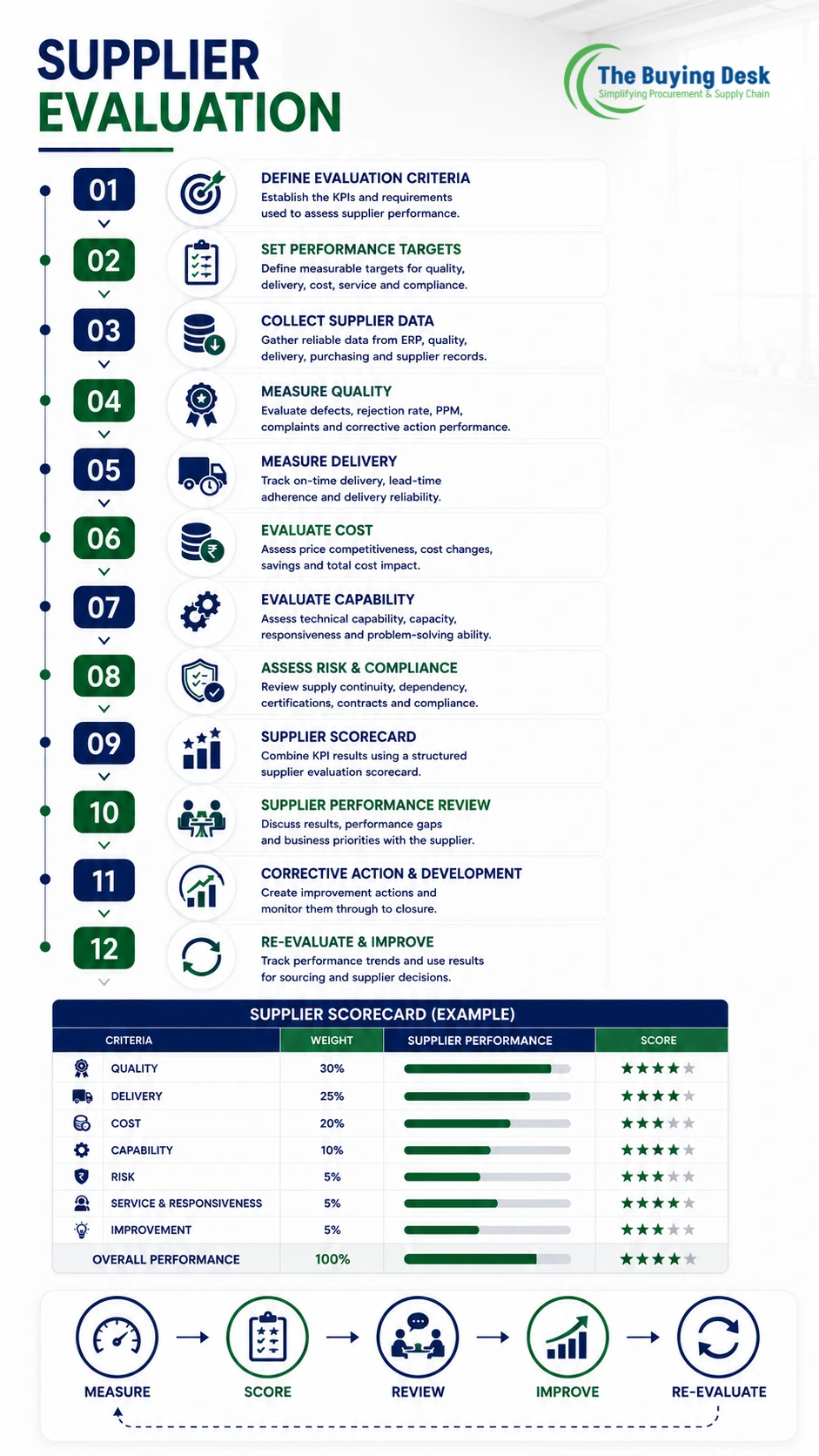
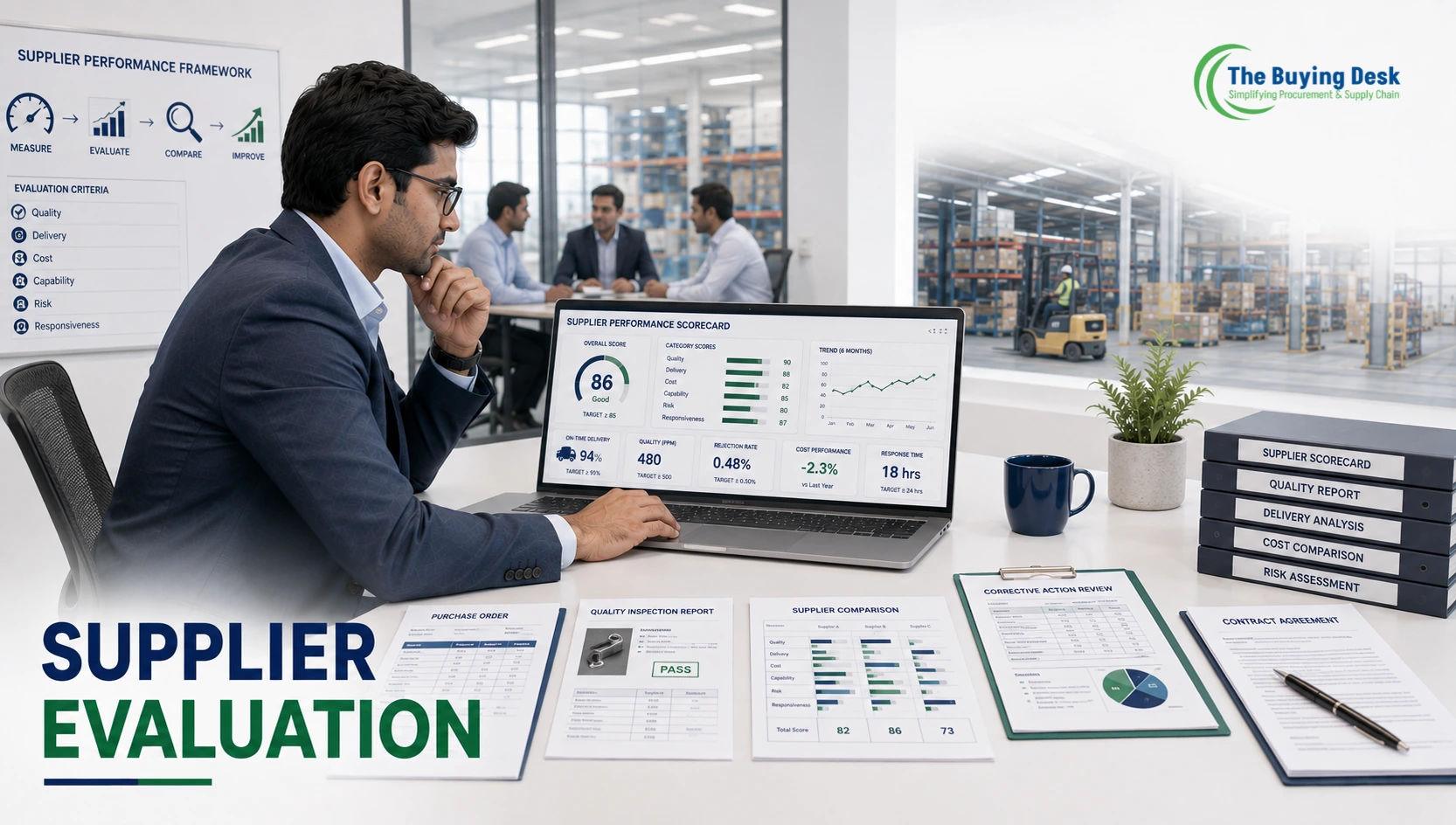
A practical supplier scorecard might look like this:
| KPI | Weight | Target | Supplier Result | Score |
|---|---|---|---|---|
| Quality | 30% | ≤ 500 PPM | 420 PPM | 5 |
| On-Time Delivery | 25% | ≥ 95% | 96% | 5 |
| Cost | 20% | Target achieved | Good | 4 |
| Technical Capability | 10% | Required | Good | 4 |
| Responsiveness | 5% | ≤ 24 hrs | 18 hrs | 5 |
| Compliance | 5% | 100% | 100% | 5 |
| Improvement | 5% | 2 initiatives/year | 1 | 3 |
The final score can then be converted into a supplier category.
One example:
| Score | Rating | Recommended Action |
|---|---|---|
| 90–100% | Excellent | Preferred / Strategic |
| 80–89% | Good | Continue & Develop |
| 70–79% | Acceptable | Monitor |
| 60–69% | Needs Improvement | Corrective Action |
| Below 60% | Poor | Escalation / Replacement Review |
These thresholds are examples and should be customized according to organizational requirements.
A supplier evaluation matrix allows procurement to compare suppliers across multiple criteria.
For example:
| Criteria | Weight | Supplier A | Supplier B | Supplier C |
|---|---|---|---|---|
| Quality | 30% | 4.5 | 4.8 | 3.8 |
| Delivery | 25% | 4.0 | 4.7 | 3.5 |
| Cost | 20% | 4.2 | 3.8 | 4.8 |
| Capability | 10% | 4.0 | 4.8 | 3.6 |
| Risk | 10% | 4.2 | 4.6 | 3.2 |
| Responsiveness | 5% | 4.0 | 4.7 | 3.5 |
This can help management understand why a supplier received a particular overall rating.
Supplier evaluation should not end when the scorecard is completed.
The scorecard should lead to a conversation.
A supplier review meeting can discuss:
For every major gap, define:
This transforms supplier evaluation into supplier improvement.
When supplier performance falls below expectations, procurement and quality teams should avoid simply reducing the supplier’s score.
The objective should be to understand the reason.
A corrective action process can follow:
Problem Identification
↓
Root Cause Analysis
↓
Corrective Action
↓
Implementation
↓
Effectiveness Verification
↓
Closure
For recurring quality problems, methods such as 5 Why, Fishbone Analysis, 8D or CAPA may be appropriate depending on the organization’s quality system.
Evaluation frequency should depend on supplier criticality.
Possible frequency:
Monthly KPI Review + Quarterly Business Review
Possible frequency:
Monthly or Quarterly Performance Review
Possible frequency:
Quarterly or Half-Yearly
Possible frequency:
Annual or Risk-Based Review
There is no need to apply the same evaluation frequency to every supplier.
Supplier evaluation becomes more effective when combined with supplier segmentation.
For example:
High business impact and high relationship importance.
Focus on:
High supply risk or significant operational impact.
Focus on:
High spend but relatively lower supply risk.
Focus on:
Low value and low risk.
Focus on:
The evaluation approach should reflect the supplier’s position in the business.
Annual reviews may not identify rapidly developing problems.
Critical suppliers should be monitored more frequently.
A scorecard with 30–40 KPIs can become difficult to manage.
Focus on the indicators that actually influence business performance.
“Good supplier” and “bad supplier” are not measurable.
Use data wherever possible.
A single month’s performance can be misleading.
Look at trends over time.
Quality is critical, but supplier performance also includes delivery, cost, responsiveness, risk and capability.
Supplier evaluation should be a two-way discussion.
Suppliers may identify issues in forecasts, specifications, payment processes or internal planning.
The purpose should be performance improvement, risk management and better decision-making.
Supplier performance data should influence:
Supplier evaluation data can help answer important business questions.
If the supplier consistently performs well, additional allocation may be justified.
Repeated poor performance may require business reallocation.
If the supplier has strategic potential but performance gaps exist, supplier development may be appropriate.
If risk or performance is unacceptable, dual sourcing may be required.
Performance data provides objective evidence for commercial discussions.
Supplier evaluation can also reveal hidden costs.
Consider two suppliers:
Supplier A
Price = ₹100
Quality rejection = 1%
On-time delivery = 96%
Supplier B
Price = ₹96
Quality rejection = 5%
On-time delivery = 82%
Supplier B appears cheaper.
But if Supplier B creates:
the apparent ₹4 saving may disappear.
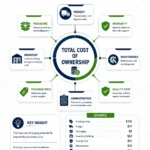
This is why procurement should connect supplier evaluation with Total Cost of Ownership.
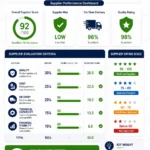
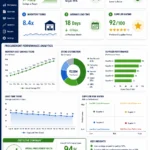
A procurement dashboard can show:
A simple dashboard might use:
Green = Performing
Amber = Needs Attention
Red = Critical
The dashboard should help procurement quickly identify where action is required.
Digital procurement systems can automate much of the supplier evaluation process.
Technology can support:
However, automation should not replace human judgment.
A dashboard can identify that delivery performance dropped from 97% to 88%.
The procurement team still needs to determine why.
Imagine a supplier delivers automotive components.
Annual performance:
Suppose the organization’s targets are:
The supplier would have:
Delivery: Good
Responsiveness: Good
Cost: Meets target
Quality: Needs improvement
The correct response is not necessarily immediate supplier replacement.
Instead, procurement and quality may initiate a supplier improvement plan focused on reducing quality issues.
This demonstrates why supplier evaluation should lead to action, not merely a score.
Before completing a supplier review, ask:
A mature supplier evaluation system should:
What is supplier evaluation?
Supplier evaluation is the systematic assessment of supplier performance against predefined criteria such as quality, delivery, cost, capability, responsiveness, compliance and risk.
What are the most important supplier evaluation criteria?
The most common criteria are quality, delivery, cost, technical capability, capacity, responsiveness, compliance, risk and continuous improvement.
What is a supplier scorecard?
A supplier scorecard is a structured tool used to measure supplier performance against defined KPIs, targets and weighted criteria.
How often should suppliers be evaluated?
The frequency depends on supplier criticality and risk. Critical suppliers may require monthly monitoring, while lower-risk suppliers may be evaluated quarterly, half-yearly or annually.
What is supplier performance evaluation?
Supplier performance evaluation is the ongoing measurement of how effectively a supplier meets agreed quality, delivery, cost, service and other contractual requirements.
What should happen if a supplier receives a poor score?
The organization should investigate the root causes, communicate the performance gap, establish corrective actions and monitor improvement. For persistent critical failures, business reallocation or supplier replacement may be considered.
Should supplier evaluation be based only on KPIs?
No. KPIs provide objective evidence, but procurement should also consider supplier capability, strategic importance, risk, future potential and qualitative business factors.
Supplier evaluation is not simply a yearly rating exercise.
It is a continuous management process that helps procurement understand whether suppliers are delivering the expected quality, cost, delivery, service, capability and business value.
A strong supplier evaluation system connects:
Data → KPI → Score → Review → Corrective Action → Improvement
The most effective procurement teams do not use supplier scorecards merely to identify poor suppliers.
They use them to:
Protect supply → Improve performance → Reduce risk → Develop suppliers → Create business value
And most importantly, supplier evaluation should influence real procurement decisions such as business allocation, supplier development, sourcing strategy, negotiation and supplier replacement.