A supplier may offer the best price, excellent quality and attractive payment terms—but still represent a significant business risk.
Why?
Because procurement performance depends not only on what a supplier charges, but also on whether the supplier can consistently deliver the required product or service when the business needs it.
A supplier may suddenly face financial problems, capacity constraints, quality failures, raw material shortages, regulatory issues, cybersecurity incidents, geopolitical disruptions or logistics challenges.
This is why modern procurement teams need a structured approach to Supplier Risk Management.
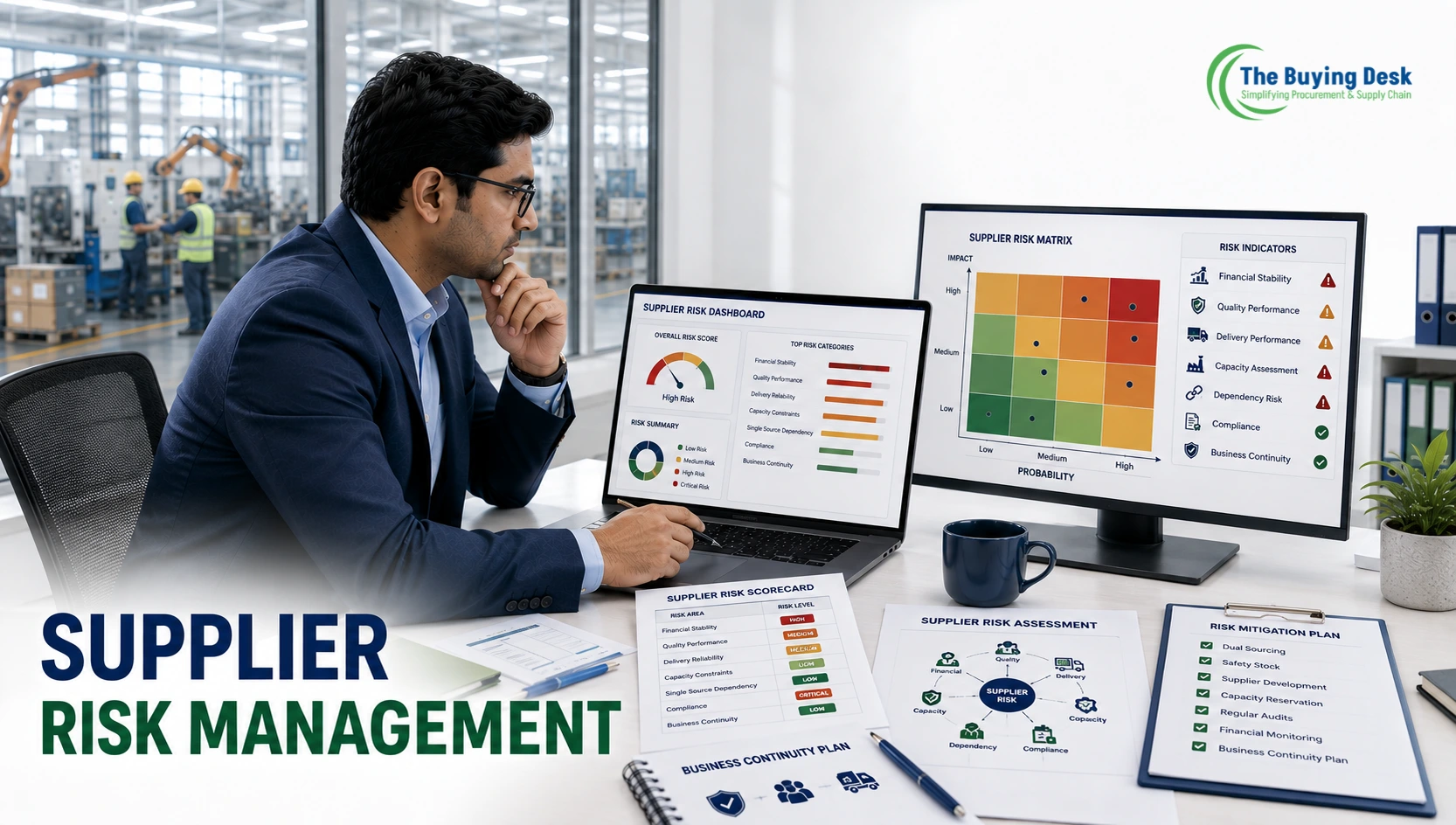
Supplier risk management is the process of identifying, assessing, monitoring and mitigating risks associated with suppliers throughout their relationship with an organization.
The objective is not to eliminate every supplier risk. That is rarely possible.
The objective is to understand the risks, prioritize them and take appropriate action before they become major business problems.
Supplier Risk Management is a systematic process used by procurement and supply chain teams to identify and manage risks associated with suppliers.
It covers the supplier lifecycle from:
Supplier Identification → Qualification → Selection → Onboarding → Monitoring → Development → Continuity
Supplier risk can affect:
A strong supplier risk management system therefore looks beyond purchase price and evaluates the overall risk exposure created by a supplier relationship.
Organizations often focus heavily on supplier price negotiations.
However, a small price saving can become insignificant if a supplier failure stops production for several days.
For example, suppose a supplier offers a component at ₹100 per piece compared with another supplier offering ₹103.
The ₹3 saving may appear attractive.
But if the ₹100 supplier has unreliable delivery and causes a production stoppage, the actual business impact could be many times greater than the purchase-price saving.
This is why procurement should consider:
Cost + Quality + Delivery + Capability + Financial Stability + Compliance + Continuity + Risk
Supplier risk management helps procurement teams make better sourcing decisions while protecting the business from avoidable disruptions.
Supplier risk can come from several different sources.
Financially unstable suppliers may struggle to maintain operations, purchase raw materials, retain employees or invest in production capacity.
Procurement teams may consider:
Financial risk becomes particularly important for suppliers providing critical or difficult-to-replace materials.
Poor supplier quality can result in:
Quality risk should be monitored through supplier quality KPIs, audits, inspection results and corrective-action performance.
A supplier may have good quality but poor delivery performance.
Delivery risk can result from:
Procurement should monitor supplier on-time delivery against agreed delivery dates.
A supplier may be technically capable but unable to support increasing demand.
Capacity risk should consider:
Capacity risk is particularly important when a supplier supports a critical component or rapidly growing product.
Depending heavily on one supplier creates concentration risk.
If that supplier stops supplying, the organization may have limited alternatives.
Single-source risk can be justified in some situations, especially where technology, tooling, qualification or intellectual property creates barriers to switching.
However, the risk should be understood and managed.
Supplier location can create additional exposure.
Potential risks include:
A geographically concentrated supplier base can increase vulnerability to regional disruptions.
Suppliers may need to meet specific:
Failure to meet these requirements can create legal, financial and reputational consequences.
Modern suppliers increasingly exchange digital information with customers.
This creates risks related to:
For technology-intensive or strategically important suppliers, cybersecurity should be included in supplier risk assessment.
A supplier’s actions can affect the reputation of the buying organization.
Potential areas include:
The level of assessment should reflect the organization’s industry, regulatory requirements and supplier criticality.
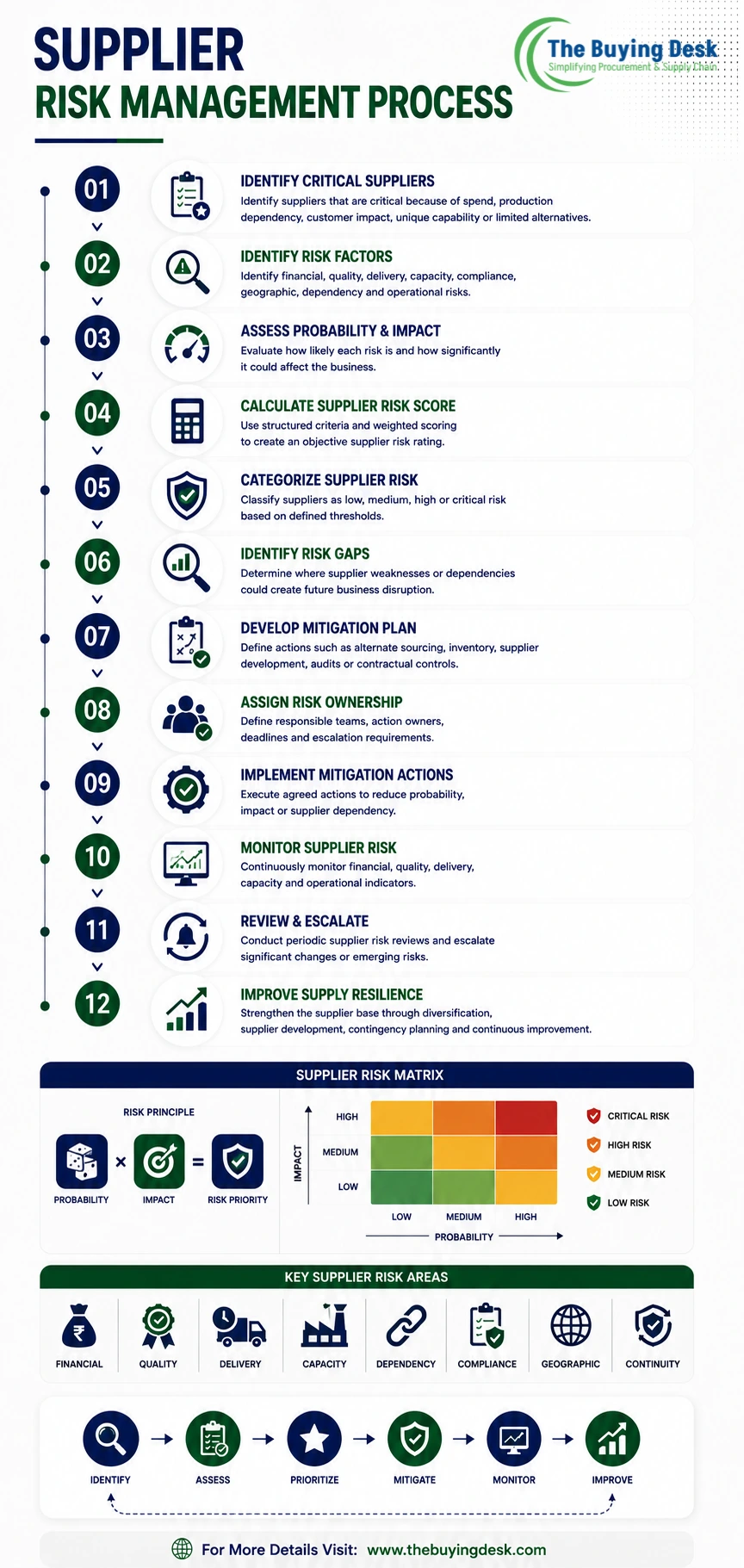
A structured supplier risk management process can be divided into several stages.
Not every supplier requires the same level of risk management.
First identify suppliers that are critical because of:
These suppliers should receive greater attention.
Determine the major risks associated with each supplier.
Consider:
Financial + Quality + Delivery + Capacity + Compliance + Geographic + Dependency + Operational Risk
The objective is to create a complete picture of supplier exposure.
Each risk should be evaluated based on factors such as:
Probability × Impact
For example:
| Risk | Probability | Impact | Priority |
|---|---|---|---|
| Delivery disruption | High | High | Critical |
| Quality issue | Medium | High | High |
| Financial instability | Low | High | Medium |
| Capacity shortage | Medium | Medium | Medium |
| Compliance issue | Low | High | High |
This allows procurement teams to focus resources on the most important risks.
Organizations can create a supplier risk score using weighted criteria.
For example:
| Risk Area | Weight |
|---|---|
| Quality | 20% |
| Delivery | 20% |
| Financial Stability | 15% |
| Capacity | 15% |
| Compliance | 10% |
| Dependency | 10% |
| Geographic Risk | 5% |
| Operational Risk | 5% |
The weights should be customized according to the organization’s industry and supplier criticality.
A supplier supporting a critical production component may require much higher weighting for delivery and capacity.
A simple classification can be:
Low Risk
Normal monitoring and standard supplier management.
Medium Risk
Increased monitoring and defined mitigation actions.
High Risk
Formal risk mitigation plan, management review and closer monitoring.
Critical Risk
Immediate action required, including contingency planning and potentially alternative sourcing.
Risk assessment alone does not reduce risk.
Procurement must define appropriate mitigation actions.
Examples include:
Supplier risk is not static.
A supplier that was low-risk six months ago may become high-risk due to:
Therefore supplier risk should be continuously monitored.
A simple risk matrix can help procurement teams prioritize suppliers.
Routine monitoring.
Develop preventive actions.
Prepare contingency plans.
Treat as a critical supplier risk requiring immediate action.
This approach helps procurement teams focus on risks that could materially affect business continuity.
Develop more than one qualified supplier where commercially and technically practical.
This can reduce dependency on a single source.
Work with strategic suppliers to improve:
Supplier development can convert a high-risk supplier into a more reliable strategic partner.
For highly critical materials, maintaining appropriate inventory may provide additional protection against supply interruptions.
Inventory decisions should consider:
Maintain potential alternative suppliers for critical materials.
An alternative supplier does not always need to receive regular orders immediately. However, qualification and technical readiness can significantly reduce response time during a disruption.
Contracts can include appropriate provisions covering:
Critical suppliers should have appropriate contingency plans covering events such as:
Supplier risk and supplier performance are related but different.
Supplier Performance asks:
How well is the supplier performing today?
Supplier Risk asks:
What could prevent the supplier from performing tomorrow?
For example, a supplier may currently achieve 98% on-time delivery.
However, if its capacity utilization is already 95%, demand is increasing rapidly and there is no expansion plan, future capacity risk may be high.
Therefore procurement should monitor both current performance and future risk.
Useful KPIs include:
Percentage of suppliers classified as high or critical risk.
Percentage of critical suppliers covered by formal risk assessments.
Percentage of identified risk actions completed within the agreed timeline.
Percentage of critical spend or materials dependent on a single supplier.
Percentage of critical suppliers requiring financial monitoring or review.
Measures delivery reliability and helps identify potential continuity risks.
Tracks defects, rejection rates, complaints and corrective actions.
Measures the percentage of critical materials with an approved alternative source.
Percentage of critical suppliers with an acceptable continuity plan.
Measures whether critical suppliers are being reviewed at the required frequency.
The lowest purchase price does not necessarily represent the lowest total business cost.
A supplier providing office stationery does not necessarily require the same risk controls as a supplier providing a production-critical component.
Supplier risk must continue throughout the supplier relationship.
Single-source arrangements may be technically justified, but the associated risk must be understood.
Identifying a risk without assigning an owner and deadline rarely produces improvement.
Supplier risk assessments should use current information.
Changes in delivery, quality, financial condition, capacity or responsiveness can indicate emerging supplier problems.
A mature procurement organization should:
Procurement teams can use a simple framework:
IDENTIFY
What could go wrong?
↓
ASSESS
How likely is it and what would be the impact?
↓
PRIORITIZE
Which risks require immediate attention?
↓
MITIGATE
What action can reduce the risk?
↓
MONITOR
Is the risk increasing or decreasing?
↓
IMPROVE
What can be changed to create a more resilient supply base?
This turns supplier risk management from a reactive activity into a continuous procurement discipline.
Supplier risk management is no longer an optional activity for modern procurement teams.
A supplier can influence production continuity, customer service, quality, cost, compliance and ultimately business performance.
The goal is not to eliminate every supplier risk.
The goal is to identify important risks early, understand their potential impact and take practical action before they become disruptions.
A strong supplier risk management system connects:
Supplier Selection → Supplier Qualification → Supplier Performance → Supplier Development → Risk Management → Business Continuity
When procurement manages these areas together, supplier relationships become more resilient, predictable and valuable.
The most effective procurement teams do not simply ask:
“Which supplier offers the lowest price?”
They ask:
“Which supplier can provide the required value reliably, sustainably and with an acceptable level of risk?”
That is the foundation of strategic supplier risk management.
What is supplier risk management?
Supplier risk management is the process of identifying, assessing, monitoring and mitigating risks associated with suppliers throughout the supplier lifecycle.
What are the main types of supplier risk?
Common types include financial, quality, delivery, capacity, single-source, geographic, compliance, cybersecurity, operational and reputation-related risks.
How do you assess supplier risk?
A common approach is to identify risk factors, evaluate probability and business impact, assign weighted scores and classify suppliers into low, medium, high or critical risk categories.
Why is supplier risk management important?
It helps organizations reduce supply disruptions, protect production, improve continuity and make better sourcing decisions.
What is the difference between supplier risk and supplier performance?
Supplier performance measures how well a supplier is performing currently, while supplier risk focuses on factors that could prevent reliable performance in the future.
How can procurement reduce supplier risk?
Procurement can use dual sourcing, alternative supplier development, supplier development, strategic inventory, contractual controls, audits and business continuity planning.
How often should supplier risk be reviewed?
The frequency should depend on supplier criticality and risk level. Critical suppliers generally require more frequent monitoring than low-risk suppliers.
Is single sourcing always a risk?
Single sourcing creates dependency risk, but it may be justified because of technology, tooling, intellectual property, qualification requirements or limited market availability. The important point is to understand and manage the exposure.