Choosing the right supplier is one of the most important decisions in procurement.
A supplier may offer the lowest price, but that does not necessarily make them the best supplier. A supplier that consistently delivers the right quality, on time, at a competitive total cost, while managing risks and responding quickly to business requirements, can create much greater value.
This is why professional procurement teams do not treat supplier selection as simply collecting quotations and choosing the lowest price.
Supplier selection is a structured process of identifying, qualifying, evaluating, comparing and selecting suppliers based on business requirements.
A well-designed supplier selection process helps organizations improve cost, quality, delivery, supply continuity, compliance and long-term supplier performance.
In this article, we will understand the complete supplier selection process, important supplier selection criteria, supplier scoring methods, common mistakes and practical examples.
Supplier selection is the process of identifying potential suppliers and evaluating them against predefined commercial, technical, quality, delivery, capability and risk criteria before selecting the most suitable supplier.
The objective is not necessarily to find the cheapest supplier.
The objective is to find the supplier that provides the best overall value for the business.
For example, suppose three suppliers quote for the same component:
| Supplier | Price | Quality | Delivery | Capacity | Risk |
|---|---|---|---|---|---|
| Supplier A | ₹95 | Good | Good | Medium | Medium |
| Supplier B | ₹100 | Excellent | Excellent | High | Low |
| Supplier C | ₹88 | Average | Poor | Low | High |
Supplier C may appear attractive because of the lowest price.
However, if poor quality creates rejection costs, delayed deliveries cause production interruptions and limited capacity creates supply risk, Supplier C may actually be the most expensive option in the long run.
This is why supplier selection should consider total value and total risk, not price alone.
A supplier directly or indirectly affects several areas of business performance.
The wrong supplier can create:
The right supplier can help an organization achieve:
For manufacturing organizations, supplier selection can be particularly important because a supplier’s performance may directly affect production continuity and customer deliveries.
These terms are related but not identical.
Supplier evaluation is the process of assessing a supplier against defined criteria.
Supplier selection is the decision-making process that uses the evaluation results to determine which supplier should be selected.
A simple way to understand it is:
Supplier Evaluation → Supplier Comparison → Supplier Selection
Evaluation produces the evidence.
Selection produces the decision.
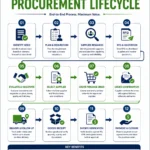
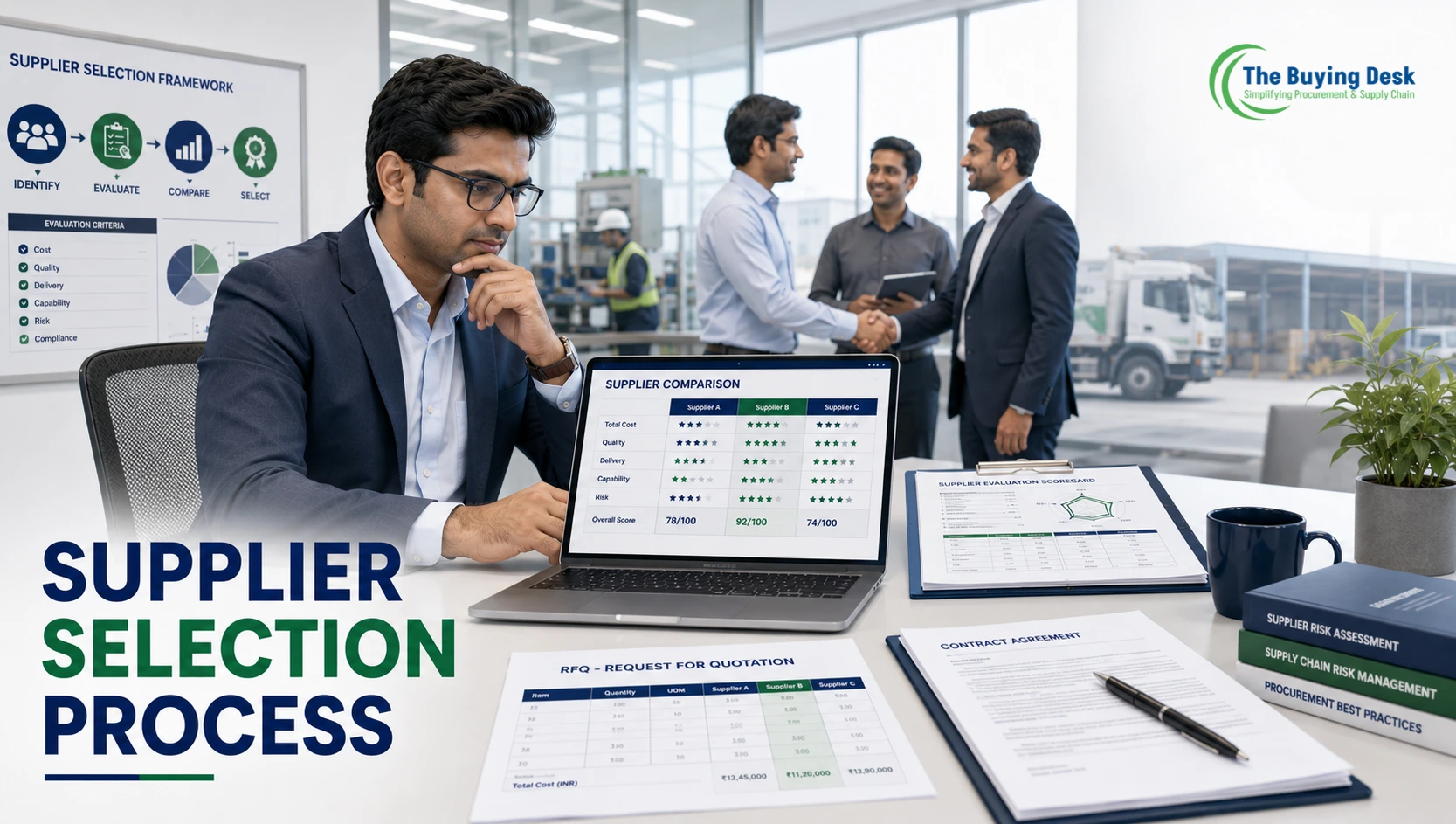
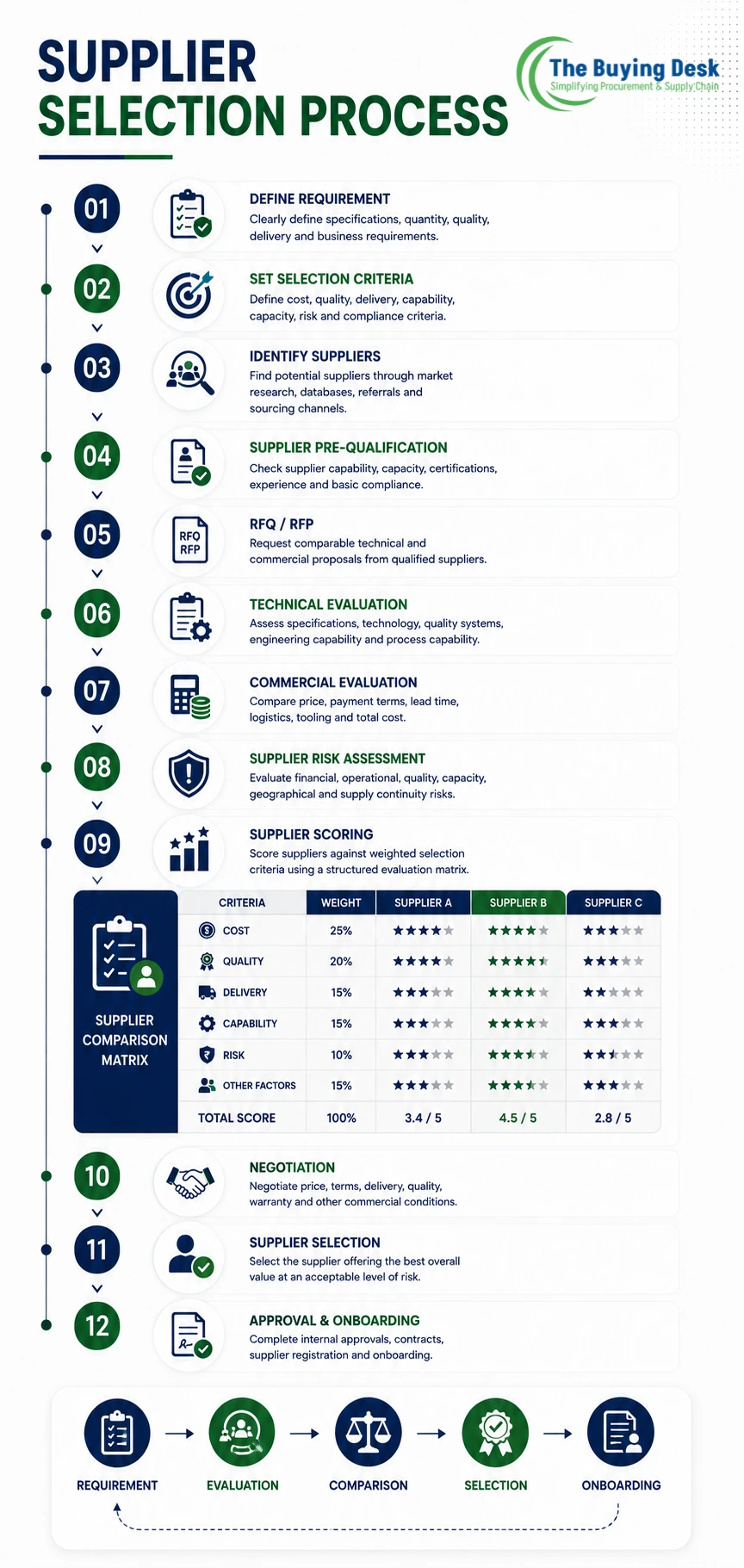
A robust supplier selection process can be divided into the following stages:
1. Define the Requirement
↓
2. Establish Supplier Selection Criteria
↓
3. Identify Potential Suppliers
↓
4. Pre-Qualify Suppliers
↓
5. Issue RFQ / RFP
↓
6. Evaluate Technical & Commercial Offers
↓
7. Assess Supplier Capability
↓
8. Conduct Risk Assessment
↓
9. Negotiate Commercial Terms
↓
10. Score and Compare Suppliers
↓
11. Select Supplier
↓
12. Complete Approval & Onboarding
Let’s examine each stage.
Supplier selection should begin with a clear understanding of what the business needs.
Before approaching suppliers, procurement should understand:
For a manufacturing component, the requirement may include:
If the requirement is unclear, supplier comparison can become unreliable.
Before receiving quotations, define how suppliers will be evaluated.
Typical criteria include:
The weight assigned to each criterion should depend on the category.
For example, quality and technical capability may receive greater weight for a safety-critical component than for ordinary office supplies.
The next step is to develop a supplier pool.
Potential suppliers can be identified through:
For strategic or technically complex purchases, procurement should avoid relying on only one known supplier unless there is a justified reason.
A broader supplier pool creates greater competition and may improve sourcing options.
Not every supplier that submits a quotation should automatically enter the final evaluation.
Pre-qualification helps remove suppliers that do not meet minimum requirements.
A supplier pre-qualification questionnaire may cover:
Suppliers that fail critical minimum requirements can be removed before the detailed RFQ stage.
Once qualified suppliers are identified, procurement can request commercial and technical proposals.
An RFQ — Request for Quotation is generally used when the requirement is sufficiently defined and suppliers can provide comparable pricing.
An RFP — Request for Proposal is generally more appropriate when procurement needs suppliers to propose a solution, approach or service model.
A good RFQ/RFP should clearly communicate:
The more consistent the RFQ, the easier it becomes to compare suppliers.
Supplier quotations should be evaluated systematically.
Avoid making the decision solely from the first page of the quotation.
Evaluate at least:
This creates a more complete supplier comparison.
A supplier may meet the specification on paper but still lack the capability to consistently deliver.
Capability assessment may include:
For critical suppliers, a supplier audit or plant visit can provide much more useful information than a quotation alone.
Supplier selection should also consider risk.
A supplier with excellent pricing but high supply risk may not be the right choice.
Consider:
A supplier selection decision should balance opportunity and risk.
Once the technically suitable suppliers have been identified, procurement can negotiate.
Negotiation may cover:
However, negotiation should not automatically focus only on reducing the quoted price.
The objective should be to improve the overall commercial package.
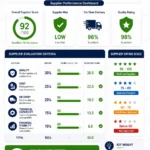
A supplier scoring model can make the decision more objective.
For example:
| Criteria | Weight | Supplier A | Supplier B | Supplier C |
|---|---|---|---|---|
| Cost | 25% | 8 | 9 | 10 |
| Quality | 25% | 9 | 10 | 7 |
| Delivery | 20% | 8 | 9 | 6 |
| Capability | 15% | 8 | 9 | 7 |
| Risk | 10% | 8 | 9 | 5 |
| Responsiveness | 5% | 8 | 9 | 7 |
A weighted score can then be calculated for each supplier.
For example:
Weighted Score = Supplier Rating × Criterion Weight
The final score helps procurement compare suppliers more systematically.
Importantly, scoring should not replace professional judgment. A critical failure in one area may justify rejecting a supplier even if its overall numerical score appears attractive.
The supplier selection decision should consider:
Commercial Value + Quality + Delivery + Capability + Risk + Strategic Fit
The selected supplier should satisfy the organization’s minimum requirements and provide an acceptable overall value proposition.
For important categories, procurement should document why the supplier was selected.
This creates transparency and helps during future reviews or audits.
Supplier selection is not complete until the required internal approvals are obtained.
Depending on the organization, this may involve:
Supplier onboarding may include:
Only after the necessary controls are completed should the supplier become an active supplier.
The criteria should be adapted to the category, but the following framework works well for many procurement decisions.
Consider more than unit price.
Look at:
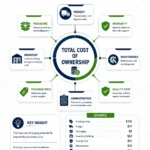
This is why Total Cost of Ownership (TCO) can be more useful than simple purchase price comparison.
Evaluate:
Consider:
Evaluate:
A supplier must have sufficient capacity to support both current and future demand.
Consider:
A financially unstable supplier can become a major supply risk.
For critical suppliers, consider appropriate financial due diligence.
A good supplier should respond effectively to:
Depending on the industry, consider:
Location affects:
The nearest supplier is not automatically the best supplier, but location can be an important factor.
For strategic categories, ask:
A supplier selection matrix provides a structured way to compare suppliers.
A practical model might look like this:
| Criteria | Weight |
|---|---|
| Cost / TCO | 25% |
| Quality | 20% |
| Delivery | 15% |
| Technical Capability | 10% |
| Capacity | 10% |
| Financial Stability | 5% |
| Risk | 5% |
| Responsiveness | 5% |
| Strategic Fit | 5% |
The weights should not be treated as universal. They should be adjusted based on the category and business risk.
For example, for a safety-critical component, quality and technical capability may deserve substantially more weight than price.
Suppose a company needs a critical machined component.
Three suppliers submit proposals.
A procurement team focused only on purchase price may select Supplier A.
A strategic procurement team would evaluate the potential cost of:
Supplier B could therefore provide better total value, even with a higher unit price.
This is one of the most important lessons in supplier selection:
The lowest price is not always the lowest cost.
This is one of the most common procurement mistakes.
Low price can be attractive, but poor quality or delivery can create much larger downstream costs.
Single sourcing can sometimes be justified, but it should be based on technical, commercial or strategic reasons.
A supplier may win the business but fail to support the required volume.
Supplier dependency should be understood before awarding critical business.
One supplier may include freight while another does not.
One may offer different payment terms.
One may quote different packaging.
Always compare suppliers on a comparable basis.
Consider the full cost over the supplier relationship.
Procurement should be involved early, particularly when requirements are still being defined.
A clear evaluation record improves transparency and future supplier reviews.
Before finalizing a supplier, procurement should ask:
Not every purchase requires the same level of supplier selection.
The process may be relatively simple:
Requirement → RFQ → Quote Comparison → Approval → PO
A more detailed process may be required:
Requirement → Market Research → Pre-Qualification → RFI → RFQ/RFP → Technical Evaluation → Commercial Evaluation → Audit → Risk Assessment → Negotiation → Business Case → Approval → Contract → Onboarding
This principle is important:
The higher the business impact and supply risk, the stronger the supplier selection process should be.
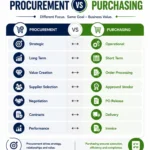
Traditional purchasing often asks:
“Who has the lowest price?”
Professional procurement asks:
“Which supplier provides the best total value at an acceptable level of risk?”
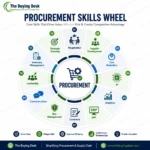
That difference represents a major shift from transactional purchasing to strategic procurement.
Modern procurement teams can use digital tools to improve supplier selection.
Technology can support:
However, technology should support decision-making rather than replace procurement judgment.
The quality of the decision still depends on the quality of the data and evaluation criteria.
Supplier selection should not be viewed as an isolated event.
It is the beginning of the supplier relationship.
The journey is:
Supplier Identification
↓
Qualification
↓
Evaluation
↓
Selection
↓
Onboarding
↓
Performance Management
↓
Supplier Development
↓
Continuous Improvement
A supplier that performs well after selection may become a strategic supplier.
A supplier that repeatedly fails may require corrective action, development or replacement.
A mature procurement organization can continuously improve supplier selection by:
What is the supplier selection process?
The supplier selection process is a structured method of identifying, qualifying, evaluating, comparing and selecting suppliers based on factors such as cost, quality, delivery, capability and risk.
What are the main supplier selection criteria?
Common criteria include cost, quality, delivery, technical capability, capacity, financial stability, responsiveness, compliance, risk and strategic fit.
Should procurement always select the lowest-cost supplier?
No. The lowest purchase price does not necessarily represent the lowest total cost. Quality, delivery, logistics, inventory, risk and lifecycle costs should also be considered.
What is a supplier selection matrix?
A supplier selection matrix is a structured evaluation tool that assigns weights and scores to supplier criteria, helping procurement compare suppliers objectively.
What is the difference between supplier qualification and supplier selection?
Supplier qualification determines whether a supplier meets minimum requirements. Supplier selection determines which qualified supplier should receive the business.
When should a supplier audit be conducted?
Supplier audits are particularly useful for critical, high-risk or technically complex suppliers where a document-based evaluation may not provide sufficient confidence in actual capability.
What is the most important supplier selection criterion?
There is no single criterion that is always the most important. The weighting should depend on the category, business impact, technical requirements and supply risk.
Supplier selection is much more than comparing three quotations.
A strong supplier selection process evaluates the supplier across:
Cost + Quality + Delivery + Capability + Capacity + Risk + Compliance + Strategic Fit
The best supplier is not necessarily the supplier with the lowest quoted price.
The best supplier is the one that can consistently provide the right value, quality, service and supply reliability at an acceptable level of risk.
For procurement teams, supplier selection should therefore be treated as the beginning of a long-term supplier relationship rather than the end of an RFQ process.